



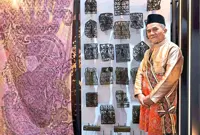
KUALA TERENGGANU: Kraftangan Malaysia’s Terengganu branch, together with 16 entrepreneurs under its umbrella, has succeeded in producing batik products with the use of clay instead of candle wax.
Its director, Fazlin Mohamad Zaki, said the new batik products were known as marble clay, marble screen as well as marble clay and screen.
These batik products would be on display and put up for sale for the first time at the East Coast Craft Textile Festival in Kuantan from Feb 17 to Feb 26, and on National Craft Day held at the Kuala Lumpur Craft Complex from Feb 23 to March 7.
“The clay is from the same raw material used in the manufacturing of pottery and ceramic products. It is an alternative to the traditional hot wax, which is applied as a colour resistant material,” she told Bernama here.
Fazlin said the new innovation by Kraftangan Malaysia was more economical and easier to handle.
Meanwhile, several of the entrepreneurs when met, agreed that the clay mixture was more viable than the blend of wax and resin.
Norazizah Kasim, 43, said clay was more accessible in the market, more cost-effective and eco-friendly.

There is also no need to deal with the heat for the wax and resin mixture, she said.
“The printing batik blocks need only be dipped briefly into the clay mixture and then stamped onto the fabric and left to dry before the dyeing process is done,” said the Gee Batik Collections owner whose focus has been on the tie and dye technique.
Among the batik products expected to be popular at the two festivals are shirts, blouses, palazzo pants, headscarves, kaftans and jubah (Muslimah long dress).
Sharing a similar sentiment, Mohd Shawal Awi, 37, said the clay technique was suitable for the younger generation who might be interested in batik production because with clay, errors in the stamping process could be easily corrected to avoid fabric wastage.
“That is the advantage of using clay. Anyone can learn and not have to worry about fabric wastage. Most importantly, the process is very safe and convenient,” said Mohd Shawal, whose various batik motifs for men’s shirts are popular.
Another batik entrepreneur, Suhaila Muda, 41, said the use of clay was also easier as the boiling process was no longer required to remove the wax-resin mixture.
“The fabric only needs to be washed and dried for the dyeing process and this saves time and fuel,” she said.
Already a subscriber? Log in
Get 20% OFF The Star Digital Access
Cancel anytime. Ad-free. Unlimited access with perks.


