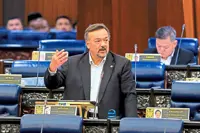
KUALA LUMPUR: Fugitive businessman Low Taek Jho, known as Jho Low, loaned RM70,000 to Datuk Shahrol Azral Ibrahim Halmi in 2009, in order to increase the share capital of Terengganu Investment Authority Bhd (TIA).
The funds were deposited straight into Shahrol’s account, the High Court heard yesterday during former prime minister Datuk Seri Najib Razak’s 1MDB corruption trial.
Shahrol, 49, who was former chief executive officer of 1Malaysia Development Bhd (1MDB), was then the chief executive officer of TIA.
Under examination by lead prosecutor Datuk Seri Gopal Sri Ram, Shahrol said the funds were given by Low as the newly-founded sovereign wealth fund - which served as a precursor to 1MDB - was in the midst of obtaining government guarantee for its issuance of bonds.
Sri Ram: Was any money extended for this purpose?
Shahrol: Yes, RM70,000.
Sri Ram: Did the company have RM70,000?
Shahrol: Not at that time.
Sri Ram: Where did the money come from?
Shahrol: It was Low who gave me the money.
Shahrol told the court that he had told Low that TIA needed more funds and that it was an “emergency”.
“The next day, the amount appeared in my bank account,” he said, adding that it was credited via cash deposit.
Shahrol said he gave the RM70,000 to TIA in the form of a director’s loan, and was later reimbursed for the same amount after the wealth fund had obtained proceeds from the bond issuance.
“I then told Low that I wanted to give the money back to him, but he kept saying ‘later, later’.
“So, I stopped asking and used the money for charitable purposes,” he said, adding that one of the charitable acts he did using the money was to sponsor a group of orphans to watch a performance at Istana Budaya here.
The court also heard that Shahrol and others at TIA had worked at an “extremely frantic” pace to obtain the government guarantee for the bond issuance.
“We were moving at super-speed as there was a sense of urgency and a sense that - at least for me - there is a need to prove to the stakeholders that we can be trusted to deliver,” he said, adding that the stakeholders referred to were then-Yang Di-Pertuan Agong and Terengganu ruler Sultan Mizan Zainal Abidin and Najib.
Shahrol is the ninth prosecution witness.
Earlier, defence counsel Tan Sri Muhammad Shafee Abdullah urged that Low be produced in court as soon as possible to corroborate what prosecution witnesses had said in court.
Shafee said this as defence submitted an objection against the alleged hearsay portions in Shahrol’s witness statement, which included the part where the witness described the relationship between Low and Najib as being “close”.
He argued that allowing hearsay evidence would lead to an unfair and unjust trial.
“When it comes to Low, natural justice principle is not here as I cannot question him,” Shafee told the court.
Shafee said hearsay evidence could not be admissible unless Low was called to give his testimony in court.
“The Inspector-General of Police said that we (Malaysia) have identified where Low is. The Prime Minister said it, the Deputy Prime Minister said it.
“I would like to invite Low be produced, so we can determine the truth,” he said.
He then added that whatever Shahrol heard from Low might not be the truth, as Najib’s former special officer Datuk Amhari Efendi Nazaruddin had, before this, labelled the fugitive businessman as a “master manipulator”.
Amhari was the eight prosecution witness.
Prosecution, however, argued that the witness statement was not hearsay, as it was within the context of determining whether or not Najib was misled by Low.
“The context in which the statement is made (where) the charge against accused is corruption, and that he had abused his office and position.
“In that context, his defence appears to be that he was misled by Low. The prosecution is therefore entitled to show he was not or could not have been misled by Low.
“What Low told the particular witness (Shahrol) is (then) of particular importance,” said Sri Ram.
He added that the contentious portions in the witness statement were circumstantial evidence rather than hearsay.
High Court judge Justice Collin Lawrence Sequerah reserved his judgement, adding that the ruling could be suspended until the end of the prosecution’s case.
Najib, 66, faces 25 charges in total - four for abuse of power that allegedly brought him financial benefit to the tune of RM2.3bil; and 21 for money laundering involving the same amount of money.
He faces imprisonment of up to 20 years and a fine of up to five times the sum or value of the gratification or RM10,000, whichever is higher, if found guilty.
Already a subscriber? Log in
Get 20% OFF The Star Digital Access
Cancel anytime. Ad-free. Unlimited access with perks.