NO one can ever accuse Agriculture and Agro-based Industry Minister Datuk Salahuddin Ayub of not knowing anything about farming.
Known more for his political exploits – first as PAS Youth chief and then, its vice-president, and now in Parti Amanah Negara as deputy president – Salahuddin used to grow cocoa in the early 1980s on a 10-acre farm back in his village, Kampung Serkat, Pontian, a town famed for its seafood on the southeastern coast of Johor.
Of Malay-Chinese parentage, he received his early education in Sekolah Rendah Inggeris Serkat before furthering his secondary studies in SMK Sri Perhentian, Pontian, and SMK Datuk Penggawa Barat.
“At that time, I believe that I would stay in my kampung. I wanted to be a successful farmer.
“In Pontian, I bought fish from the fishermen and sold it at a small market,” reminisces the Pulai MP, who defeated former deputy Home Minister Datuk Nur Jazlan Mohamed with a 28,924-vote majority in the last general election.
So convinced was he then of his future plans as a cocoa farmer, Salahuddin even built a small house in the orchard for his family.
“This is a real story,” he insists, though with a laugh, during a recent interview at MAEPS in Serdang, where he had just come from a briefing on the Malaysia Agriculture, Horticulture and Agrotourism Show.
However, diseases, including fungal infections and the rampant infestation of the cocoa pod borer pest, a larvae of the Conopomorpha cramerella moth, put paid to his hopes of becoming a farmer as well as devastated the local cocoa industry, shrinking from its height of some 400,000 ha in the 1980s to about 15,000ha in 2017.
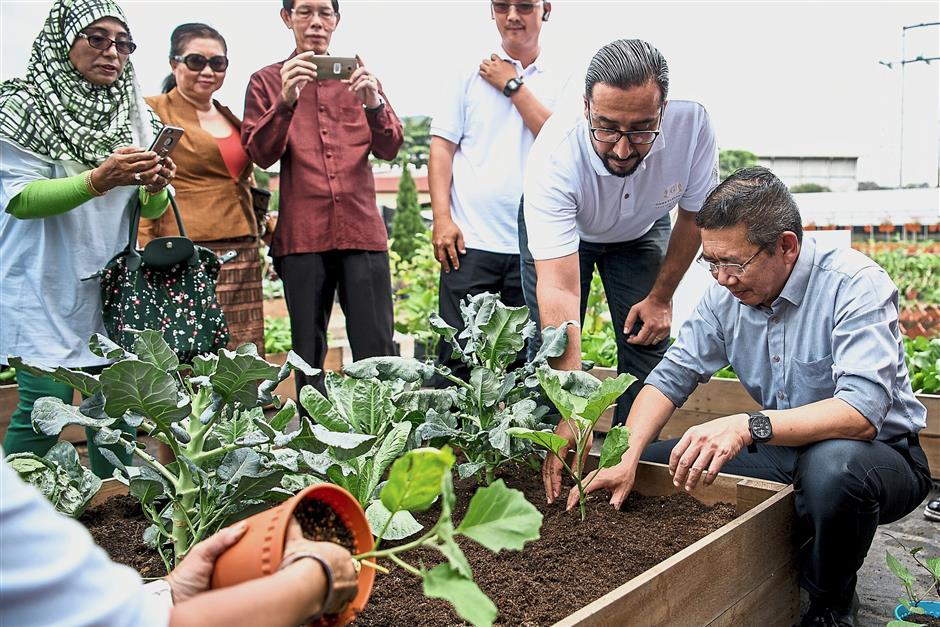
“We burnt our cocoa because of the fungus. It’s a blessing in disguise because I joined politics after that,” says Salahuddin, chuckling a little at how it all started for him.
The crop failure wasn’t completely a waste though.
As a farmer, the 56-year was forced to get his hands dirty, so to say, learning about fertilisers, soil profiling, plant tissue, crop diseases and even marketing – all of which now stands him in good stead with his appointment as minister on May 21 this year under the Pakatan Harapan government.
Indirectly, Salahuddin has gone back to what he once wanted to do – farming.
He knows that, too, saying that because of his past experience, he is far more acquainted than others with the struggles and toil of the ordinary farmers.
“At very least, I might look back at my path and it’s helping now with my experience, (with) their (farmers) battlecry,” he points out.
So much so that Salahuddin, a graduate of both Tunku Abdul Rahman University College with a diploma in business administration and Universiti Putra Malaysia in Bachelor of Science (Human Resource Management), has vowed to spend up to 70% of his time in office – well, not in his actual office in Putrajaya but on the ground.
“That is my way,” he stresses, adding that he wanted to make sure that farmers and in fact, all stakeholders in the country’s agricultural sector, feel for and embrace his mission.
For Salahuddin has set for himself – in between juggling his duties as Simpang Jeram assemblyman in Johor – the grand mission of increasing productivity in the local agricultural sector, promising, among others, higher padi yields and more fresh milk and beef, and consequently, cutting the country’s food import bill, which now comes in at a staggering RM41bil.
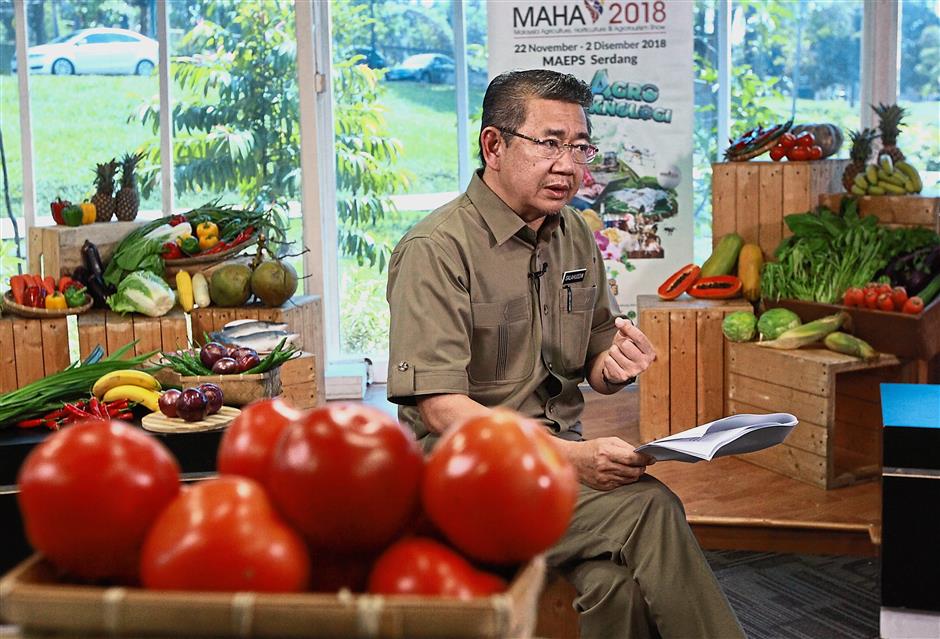
“This is our duty now. This is my life now in this ministry: to ensure that we provide enough food for our country.
“And (we can do it) slowly, practically and make it tangible so that we can achieve it.
“(We must) make it a reality, not just a dream,” he says.
Salahuddin aims to hike Malaysia’s rice yields by another 5% from the current self-sufficiency level of 70%, at which it has stuck stubbornly for years, fresh milk from 58% to 100%, reproduced milk such as butter and yoghurt from 5% to between 15% and 20%, and beef from 28% to betwen 30% and 35%.
And he wants to do all this by wielding better and more advanced technology, citing countries like China, Japan, South Korea and Vietnam, which Malaysia has much to learn from.
He is especially impressed with the idea of using drones to map out farm land and profile soil types to ensure that only the right fertiliser is used for the right type of soil and is hoping to rope in research and development from the Malaysian Agricultural Research and Development Institute (Mardi).
Asked if his targets were doable as this had been the oft-repeated promise of almost every minister under the previous administration, only to have it fail, Salahuddin says: “Give me five years.”
Calling this his “new direction” for the ministry, he is only too aware of how ambitious this plan is and thinks his greatest challenge now will be to get everyone in falling behind it.
“My greatest challenge now is to ensure that I can fulfil all my direction in my office.
“My biggest challenge is to get all the relevant support from all levels of the ministry – the KSU (the secretary-general), the TKSU (his deputy).
“Let them be part of my mission,” he vows.
To Salahuddin, it is important that he is not striving toward his ministry’s goals alone.
“We must work together and the stakeholders must understand – the farmers and the fishermen on the ground – and embrace my mission.
“That’s very important and that is the great challenge to make sure that I am not alone.”
The father of six is also taking over the reins of the ministry at a time when conditions cannot be more challenging.
On top of the deadline of ensuring that local durian farmers are ready to export fresh fruits to China by year end – the ministry officers are currently touring orchards to brief players on all the quarantine requirements imposed by the Middle Kingdom – the minister has to deal with the effects of climate change, which have wreaked havoc with global weather patterns, bringing with it droughts, floods and diseases that have crippled crops.
In Malaysia, for instance, the emergence of Panama disease, a plant fungus, has proved deadly to many banana plantations while Kedah, Malaysia’s rice bowl, was stricken with prolonged drought early last year. Salahuddin knows something about the crop failure – after all, he has had to abandon his cocoa farm over a fungal outbreak – and has pledged to clamp down on biosecurity and biosafety issues such as diseases by tightening existing regulations and rules on a “case-by-case basis.”
“To ensure that quarantine procedures must be followed – that’s very important.
“All the species and varieties that come in and out of the country must follow all the procedures. No bribes, no corruption,” declares Salahuddin.
To a query on whether enforcement of regulations had been lax in the past, he says, “To be sure, I think so. There were some loopholes.”
On June 26, the ministry’s Department of Malaysian Quarantine Inspection Services (Maqis) announced that it has gazetted 57 exit and entry points for the surveillance of items brought in and out of the country.
This, said its director-general Datuk Mokhtaruddin Husain, had come in the wake of two sardine brands imported from China, via the North Butterworth Container Terminal, that were found to contain worms.
The question of biosafety and biosecurity is important, Salahuddin reiterates, especially if Malaysia hopes to continue exporting its fruits and vegetables into the international market, as shown by the stringent quarantine procedures put into place for durians, even for one as mad for Musang King as China.
The memorandum for the export of whole fruits instead of just frozen pulp previously was signed during Prime Minister Tun Dr Mahathir Mohamad’s visit to Beijing in August.
“We will follow all the procedures,” he pledges.
Besides Maqis, Salahuddin says all the departments under his ministry have their own biosafety or biosecurity divisions as well.
For the mitigation measures against the effects of climate changes, Salahuddin is optimistic about an opportunity to work with the World Bank on its concept of “climate smart agriculture”.
The concept touts an integrated approach to managing cropland, livestock, forests and fisheries that will address the challenges of food security and climate change.
Besides increasing productivity and enhancing resilience in crops, it aims to do all this with less impact on the environment.
“We had a briefing from the World Bank that day.
“I think we can follow some of the recommendations and some of the things we can anticipate in the future in terms of climate change or protect our crops,” he says, adding that Malaysia could also try asking for funds from the World Bank in event of a collaboration.
While his ministry’s new direction has yet to be officially launched, the farmer in Salahuddin is already raring to go.
And yes, he still has his farm, now planted with oil palm.
“My brother looks after it now,” he says.
Already a subscriber? Log in
Get 20% OFF The Star Digital Access
Cancel anytime. Ad-free. Unlimited access with perks.