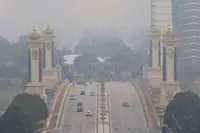
THE return of thick haze caused by fires in Indonesia has once again left parts of South-East Asia asking a familiar question: When smoke crosses borders and affects millions of people, why is it so difficult for affected countries to take legal action against the country where the smoke originates?
The question has become particularly pressing this year, with fires in Indonesia’s Sumatra and Kalimantan provinces contributing to one of the worst transboundary haze episodes in years to affect neighbouring countries, including Malaysia.
Malaysia has even offered firefighting assistance to Indonesia as the two countries grapple with the latest outbreak, underscoring the regional nature of a problem that has persisted for decades.
But beyond emergency responses and diplomatic engagement lies a more difficult question of accountability: If one country’s fires cause environmental and health impacts in another, what legal avenues are actually available for the “suffering neighbours”?
For Asean member countries, representative of Malaysia to the Asean Intergovernmental Commission on Human Rights (AICHR) Edmund Bon says the Asean Charter provides the overarching framework, but disputes involving haze would have to be pursued under the specific Asean instrument governing the issue: the Asean Agreement on Transboundary Haze Pollution (AATHP).
“The Asean Charter is the overarching framework and if there is an inter-state complaint where there is a specific Asean instrument such as the AATHP, then the complainant must go under that specific mechanism.
“This is why haze disputes first require a complaint and then consultation or negotiation. But it is only open to governments, and companies or the people cannot make the complaint. If governments do not complain against each other, then the process cannot even start.”

The AATHP, adopted in 2002 and in force since 2003, was established to prevent and monitor transboundary haze arising from land and forest fires through national efforts and regional cooperation. Its dispute settlement provision states that disputes between parties over the interpretation, application or compliance with the agreement are to be settled through consultation or negotiation.
For Bon, the limitation points to a wider gap in the region’s human rights architecture.
“This is why human rights experts have been calling for an Asean human rights court urgently. Even if it is not to hear complaints about all human rights, at least start with environmental human rights, where the communities and people affected can sue companies or governments in the court for causing the haze.”
The question of who could actually bring such a case is complicated by another obstacle: jurisdiction.
“Affected people can sue in their own courts or the courts in other countries. But evidentially, it is difficult to get the evidence and jurisdictionally it may be difficult to have power over a company outside the court’s jurisdiction.
“For example, even with the Singapore transboundary law, it is difficult to get evidence and for the Singapore courts to entertain a case involving companies operating in Indonesia, for example.”
That leaves affected communities facing a difficult legal landscape, particularly when evidence, corporate responsibility and jurisdiction extend beyond national borders.
Bon also argues that the haze illustrates the limitations of treating environmental harm as something confined within individual countries.
“Like many human rights issues, we are blind if we think that they only affect one country. Refugees leave Myanmar, impacting their neighbours including Malaysia. Haze pollution is physical interference of Asean member states and the health of people as we all share the same airspace.
“You cannot break down who owns whose oxygen. We can talk about unity and respect and collaboration, but this issue shows where the non-interference principle breaks down.
“We have shared vulnerabilities and that is why we need stronger measures to tackle the problem.”
The argument for viewing haze through a human rights lens gained greater regional recognition last year.
Asean leaders adopted the Asean Declaration on the Right to a Safe, Clean, Healthy and Sustainable Environment (Ader) in October 2025, recognising the growing need to address transboundary environmental concerns and linking environmental protection with human rights.
Bon says the AICHR has already sought to advance that conversation.
“Of course, based on the Ader, AICHR has already made it clear that we want stronger accountability measures but there are some in Asean who think we are too ambitious.
“I have proposed things like having a specific rapporteur to manage the problems faced by the people for each country and to have a coordinated mechanism to receive complaints for negotiations to start. I also proposed that the AICHR take stronger steps first to investigate the cases and come up with recommendations.”
For communities affected by haze, the AICHR can already receive communications concerning human rights issues. Its 2025 Operational Guidelines on External Communications state that written communications may be submitted to the AICHR, after which the relevant representatives may consider consultations, seek further information and determine appropriate follow-up within Asean’s consensus-based and non-interference framework.
Bon says this provides a possible avenue for people whose concerns may otherwise struggle to gain regional attention.
“Yes, we receive complaints and the procedures are set out here. Detail the complaints as best as you can, and once we receive the complaints, depending on whose case it is, we are able to call for briefings and ask for more information and from there decide what can be done.”
However, receiving complaints is not the same as having the power to issue binding judgments; looking ahead, Bon says Asean needs to consider stronger regional mechanisms.
“Yes, we need a human rights court, enhance the powers of AICHR to do fact-finding and investigate, and make binding decisions on the issue.”
Until such mechanisms exist, affected populations may have to rely primarily on national avenues while seeking regional action collectively.
In Malaysia for example, the Natural Resources and Environ-mental Sustainability Ministry is exploring a dedicated law to address transboundary haze, including studying Singapore’s legislative model. According to Environmental Management Division undersecretary Dr G. Pubadi, Minister Datuk Seri Arthur Joseph Kurup has directed the formation of a special committee involving multiple ministries and agencies to review and strengthen Malaysia’s haze mitigation measures.
“Each population needs to go to their own mechanisms nationally, and then join forces to pressure Asean on the matter. Where some countries’ judicial systems are weak, then regionally we have to act together,” says Bon.