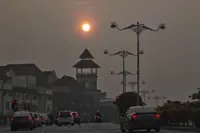
KUALA LUMPUR: The Natural Resources and Environmental Sustainability Ministry is examining mechanisms to draft specific legislation addressing transboundary haze, and this includes considering the approach implemented by Singapore.
Dr G. Pubadi, the ministry's Environmental Management Division undersecretary, said Minister Datuk Seri Arthur Joseph Kurup recently directed the setting up of a special multi-ministry and agency committee to study measures to strengthen efforts in tackling the haze.
"The ministry is examining the mechanisms already in place in Singapore to draft a specific Act to address the haze issue.
"However, drafting an Act is not a simple matter," he said on Bernama TV's Ruang Bicara segment titled "Regional Action and Cooperation to Address Transboundary Haze" on Thursday (Sept 24) night.
(Under the Transboundary Haze Act passed in 2014, Singapore has legal powers to impose up to S$2mil in fines on companies responsible for acts outside the country that contribute to air pollution within its borders.)
Pubadi noted that Malaysia had also presented a paper on Science Diplomacy and a Sustainable Haze Fund at the 27th Technical Working Group (TWG) meeting and the Sub-Regional Ministerial Steering Committee (MSC) meeting in Bali, Indonesia, recently.
He said the proposal received support from the five countries attending the meeting, namely Indonesia, Brunei, Singapore, Thailand and Timor-Leste.
According to him, the matter will be reviewed by the Asean Secretariat before being brought to a meeting involving 11 countries in Vietnam in December.
Malaysia has also proposed more open sharing of haze-related data.
"… regarding this data, if implemented, all countries should simply be able to share it openly and transparently; this would assist all nations in taking appropriate follow-up actions to address the haze issue or open burning," he said.
Additionally, Pubadi said Malaysia views financial sustainability as a crucial element in strengthening Asean mechanisms, ensuring the region possesses sufficient resources including equipment and other necessities to tackle fires and transboundary haze.
Meanwhile, Environment Department (DOE) enforcement director Rosli Zul advised the public to refer to the department's air quality readings to avoid confusion with other platforms that employ different measurement methods.
This is because the DOE employs 68 air quality monitoring stations nationwide, he added.
He said enforcement against open burning, a major contributor to haze, continues to be intensified, noting that nearly 80% of complaints received by DOE annually relate to such activities.
On the current haze situation, Rosli said the transition to the North-East Monsoon, expected around mid-October, could potentially mitigate the impact of transboundary haze as wind patterns shift, even if fires in Sumatra and Kalimantan have not yet ceased.
Consequently, he said, monitoring efforts would be enhanced to ensure domestic fires do not become a source of haze after mid-October, utilising measures such as weather forecasting collaboration and satellite imagery. – Bernama