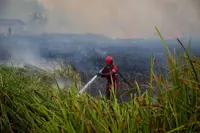
ON Sept 7, Indonesia’s National Police named 138 suspects across 200 forest and land fire cases, alongside ongoing investigations into eight corporations. Days earlier, the country’s Forestry Ministry announced legal proceedings against 21 companies over fires that scorched more than 11,400ha across Sumatra and Kalimantan.
While these figures suggest action, for the millions breathing toxic air, prosecution is not the same as protection.
More than 1.4 million Indonesian schoolchildren have been forced into remote learning, cross-border haze has triggered a state of emergency in Sarawak, and emissions from Indonesia's wildfires reached the highest levels in the world this week.
This is no longer merely a story about forest fires or Indonesia’s bilateral ties with its neighbours. It is a fundamental test of governance, and of the state's duty to shield its people from preventable harm.
For decades, haze has been dismissed as an inevitable byproduct of dry weather, peatland fires, and the El Nino weather cycle. While climate conditions matter, they do not dictate how land is cleared, whether regulations are enforced, or who profits. Those are human and political choices, and everyday citizens bear the consequences.
Children miss school, workers labour in unsafe conditions, families fall ill, and rural and indigenous communities lose both their livelihoods and access to essential natural resources. This burden is profoundly unequal: Women often shoulder heavier caregiving demands, while pregnant women, children, the elderly, and persons with disabilities face heightened health risks from severe air pollution.
Clean air is a human rights issue. Addressing it requires asking not only who suffers and who is most vulnerable, but also who created or profited from the risk, who failed to prevent it, and what remedies exist for the victims. These questions must sit at the centre of the haze debate.
Indonesia must continue to prosecute illegal burning through rigorous, transparent investigations. Yet the chronic recurrence of this crisis points to a deeper structural failure. The problem is not an absence of laws, institutions or regional agreements; it is the persistent gap between what these mechanisms promise and what communities endure on the ground.
Indonesia has spent years establishing regulatory bodies, monitoring frameworks and peatland management policies. It ratified the Asean Agreement on Transboundary Haze Pollution in 2014. Asean, in turn, has devoted decades to constructing regional monitoring systems, coordination bodies and ministerial processes.
Yet the smoke returns year after year. The real question is whether these responses have actually protected people's rights. True accountability must follow the entire chain of responsibility, it cannot simply stop at the individual holding the match.
The economic networks driving industrial land use frequently span multiple corporate entities and jurisdictions. A concession may be registered to a local subsidiary, while parent companies, financiers, and primary supply chains operate abroad. Disentangling these networks is crucial to uncovering who owns and controls the land, who authorised and profited from its clearing, what risks were known, and what measures were taken to prevent foreseeable destruction.
This is precisely where the United Nations Guiding Principles on Business and Human Rights apply.
Corporations have a duty to identify, prevent, mitigate, and account for the human rights impacts linked to their operations and commercial relationships. Applying these standards consistently to high-risk land management would sharpen both prevention and legal liability.
Companies operating in vulnerable ecosystems must conduct rigorous environmental and human rights due diligence, paying specific attention to local and indigenous communities. Complex corporate hierarchies must not serve as shields against accountability, nor should public sustainability pledges substitute for verifiable evidence of harm prevented.
In 2025, Asean adopted the Declaration on the Right to a Safe, Clean, Healthy, and Sustainable Environment, and the Asean Intergovernmental Commission on Human Rights (AICHR) began drafting a regional plan of action to implement it. Transboundary haze represents its most urgent test.
The action plan must establish clear, binding expectations on fire prevention, mandatory corporate due diligence, institutional transparency, public participation, and access to legal remedy. Asean does not need another layer of bureaucracy; it needs to leverage the instruments it already possesses.
First, Asean must treat transboundary haze as a human rights imperative rather than a recurring diplomatic dispute.
Second, the grouping must enforce cross-border transparency. Data regarding land concessions, beneficial ownership, environmental permits, fire hot spots, and enforcement proceedings must be made publicly available across jurisdictions. Communities cannot demand justice when corporate ownership and supply-chain beneficiaries remain obscured.
Third, the AICHR must utilise this environmental rights framework to adopt an active protection mandate. This includes documenting regional patterns of harm, taking direct testimony from impacted communities, and conducting thematic inquiries into transboundary environmental damage alongside national human rights institutions (NHRIs) and civil society.
The human rights institutions can also bridge the divide between regional declarations and local realities by investigating abuses, mapping corporate and state liability, and expanding paths to legal redress.
Responsibility, however, is differentiated.
Indonesia bears the primary obligation to prevent and prosecute environmental destruction within its borders. Neighboring states must safeguard their populations from transboundary harm. Corporations must respect human rights and provide full remediation. Asean must facilitate decisive cooperation when environmental damage crosses borders.
These responsibilities should reinforce one another. Instead, accountability remains fragmented while the harm is borderless.
Smoke does not recognise concession boundaries, nor does it distinguish between Indonesian, Malaysian, or Singaporean lungs. Human rights protections cannot stop at national borders either.
The response to haze cannot be judged by the volume of arrests, open investigations, or resources deployed. It must be judged by whether people are protected from recurring, foreseeable harm.
Corporations cannot be judged by paper pledges, but by whether they actively eradicate harm across their supply chains.
Asean cannot be evaluated by the summits it convenes, but by whether its institutions enforce accountability and prevent catastrophe.
The haze may be stoked by climate patterns, but its human toll is driven by policy choices, concerning land allocation, regulatory enforcement, corporate power, and transparency. Those forced to breathe the consequences deserve robust prevention, institutional accountability, and genuine remedy. – The Jakarta Post/Asia News Network
Yuyun Wahyuningrum is a senior fellow at the Asia-Pacific Centre for the Responsibility to Protect and former Indonesian representative to the Asean Intergovernmental Commission on Human Rights.