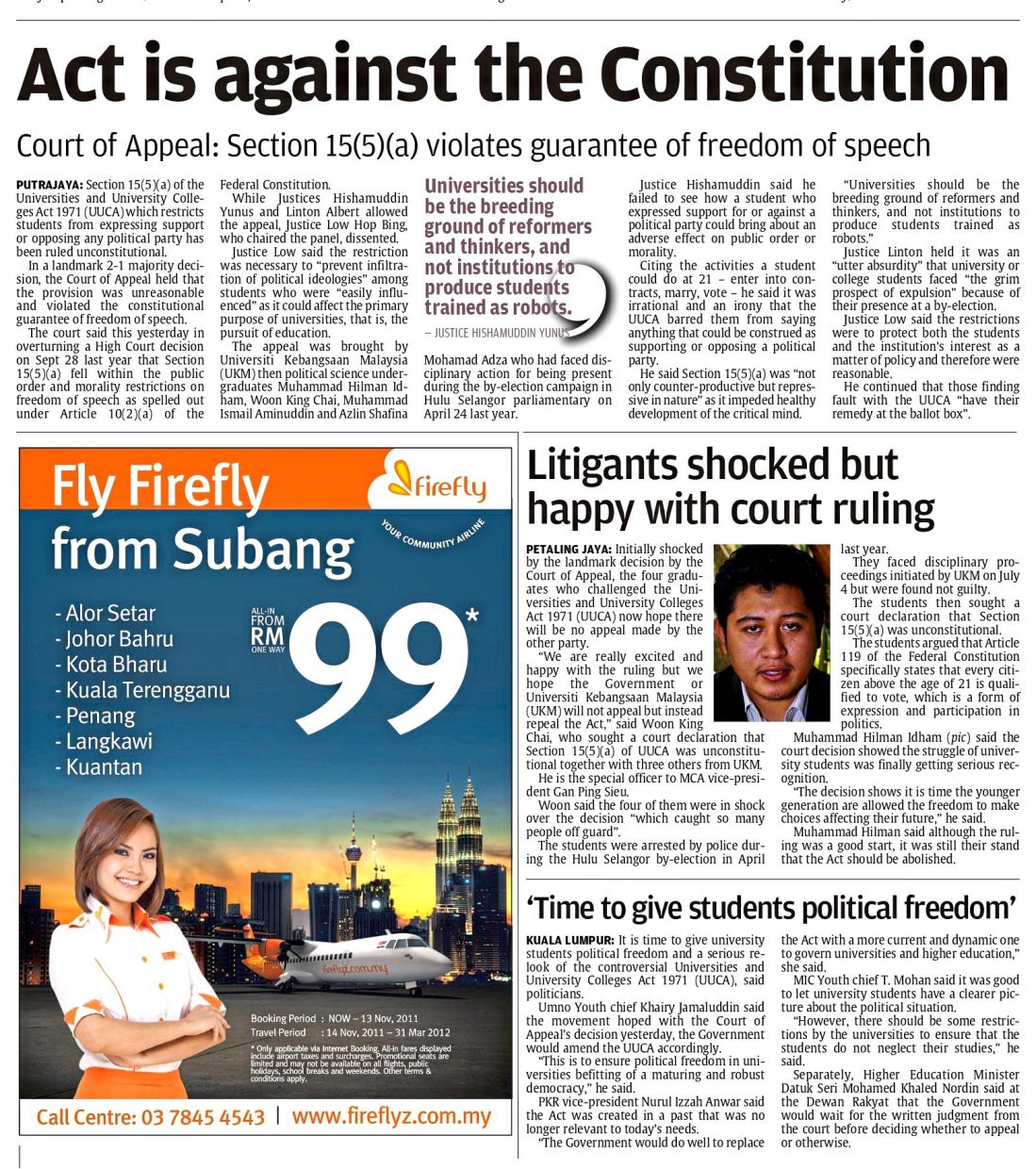
IN 2011, four Universiti Kebangsaan Malaysia students won a Court of Appeal ruling that struck down the ban on university students taking part in politics.
Their fight to have their voices heard after they were detained for joining a by-election campaign – which was not allowed under the Universities and University Colleges Act 1971(Auku) – left a big impact on their lives.
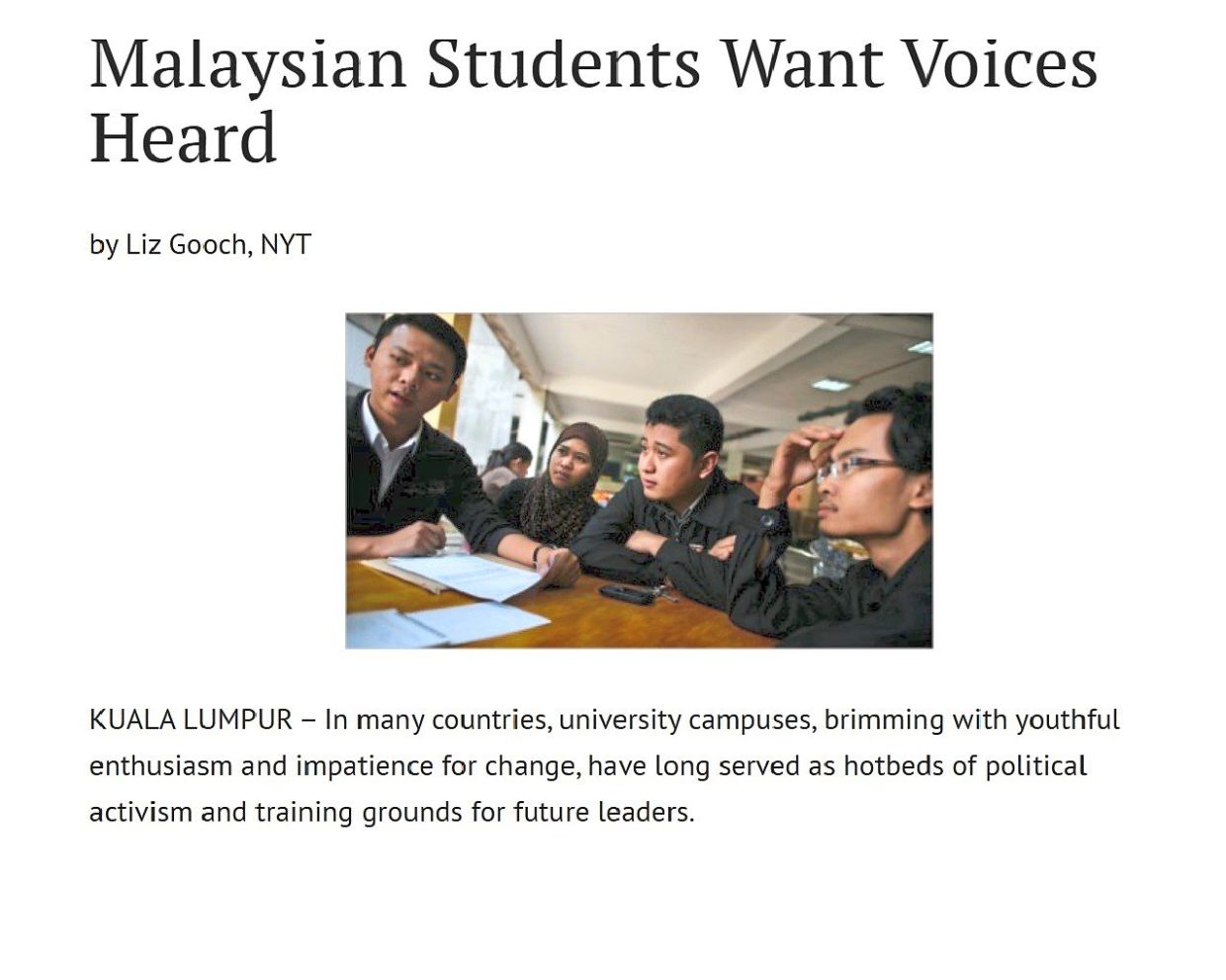
For two of the students in the landmark case, dubbed the ‘UKM 4', it opened the door to careers in the political and policy spheres.
Muhammad Hilman Idham is now a Bersatu youth chief, and Woon King Chai is director of the Institute of Strategic Analysis and Policy Research (Insap).
Fifteen years on, as the government moves to repeal Auku in full, The Star spoke to Hilman and Woon about the fight that shaped them and what the government’s reform must deliver.
> This year marks fifteen years since that ruling. How significant is the decision to repeal Auku in full?
Woon: There are two parts to the story of student activism.
Up to our case, it was the fight for political freedom. Why should university students be barred from politics when their peers of the same age can vote and stand for office?
Once the Court of Appeal ruled the prohibition unconstitutional in 2011, the fight shifted to university autonomy and academic freedom.
Auku was written in 1971 for circumstances that no longer apply, so it matters that the government now thinks clearly about what higher education should look like in the 21st century, not just what is convenient today.
Hilman: Auku is one thing, but the philosophy behind it is another. After the May 13, 1969 racial riots, the government eventually tightened control in universities over time to curb what the authorities called subversive elements and that reasoning does not fit today.
The government has decided to abolish it, and the spirit behind it must change too. The reform cannot only be legal. It has to reach the campus culture and student autonomy, and the way universities are funded.
ALSO READ: Auku 4: A fight for their right to be heard
> What must the new law avoid?
Woon: What we do not want is old wine in a new bottle. When Auku was written in 1971, no one could have imagined students taking such direct part in politics and in every area of life.
This is about modernising the higher education framework for the 21st century. It means bringing the values of a university out into its surrounding community, not treating the campus only as a customer base for the eateries and printing shops around it. That cannot be the only economic impact of a university.
Hilman: We keep the spirit of reform but change the philosophy. The point of a university is to change the way people think, to be a place where ideas are formed.
> You have said academic freedom is about more than politics. What do you mean?
Woon: The physical design of our universities tells the story. Overseas, there are campuses like the London School of Economics sit right in the city, and you are on university grounds without realising it.
Here, universities are walled and fenced off, and even Universiti Malaya is strict about it. That fence is easy to dismiss as security, but it reflects how we view education, as something separated from society.
Silicon Valley grew because it was surrounded by campuses like Stanford, where the brightest minds moved between the university and industry. That environment is what academic freedom makes possible.
Hilman: A university is a small circle where students should learn how to survive in society. They learn to manage their own affairs, their own budget, and how to run and elect their student representative council. Give them that freedom and they learn to stand on their own once they leave.
> You have both said how university places are decided must be more transparent. Why?
Woon: This is the topic closest to me. Public universities are funded largely by the Higher Education Ministry, and there have been complaints that they are underfunded and pushed to find their own money.
Even as our public universities have grown, the number of local students admitted through the subsidised UPU [Universiti Pusat Unit] channel has stayed roughly the same. What has exploded is the intake of foreign and full fee-paying local students through the direct intake channel. I would not call it unfair. I would say it is opaque. Nobody knows how it is done.
Hilman: Access, in the right way, is part of the whole purpose of a university.
Woon: We came across cases where a student turned down for a course was then offered the same place at the same university if they paid full fees. That means universities are screening by who they think can pay.
Tertiary education is central to social mobility. In our time, some of us were the first in our families to go to university. Qualified local students must have fair access to the best courses in our own universities. Is that fair? It is not.
> How should university leadership be chosen under the new law?
Woon: Appointments of university leadership and standards must be handled by an independent body, not the minister. We have had good vice-chancellors, but they are appointed by the minister, so who do you think they answer to? A law is needed to channel funding, establish universities and keep standards common. It should stop there. The real test of reform is whether the government is willing to give up the rest of that power.
Hilman: We should free our universities from political influence. Rather than the minister deciding who the next vice-chancellor is, set up an independent committee, and let the ministry focus on funding.
> Reform aside, what else needs to change?
Woon: Reform does not end with Auku. Back then we campaigned against the ISA and the Printing Presses Act. Today there is the Communications and Multimedia Act and the way online speech is now controlled. The Sedition Act is still in force. Abolishing Auku is not the end of reform.
Hilman: The fight for student autonomy is a long journey. Auku shares the same spirit as other draconian laws, built for the same purpose of control. This government has been presented as a reform government, so it should deliver.
> You were both around 21 and three years into your studies when you faced expulsion. What was that like?
Woon: Honestly, it was frightening for me. I was a typical university student, but I had never been exposed to real politics. My first brush with it was Hilman. He said there was a by-election coming up and suggested we go and take a look. I thought, what is the harm? We went, and we ended up detained by the police.
My parents were frightened too, but the four of us stood close together and realised we had done nothing wrong. So we decided to fight it all the way. If we had lost, we would have lost our degrees, and then where would we have found work?
Hilman: For me the fight did not end there. It is a long journey, and I am still in it.
> Hilman, you now lead a party youth wing. Is this a continuation of that fight?
Hilman: Struggle is a long journey, and I will continue it. It is not only about Auku. There are many draconian laws we should still examine, because the philosophy behind them is the same.
> So what does the repeal of Auku have to deliver?
Woon: Abolishing Auku is not the whole of reform. Its replacement must not simply put a new label on the old controls. It has to set a clear, modern framework for tertiary education, free the administration of universities from political influence, and guarantee fair and equitable access to public university education for every Malaysian.
Hilman: Education is one of the pillars of the nation. If we want to move the country forward, we start with this new act. We reform not only the law but the culture and the democratisation of education. We cannot end up with another act carrying the same spirit as the old one.
Putrajaya should not stop just at Auku. They should look into other draconian laws that should be abolished as well. We should do this for our future generation so they can enjoy freedom.
This interview has been edited for length and clarity.