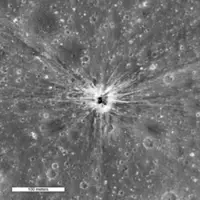
IF a rocket stage crashes into the moon and no one sees it, did it really crash?
That was the questiom posed by The New York Times science reporter Kenneth Chang after a discarded upper stage of a SpaceX Falcon 9 rocket slammed into the surface of the moon around 2:35am American Eastern time last Wednesday at a speed of 5,400mph (8,090kph).
Although widely anticipated, no one could report any obvious signs of the impact, until a Korean spacecraft, Danuri, passed over the supposed crash site about eight hours after the collision.
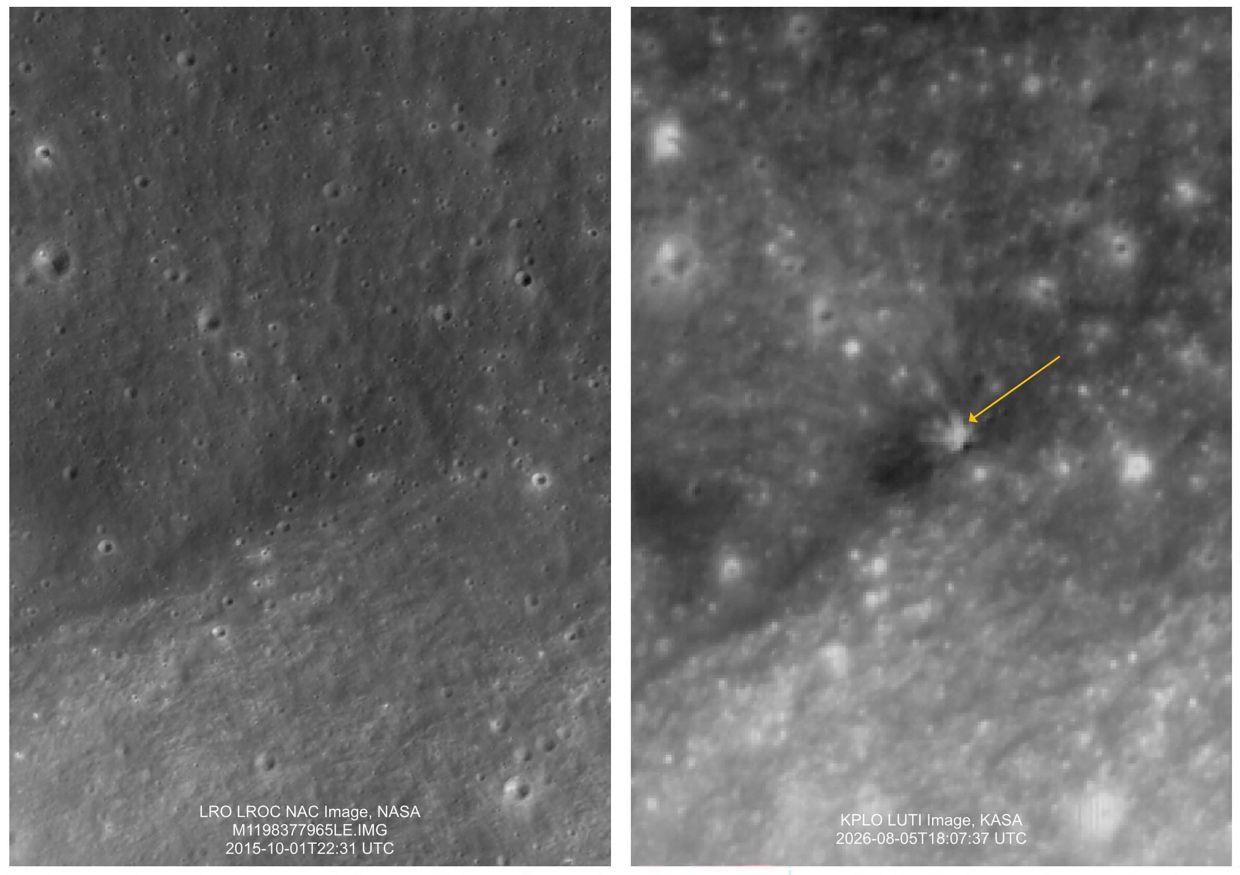
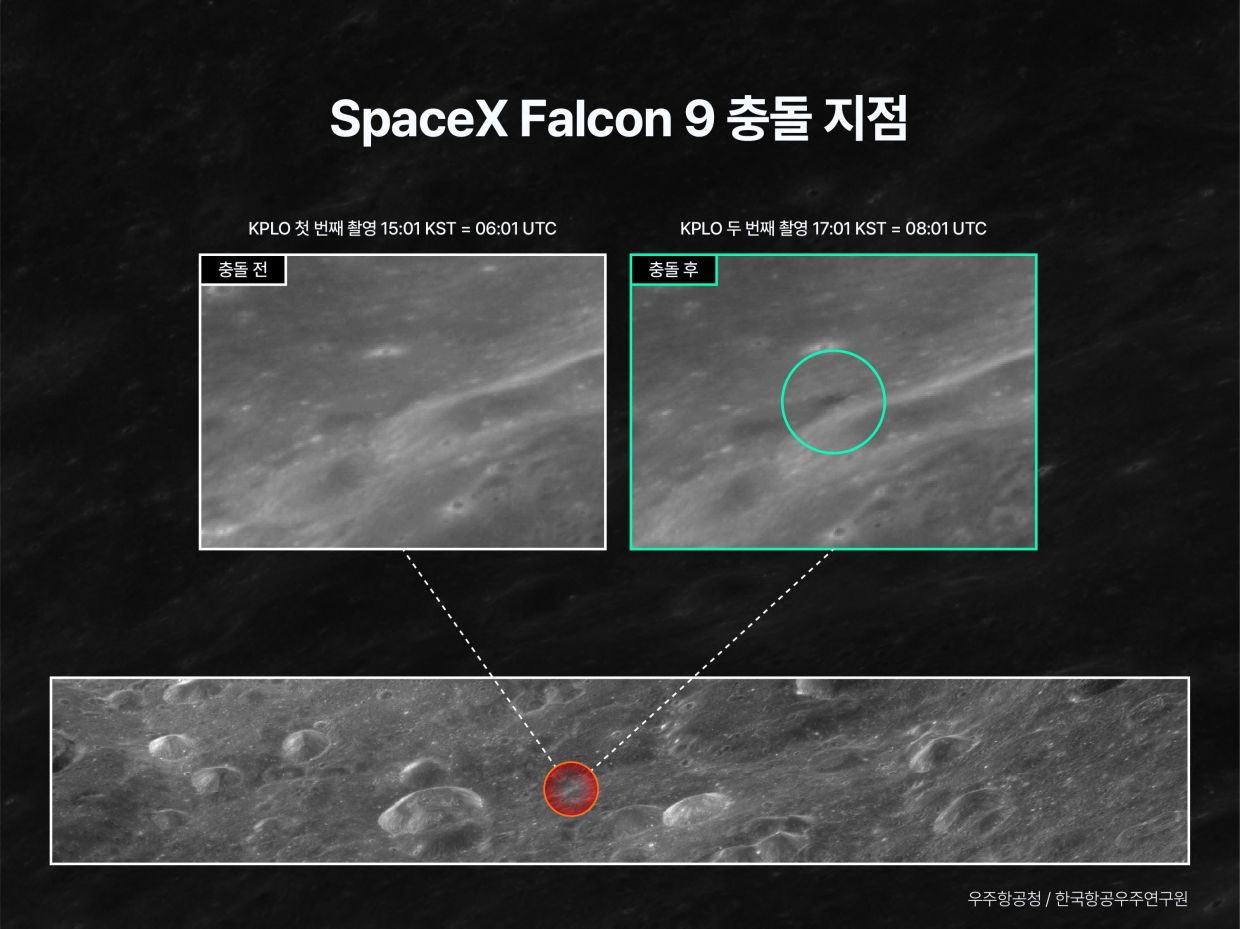
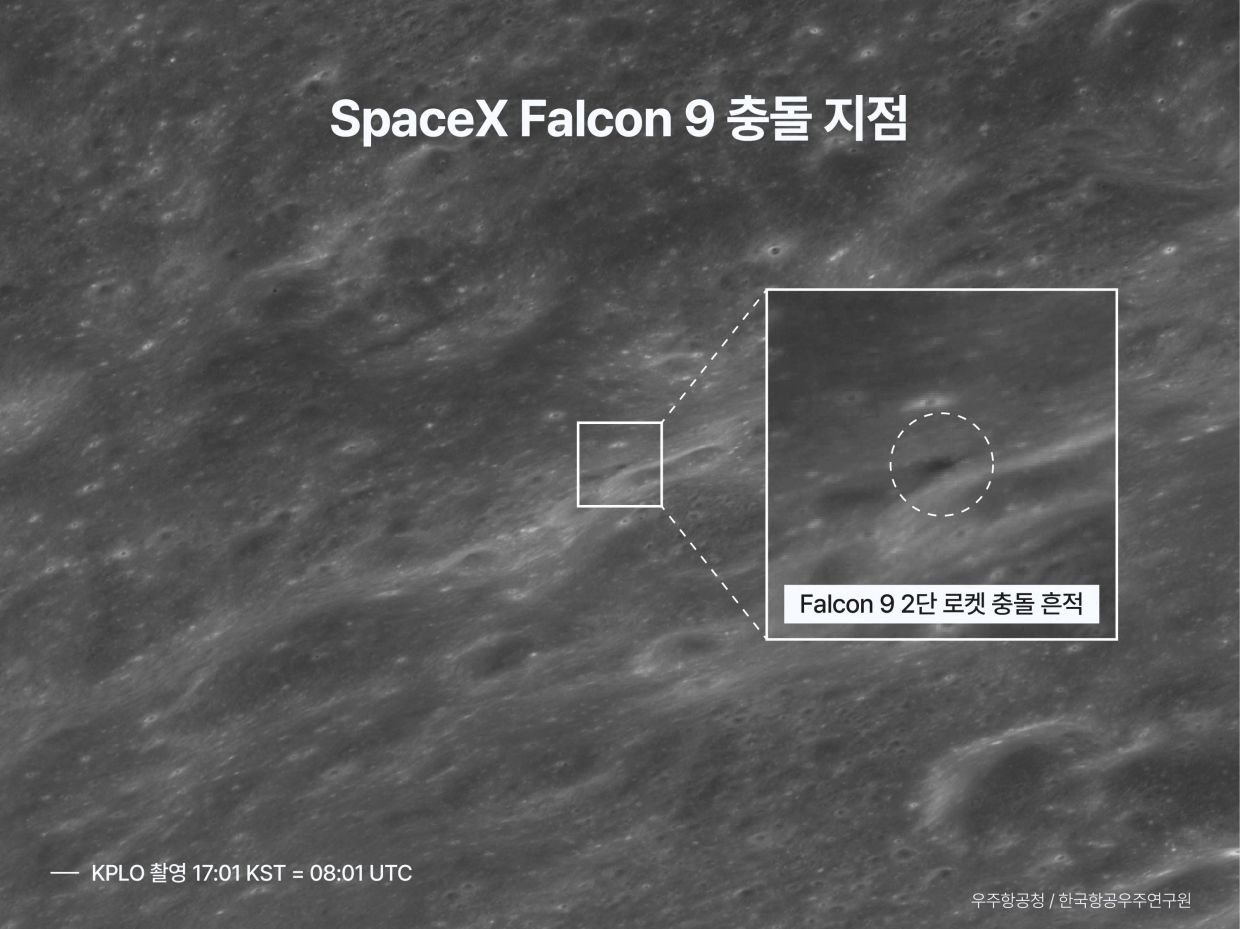
The Korea Aerospace Research Institute's satellite captured the first pictures of the moon's fresh crash scene caused by the stray SpaceX rocket after making multiple passes, according to AP.
The shots released by the Korean space agency showed that the terrain is noticeably darker where the rocket hit and carved out a crater, sending dust and rock everywhere.
Elon Musk's SpaceX launched Danuri from Cape Canaveral in 2022.
The company also sent a pair of private lunar landers to the moon last year. The upper stage from that launch is what crashed into the moon this week, placed on an accidental collision course by solar activity and gravity, according to SpaceX.
Nasa’s Lunar Reconnaissance Orbiter is also on a hunt for the crash site to provide additional photographs and is expected to fly over the crash site later this week to view the aftermath.
Initial doubts
As Chang wrote, due to the lack of sightings of the impact moment, there were concerns at first that the predictions of the moon collision were wrong, and that the Falcon 9 stage – reported to be the size of a five-storey building – had actually missed the moon.
However, many scientists were confident that the collision happened. Like everything flying around in the solar system, the rocket stage moved according to Newton’s laws of motion with only slight deviations arising from additional forces like the solar wind. The uncertainty in where the impact would occur was just a few kilometres.
The anticlimactic demise of the rocket stage was not a surprise.
Astronomers had hoped that the collision would create a bright enough flash of light and a big enough cloud of dust and debris that it could be observed through telescopes from Earth. But at the appointed time, the moon looked like the moon.
More subtle observations taken at the Lowell Discovery Telescope in Arizona and the Very Large Telescope in Chile could reveal evidence of the collision, like specific wavelengths of light emitted or absorbed by the plume of debris, but that data needed to be analysed.
“We were able to observe despite intermittent thick clouds, but need to do some quick reduction on the data to know if we saw anything,” said Patrick Lierle, a Boston University astronomer involved with the Lowell Discovery observations.
The most promising observations had come from Chile.
Another Boston University scientist, Carl Schmidt, used the Very Large Telescope to measure sodium and lithium in a plume a few tens of kilometres in size that lasted five to 10 minutes after impact.
Schmidt said he was “100% confident” that the readings came from the impact.
However, it seemed that no one was able to directly see or photograph the collision.
Computer simulations earlier calculated the effect of the rocket stage striking the moon in a vertical orientation, which would have produced the most debris, but the stage would more likely have belly-flopped at an angle instead. (The vertical case was the only one simple enough to be computed.) But even in the case of a vertical impact, the predicted flash and plume were at the edge of what might be visible, and the dynamics depended on other unknown factors like whether the stage hit solid bedrock or loose lunar soil.
According to the BBC, Nasa has insisted the crash poses no danger to Earth as astronomers wait to study the debris that may have been caused by the collision.
However, some have warned we should be worried about the build-up of space debris and the ramifications these crashes could have for the future of space exploration. — ©2026 The New York Times Company/Agencies