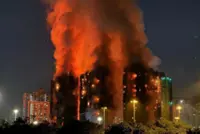
FOR condominium resident Anna Tee, hearing the fire alarm at 4am brought more confusion than panic.
Having just returned home from a night shift and preparing for bed, she opened her front door after hearing the alarm, only to find none of her neighbours evacuating.
She checked her condominium residents’ Facebook group, peered through the corridor windows for signs of smoke and even stepped into the stairwell to see whether anyone else was evacuating.
She then encountered a security guard in the stairwell, who told her it was likely a false alarm.
Exhausted from work and unsure what to do, Tee eventually decided to return to bed.
For many residents living in high-rise buildings, that moment of hesitation may feel entirely reasonable.
But fire safety experts warn that repeated false alarms can gradually erode trust in a building’s fire warning system, potentially delaying evacuation during a real emergency when every minute can make the difference between life and death.
The importance of every minute
“Although there are times the fire alarm is triggered without a real fire, every fire alarm should be treated as a genuine emergency until proven otherwise,” says Fire and Rescue Department (JBPM) director-general Nor Hisham Mohammad, stressing that residents should adopt the principle of “evacuate first, verify later”.
According to Nor Hisham, the first few minutes after a fire alarm is activated are critical, particularly in high-rise buildings where smoke and toxic gases can spread rapidly through corridors and common areas.
Residents who delay evacuation because they assume the alarm is false risk becoming trapped as conditions deteriorate, while delayed evacuations can also complicate rescue operations by firefighters.
Yet waiting to verify whether an alarm is genuine or not is often a natural human response rather than an act of carelessness.
University Malaya’s Assoc Prof Dr Farid Wajdi Akashah, a building surveying expert who specialises in fire safety, says most people do not immediately evacuate the moment they hear an alarm.
Instead, they instinctively seek confirmation by checking the corridor, asking neighbours, calling security, or waiting for an announcement before deciding whether to leave.
“People first try to understand what’s going on. This is completely normal.
“The danger isn’t panic; it’s hesitation,” he says.
Alarm fatigue
That hesitation becomes increasingly pronounced when residents have experienced repeated false alarms.
Farid says this is sometimes known as the “cry wolf” effect, adding that repeated false alarms reduce confidence in the credibility of the warning system, making residents more likely to assume the next alarm is also another false alert.
“Every time it goes off without a real emergency, residents become a little less responsive because their past experience tells them it’s probably nothing.
“A system that fails to activate is a technical failure. Repeated false alarms create a behavioural failure – people stop responding the way the system needs them to.
“Both can end the same way: delayed evacuation during a real fire,” he says.
Nor Hisham similarly warns of what he describes as “alarm fatigue”, where residents become so accustomed to repeated false alarms that they no longer react appropriately when the warning system activates.
From a safety perspective, Nor Hisham says this can become almost as dangerous as a fire alarm failing to activate during an actual fire, because although the warning is given, residents no longer respond to it.
Critical building service
While many residents may associate false alarms with faulty equipment, experts say the reality is often more complex.
Farid says false activations can indeed stem from technical faults such as ageing components, damaged wiring, contaminated detectors, weak standby batteries, or control panel failures.
However, he adds, sometimes the detector itself is functioning exactly as intended but has been installed in unsuitable locations where normal activities such as cooking, steam from bathrooms, renovation dust or even insects can trigger the system.
Referring to fire brigade data from the United Kingdom, which has one of the most detailed breakdowns, Farid says faulty smoke alarms, dust inside detectors, cooking, and accidental activations are among the most common causes.
“Malaysia doesn’t publish an equivalent breakdown of its own, but the underlying mix, a blend of technical faults, environmental triggers, and human activity, is very likely similar here.”
As such, he calls for better maintenance of fire alarm systems, describing it as a critical building service that’s “no different from a lift or an electrical installation”.
While Malaysia does not publish a breakdown of the causes of false alarms, JBPM says its new Automatic Fire Monitoring System recorded 314 false alarms between May and July 23 this year, providing a baseline for monitoring future trends.
Nor Hisham stresses that every alarm activation should be investigated instead of being dismissed simply because no fire is eventually found.
What comes after?
What happens after a false alarm, experts say, may be just as important as the alarm itself, because how management responds can influence whether residents trust the next warning.
Strata lawyer Lai Chee Hoe says responsibility for maintaining fire detection and alarm systems changes over a building’s lifespan, resting with the developer during the developer’s management period, before passing to the joint management body and later the management corporation.
When recurring false alarms occur, he says the management’s responsibility is straightforward: identify the underlying issue and rectify it.
Equally important, he adds, is communicating with residents.
Building management should distinguish between planned alarm testing and genuine false alarms, informing residents beforehand whenever testing is scheduled and explaining what happened after false activations.
“Identify whether it is a test or a defect or a broken system. Deal with the issue and communicate with the parcel owners,” he says.
Farid agrees that communication plays a crucial role in preserving residents’ confidence in the system.
One of the biggest mistakes building management can make, he says, is simply informing residents that an alarm was false without explaining what caused it or what corrective measures have been taken.
“When residents are not told anything, they start assuming management doesn’t understand the problem or that the system just isn’t reliable.
“Confidence erodes slowly, but it still erodes,” he says.
Managing false alarms, he adds, is not just about fixing equipment but also about maintaining residents’ trust in the warning system.
Meanwhile, JBPM says management should conduct regular inspections, maintain proper records, carry out fire drills, and ensure residents are kept informed after every incident.
And residents should do their part to: familiarise themselves with evacuation procedures, avoid interfering with fire safety systems, and continue treating every alarm as genuine until authorities confirm otherwise.
Because when the next alarm sounds, the greatest danger may not be the alarm itself but the hesitation created by repeated false alarms.