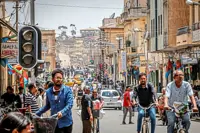
SUNIL Rastogi, an auto-rickshaw driver in New Delhi, normally works 12-hour days to make ends meet and save for the heart surgery he needs. But in summer, as temperatures climb above 37°C, he faces a dilemma.
Should he work fewer hours, bringing home less for his family and delaying his surgery, or press ahead and risk worsening his fragile health?
“I feel tired as it is,” Rastogi said recently. “This heat makes me even more tired.”
For millions of workers like Rastogi – wage labourers, construction workers, street vendors, delivery drivers – the scorching summer in New Delhi often forces them into a bitter trade-off between health and income.
They keep the machinery of the city running, and they are among the most susceptible to its harshest conditions.

On the hottest days, the surface temperature of the ground can reach 60°C, according to the Centre for Science and Environment, a New Delhi-based think tank. That is when tarmac starts to soften and barefoot workers risk blistering their feet.
Rastogi, 54, said he had to choose his health during the summer heat. He works only about five hours each day, seven less than usual, to avoid the sweltering midday sun.
That may mean putting off his surgery, but it lowers the short-term risk of a health emergency that could force him to stop working.
“I have two children,” Rastogi said. “I have responsibilities.”
Others work through the stifling heat, which can still undermine their earnings.
Nitin Verma, 58, runs a street-side flower stall. When the weather is pleasant, he said, he can earn as much as 3,000 rupees a day.
But on many summer days, he is unable to recoup even the roughly 100 rupees that he spends on tea and drinking water.
He carefully tends to his flowers, plucking wilted petals and removing rotten stems.
“Then I just sit around,” he said.
Customers rarely come.
Over the decades, summers in India have grown longer and hotter.
This year, severe heatwaves hit vast swaths of the country in April and May, with temperatures exceeding 43°C.
Although all of Delhi, the capital territory that includes New Delhi, suffers in summer, the distribution of heat is uneven.
Certain pockets, often those where the most vulnerable communities live, are more exposed to heat because of shrinking forest cover, heavy traffic and haphazard construction, according to a recent report by the Centre for Science and Environment.
With nighttime temperatures also rising, the window during which the human body can cool down enough for relief is narrowing.
Officials in Delhi enacted some relief measures for workers this year.
Each of Delhi’s 13 districts has been given a mobile relief van stocked with supplies like cold water, hats and oral rehydration salts, officials said. They have also set up tented rest areas as “cooling zones”.
At a cooling zone near Jama Masjid, one of old Delhi’s famous mosques, eight air coolers were running, and about a third of the 75 seats in the tented area were occupied.
Krishna Rani, 45, a security guard at a neighbourhood school, said she is grateful for the resting area, which she has used every evening before her hour-long bus ride home.
Rani, who has four children and is her family’s sole breadwinner, said working less is not an option.
“I can’t let heat deter me,” she said. “I have to earn for my children’s sake.”
A mobile relief van about 15km away, in a neighbourhood in South Delhi, was equipped with a small fridge, a water dispenser, sachets of rehydration salts and a drum that could hold up to 500 litres of water.
People stood in line as volunteers and government workers handed out water.
They were also handing out baseball caps emblazoned with a Hindi slogan that loosely translated to, “Beat the heat, with the Delhi government in the lead”.
Because the relief vans park in different places each day, some Delhi residents said they could be difficult to find.
The cooling zones are easier to spot, but stopping to rest means sacrificing valuable time on the job.
Roopak Yadav, 22, a delivery driver for an online platform, said that in summer, he could accept orders only within a 5km radius of where he was. Otherwise, his electric bicycle would overheat.
To compensate for the shorter trips, he accepts more delivery orders and cuts down on breaks.
“If I rest, I will lose time,” said Yadav, who had seen the relief stations but had yet to visit one. “My earnings will be reduced further.”
Instead, he has taken to asking for water from those whose homes he delivers to.
“I am parched a lot of the time,” he said. — ©2026 The New York Times Company
This article originally appeared in The New York Times
Already a subscriber? Log in
Get 20% OFF The Star Digital Access
Cancel anytime. Ad-free. Unlimited access with perks.