
IN an inconspicuous building near the UK’s Mildenhall air base, drone manufacturer Ukrspecsystems is opening a new production line, like other Ukrainian arms companies looking to secure supply chains and boost capacity.
Ukrainian drone manufacturers have in recent months announced a slew of plans to open sites in Europe, including in Germany, Denmark and now Britain.
Ukrspecsystems, which specialises in reconnaissance drones, chose Mildenhall in Suffolk, eastern England, next to a British military base.
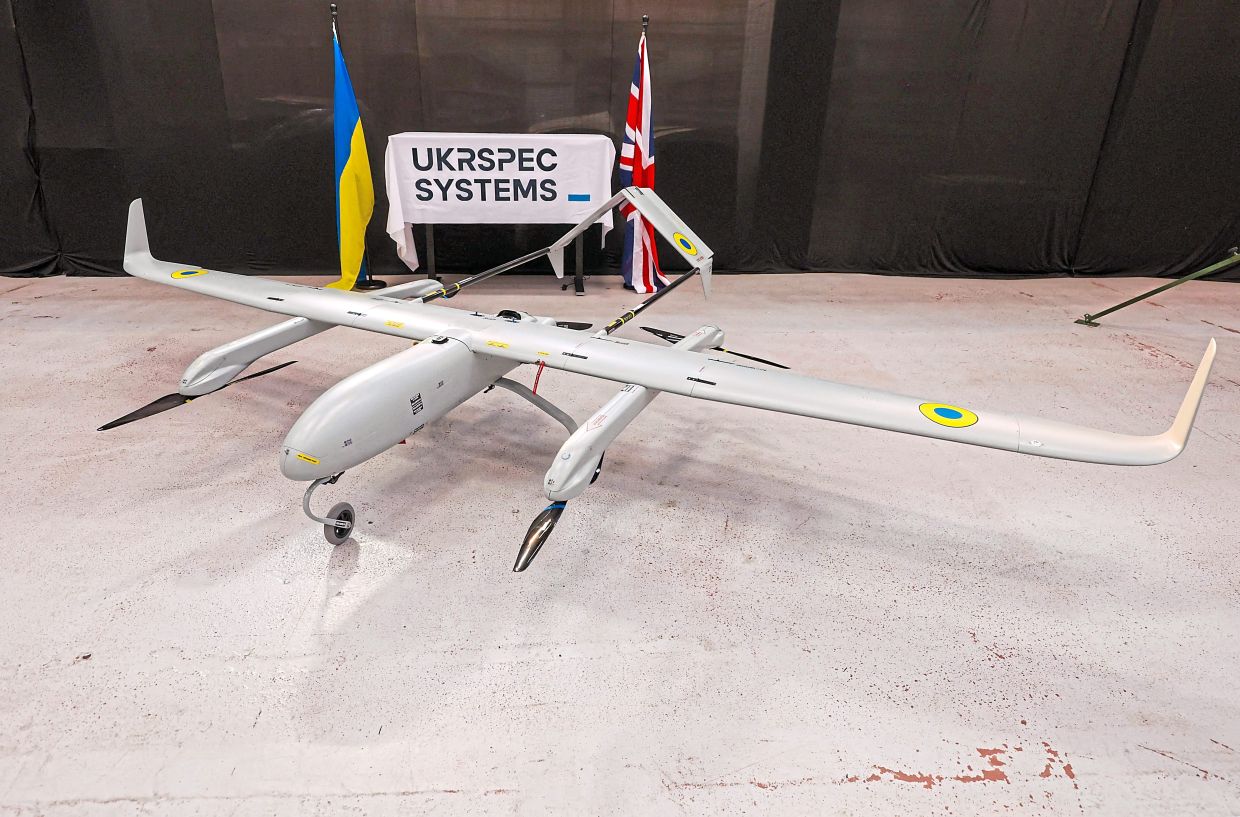
In the warehouse area where the company has set up shop, there is little indicating the presence of the weapons plant inaugurated on Feb 25 by Britain’s armed forces minister Luke Pollard and Ukrainian ambassador in London, Valery Zaluzhny – Kyiv’s former military commander-in-chief.
The site will be able to manufacture up to 200 surveillance drones (ISRs) every month, and up to 1,000 in the long-term, said director Rory Chamberlain.
These include Ukrspecsystems’ “Shark” model, identifiable by the shark-head design on its nose, which cost tens of thousands of pounds to make.
“The battlefield is large, so you’ve got to be able to get cheap but capable ISRs at quantity on the front line,” said Chamberlain.
While Ukraine has ramped up drone production since Russia’s 2022 invasion – with more than four million units produced in 2025, according to President Volodymyr Zelenskyy – the demand remains huge.
But manufacturing conditions are difficult in Ukraine, with the constant threat of Russian strikes as well as a heavy reliance on imported parts, according to the Snake Island Institute, a Kyiv-based defence think tank.
Last year, Kyiv eased an embargo on arms exports, allowing technology transfers to allied countries, which can then host assembly lines and finished products are reimported to Ukraine.
“Manufacturing these systems outside Ukraine creates extra production capacity to support Kyiv’s war effort,” noted the International Institute for Strategic Studies (IISS) in its Military Balance 2026 report.
According to the report, the partnerships support “the longer-term economic viability of (Ukraine’s) defence-industrial base”, which has the manufacturing know-how, but needs more contracts.
The “controlled exports” of certain weapon types will allow Kyiv to “increase the production of drones for the front line” and boost funding, Zelenskyy said in September.
In mid-February, the Danish government announced it was in talks to host facilities for Ukrainian drone manufacturer Skyfall.
Ukrainian firm Fire Point, which develops military drones and missiles, was the first to set up in Denmark, where it began construction in Vojens of a plant to produce propellants in December.
Production is scheduled to start later this year.
“Bringing strong Ukrainian defence companies to Denmark to work together with Danish industry will strengthen the security of both Denmark and Ukraine,” said Denmark’s Defence Minister Troels Lund Poulsen.
The expansion is “bringing that understanding” of drone manufacturing into the United Kingdom and other European countries which are less experienced in the field, said Chamberlain – particularly when it comes to adaptability and advances in embedded technologies like AI and jamming.
“How quickly you can bring updates and get those in the frontline is how successful you are. In 24 hours, we can do that,” he added.
“We have the know-how, and I think that’s what we can bring” to the United Kingdom.
“For European firms, partnering with Ukrainian companies and their battle-tested designs now may prove more advantageous than competing against them in the future,” noted the IISS report.
The partnerships have multiplied in a short span of time.
Since the end of 2024, Finnish group Summa Defence has set up several joint ventures with Ukrainian firms to produce drones in Finland.
Similarly, British firm Prevail Partners and Ukraine’s Skyeton joined forces in July 2025 aiming to produce the Raybird surveillance drone in the United Kingdom.
Zelenskyy and German Defence Minister Boris Pistorius last month received the first drone manufactured by QFI, a joint venture between German company Quantum Systems and Ukrainian firm Frontline Robotics.
It is set to produce an initial 10,000 drones per year, QFI said. — AFP