



FOR creating the world’s first genetically edited babies, He Jiankui has been reviled as China’s Dr Frankenstein.
He was sentenced to three years in prison, convicted of deceiving medical authorities.
Yet, as China pursues its ambition to become a biotechnology superpower, He is neither silenced nor fully rehabilitated.
He lives openly in a government-backed research hub north of Beijing, speaking freely about his work.
He cannot travel abroad – his passport seized – but he has become a small, outspoken figure in China’s biotech landscape.
“For a country that is adept at control, they are leaving him curiously unfettered,” said Benjamin Hurlbut, a University of Arizona life sciences professor.
“He is not seen as a liability, but apparently as a potential asset.”
In an interview at his apartment, provided along with a bodyguard by an anonymous sponsor, He said demand is growing for researchers willing to push boundaries.
He has recently been offered a post at a government-funded academy in Shenzhen, where he worked before his arrest in 2019.
His 2018 experiment, which produced twin girls – Lulu and Nana – and later a third baby, Amy, drew global outrage.
Few know the long-term health consequences of editing embryos. Critics warned it could open a Pandora’s box toward designer babies and eugenics.
He insists his goal was disease prevention: “If anyone uses this for IQ enhancement, put the scientist in jail.”
He now focuses on gene-editing research in mice, targeting Alzheimer’s and Duchenne muscular dystrophy, diseases affecting his family.
“People were not yet ready to accept what I was doing,” he said. “That is changing.”
He cited a Sun Yat-sen University poll showing broad support in China for disease-preventing gene editing – though not for IQ enhancement – and pointed to recent regulations on “new biomedical technologies” as evidence of the country’s openness.
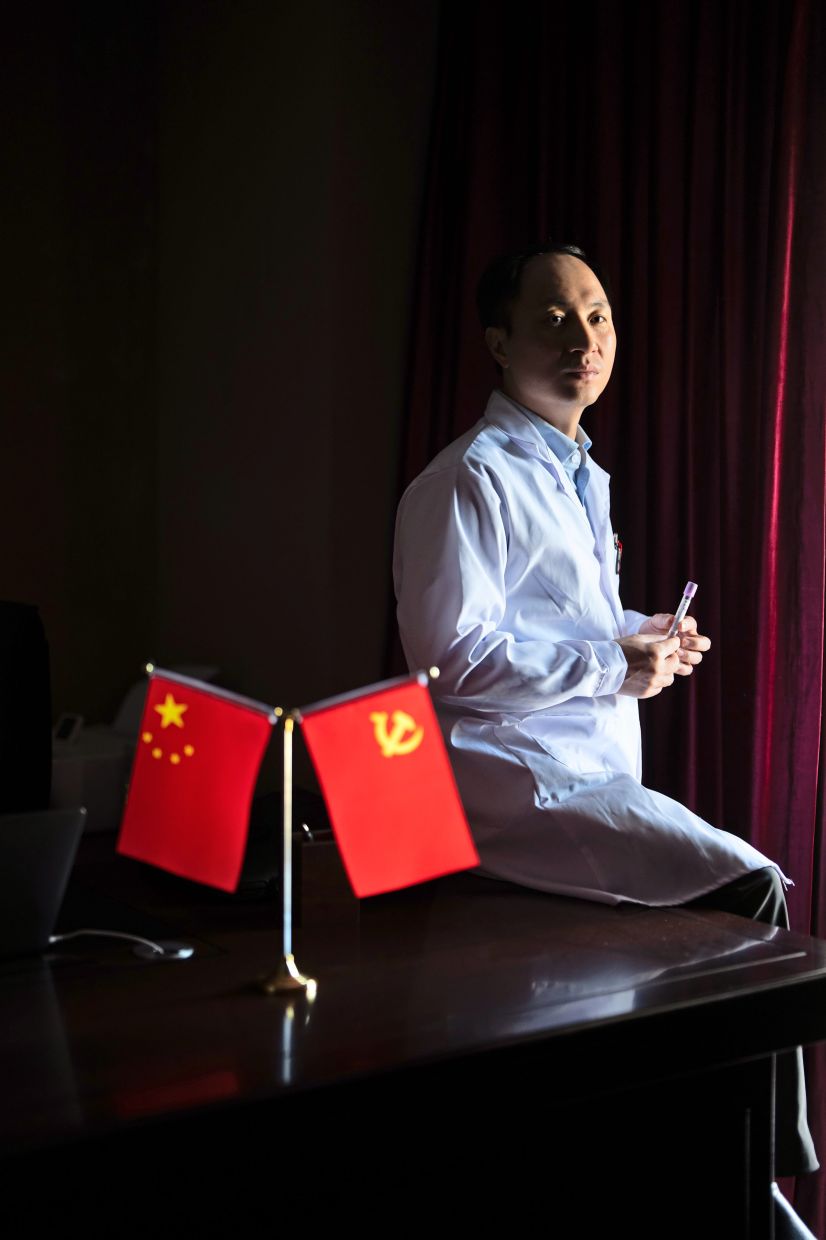
He’s work on human embryos used CRISPR-Cas9, a technique not technically difficult, Hurlbut said.
Implanting edited embryos made him “a centre of gravity for bigger moral and geopolitical issues.”
He remains critical of US research, which he says is slowed by ethics boards and regulators.
“Chinese gene-editing will take over the world just like Chinese electric vehicles have already done,” he predicted.
He has embraced a bold narrative of Chinese scientific advancement.
Early in 2024, he married Cathy Tie, a Chinese-born Canadian biotech entrepreneur, who shares his belief in China’s potential to lead in gene technology.
Tie was denied entry to China in May, ending the marriage, though she praised China’s historically fast execution in frontier medicine.
China’s top leader, Xi Jinping, has set a goal of global leadership in science and technology by 2049, the centennial of Communist Party rule.
The government is investing heavily in genetic manipulation technology.
Regulations ban modifying DNA in reproductive cells for implantation but leave room for research under oversight of the health ministry.
He called the rules “ambiguous” but a sign of “China opening up in this field”.
Hurlbut said China’s ambitions help explain why He “is not being treated like an ex-convict” and can express boosterish views.
He remains unapologetic about his past, calling the creation of “healthy, beautiful babies” an achievement.
The current state and location of Lulu, Nana and Amy remain private.
“I’m not going to put them in a cage and let people take their blood and dissect them. They are humans, so don’t treat them like mice.”
That at least some influential forces in the Chinese establishment look kindly on his work was already clear in November 2018, when news of the world’s first genetically-edited babies broke.
The People’s Daily published a story describing how twin girls had just been born from an embryo whose genes had been altered by He using Crispr.
It hailed their birth “as a historic breakthrough for China in the application of gene-editing technology for disease prevention”.
The newspaper quickly deleted the article, published on the eve of an international conference on genome editing in Hong Kong, when attendees of the conference erupted in fury at news of what He had done.
The furore at the conference led some to label him China’s Dr Frankenstein.
That name, he said, was unfair because, unlike the fictional scientist and the monster he created, “I never killed anyone” and only “made parents very happy”.
Though initially angry over the Frankenstein nickname, he has now come to embrace it, using it for a time in the biography atop his account on X.
“I like the name now,” he said, because it shows “I have superpower.” — ©2026 The New York Times Company
This article originally appeared in The New York Times
Already a subscriber? Log in
Get 20% OFF The Star Digital Access
Cancel anytime. Ad-free. Unlimited access with perks.
