
THE jigsaw puzzles that Han Li assembled at the Museum of London Archaeology, or Mola, are as bewildering as a Latin riddle.
Li, a building-material specialist at the institution, has spent much of the year laying out “thousands upon thousands upon thousands” of fragments of painted wall plaster that date to the early Roman occupation of the area around London, which began in 43AD.
Li’s task would confound even jigsaw buffs.
The cardboard puzzles familiar from summer camp had straight edges and corners, and you could work from the outside in. The delicate fragments that Li and his team of conservators are refashioning have irregular edges and form no apparent border.
Pieces are embellished with images of lyres, candelabras, flowers, white cranes and native plants.
One is illustrated with the face of a woman in tears, recognisable by her Flavian-period (69-96AD) hairstyle.
Four years ago, the plaster was recovered during an excavation at a construction site in Southwark, just south of the Thames. The scraps filled 120 assorted boxes.
Li’s job is to carefully arrange, categorise and restore the original artwork.
The frescoes that have emerged, the most colossal of which measures 4.9m by 3m, were hidden from view for more than 1,800 years.
The museum’s haul of discarded Roman-era plaster is the largest ever amassed in the English capital.
Rob Symmons, the curator of the extravagant Fishbourne Roman Palace in West Sussex, called the site “a discovery of the first magnitude”.
It is not unusual for painted wall plaster to be recovered from Roman archaeological sites, but rarely is it found in quantities that it was in Southwark, he said.
“Also, it’s unusual for excavators to have the time and expertise to attempt reconstructions like the one that Han undertook,” he added.
The Southwark plaster once adorned at least 20 internal clay walls of what is believed to have been either a luxurious private villa or an upscale inn for state couriers and officials passing through Londinium, the precursor of modern London.
“When the structure was demolished, material from different walls jumbled together and was dumped into a large pit,” Li said.
“When you are salvaging materials from a masonry wall, the plaster tends to break apart or crumble. It’s almost impossible to reconstruct the walls in their entirety, but you can reconstruct enough to see what the schemes are.”
The Romans established Londinium shortly after Roman legions, acting on the orders of Emperor Claudius, invaded parts of Britain.
The district in which the building was found is described by Andrew Henderson-Schwartz, a Mola administrator, as a vibrant and prosperous suburb.
“It was the Beverly Hills of Roman London,” he said. “This is a place they intended to stay and Romanise.”
The occupation lasted until 410AD, when the soldiers were withdrawn. Their Saxon successors neglected the area.
By the Middle Ages, Southwark, outside the control of London’s laws, was known as a place where one could find blood sports such as cockfighting and bearbaiting, alongside brothels and theatres.
In 2021, the plaster dumping site was dug up in preparation for development of the property.
The following February, a large mosaic decorated with guilloche patterns and Solomon’s knot motifs was unearthed.
A year later, the excavation yielded remnants of the most intact Roman mausoleum ever discovered in Britain.
Li noted that the lower portions of the plaster walls, known as dadoes, were frequently made to look like stone.
Some patterns mimic costly Egyptian porphyry, a volcanic rock distinguished by its purplish hue and crystal inclusions, and frame them with veins of African giallo antico, a type of yellow marble.
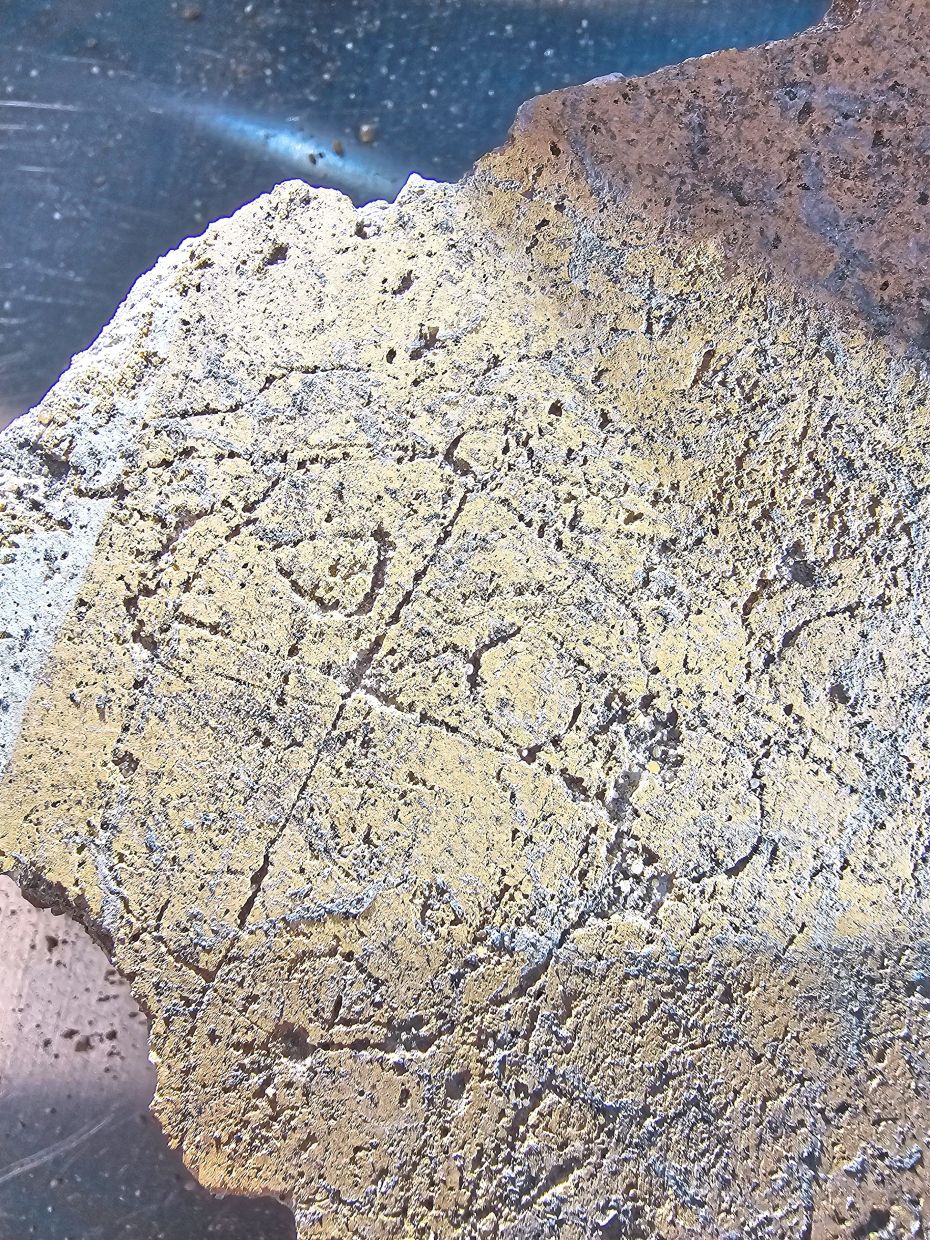
Although the names of the interior decorators are not known, the researchers discovered a tabula ansata, a carving of a decorative tablet sometimes used to sign artworks, scored with the Latin word fecit, meaning “has made this”.
Such maker’s marks were usually seen on ceramics in Roman London, but not wall plaster.
“Unfortunately, the section bearing the painter’s identity was snapped off,” Li said.
Two other fragments were joined together to reveal an etching of a near-complete Greek alphabet.
While Roman wall painters in Britain incorporated elements from other imperial outposts such as Xanten, Cologne and Lyon, some aspects of their art were distinctly British.
One fragment initially interpreted as grapes is now understood to depict mistletoe, demonstrating that the artists applied Roman artistic conventions but with a local, British colour palette.
Bright yellow panels with pale green borders dominate the middle layers of the frescoes.
That decorative touch has surfaced at only a handful of other locations across the island, including the Fishbourne Roman Palace, located about 100km southwest of the dig.
Li recently visited the palace to observe the wall plaster.
He and Symmons suspect that the same hand, or at least artistic school, was responsible for both sets of frescoes.
“When you’re looking at two paintings that look identical, down to the stroke, down to the pigment, it really kind of makes you feel like you’ve discovered something amazing,” Li said. — ©2025 The New York Times Company
This article originally appeared in The New York Times
Already a subscriber? Log in
Get 20% OFF The Star Digital Access
Cancel anytime. Ad-free. Unlimited access with perks.