Growing noise overseas against judicial reform


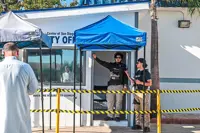
A rally outside the Israeli Consulate to protest changes to Israel’s courts in New York. — ©2023 The New York Times Company

FOR months, Beth Levine, an attorney in New York, grew worried about developments in Israel, where the far-right government has sought to diminish the judicial branch’s independence. Its efforts provoked massive protests in Israel and smaller ones in the United States, including most Sundays in Manhattan’s Washington Square Park.

Though sympathetic to the cause, Levine, who lives in the Bronx, never attended.

Then two things happened: Israel’s government passed the first of its judicial changes in July, a move supportive ministers said would eliminate an obstacle to the popular will. And Israeli expatriates in New York, loosely organised under a grassroots group called UnXeptable, planned a rally this summer across the street from Israel’s consulate in midtown to coincide with the Jewish holiday of Tisha B’Av, which commemorates the destruction of the ancient temples in Jerusalem and other tragedies.

The timing resonated with Levine, and, for the first time, she came.

“It seemed to me very significant,” she said. “Many of the worst things that happened on that holiday happened because of sinat chinam, or baseless hate, among Jews.”

There has been a flurry of activity this month.

Organisers staged rallies in dozens of cities globally two days before Israel’s Supreme Court considered an appeal of the first overhaul law, including one in front of the US Supreme Court in Washington.

Dardashti delivering remarks during the rally. — ©2023 the New York Times Company

Protesters in New York plan to greet Israeli Prime Minister Benjamin Netanyahu when he is scheduled to speak at the UN General Assembly.

And a “democracy prayer” co-authored by a prominent American rabbi was read at synagogues across the country for Rosh Hashana, the Jewish new year festival, last week.

Polling shows that, like many Israelis, many American Jews oppose the judicial changes in Israel. Yet some have also been reluctant to criticise Israel openly for what seems a domestic matter.

But this hesitation has begun to thaw, Israeli protesters and American advocates said, as more American Jews have been swayed by President Joe Biden’s vocal concern over the Israeli government’s actions and convinced by the argument that the Jewish diaspora should care about the status of Israeli democracy.

Many Jewish American leaders and organisations, including the Jewish Federations of North America, a philanthropic giant, have publicly objected to the changes, as have several prominent centrist and centre-right observers and journalists. Now, that protest is growing to include individuals and local synagogues.

“American Jews are really accustomed to being asked to rally for Israel,” said Rabbi Michelle Dardashti of Brooklyn’s Kane Street Synagogue. “Being asked to reassess our relationship with Israel and to protest the government, and publicly - that’s foreign for American Jews.”

Ana Blumenthal, an Israeli organiser based in Philadelphia, said she and her colleagues have been invited to speak by synagogues and Jewish community groups that want to become involved in protests.

“We are experiencing a shift,” Blumenthal said.

A June survey of American Jews by the non-partisan Jewish Electorate Institute found that 61% think the proposals would weaken Israeli democracy.

The new Israeli law restricts the ability of the Supreme Court to overturn laws, removing a check on the country’s political leadership. Israel’s government, the most right-leaning in its history, also hopes to entrench the role of rabbinical courts in civilian life and deepen Israel’s presence in the occupied West Bank.

Sixty-five per cent of Orthodox Jews in the same survey said the changes would strengthen Israeli democracy, revealing a split in the United States between progressive, religiously liberal Jews and conservative, strictly observant Jews, many of whom, said Rabbi Moshe Hauer, the Orthodox Union executive vice-president, “aren’t finding the level of angst of the ‘end of democracy’ rhetoric to strike home.”

American Jews “have not only an interest but a vital stake in the well-being of the state of Israel,” said Rabbi Ammiel Hirsch of New York’s Stephen Wise Free Synagogue, a Reform congregation. The current government, he added, “risks further disrupting the relationship between world Jewry and Israel”.

Jonathan Goffin, a dual American-Australian citizen in New York, said Israeli protesters - and standing alongside them, as he first did this spring - brought him closer to Israel, which he was raised in Melbourne to revere.

“Israel is supposed to be founded on liberal, democratic ideals,” Goffin said.

The rallies, he added, were “the first time in a long time I can remember being proud to carry the Israeli flag.”

Still, some engaged American Jews continue to feel the protests are not for them. Around 15% of American Jews polled by the Jewish Electorate Institute say the changes will strengthen Israel’s democracy, and another 24% don’t think the changes will have an effect.

Jonathan Greenberg, a Reform rabbi and adviser to a private charitable foundation in the Chicago area, said he has not taken a position on the changes, but feels the matter is for Israelis to decide.

“The popular will in democracies is expressed in elections,” he said. “I trust Israelis to set their own internal policies.”

Jonathan Wornick, who works for an investment advisory firm in the Bay Area and serves on the national council of AIPAC, the pro-Israel lobby, said he opposes American protests.

“There, I think, ‘Wow, democracy in action, it’s a beautiful thing,’” he said of protests in Israel. By contrast, he added, “My role as an American Jew is to support the relationship” between the United States and Israel.

Stephen Lurie, a strategist at a non-profit in New York, is not interested in attending a rally for Israeli democracy since, he said, “Israel hasn’t been a real democracy for many, many years, because of how it treats all of the people in the West Bank under its control.” — ©2023 The New York Times Company

Get 20% OFF The Star Digital Access

Monthly Plan

RM 13.90/month

RM 11.12/month

Billed as RM 11.12 for the 1st month, RM 13.90 thereafter.

Best Value

Annual Plan

RM 12.33/month

RM 9.87/month

Billed as RM 118.40 for the 1st year, RM 148 thereafter.

Follow us on our official WhatsApp channel for breaking news alerts and key updates!
StarExtra

Next In Focus

Planning for a fit take-off
Different risks with little travellers
Holiday hiccups
Ukraine ruins Crimean summer
Open war, closed border
The world’s unlikeliest EV frontier
Where the birdsare the business
Plight of the mothers who search
Bowhunting ‘Frankenfish’
City in the kill zone

Others Also Read