Unless they have wealth, position or influence, older people often become persona non grata when they retire. They are seen but not heard. On board crowded buses and trains, they are not even seen! Few commuters would give up their seats for senior citizens despite repeated announcements on the train to do so. They would feign sleep or be busy on their mobile phones.
We forget that older persons have rights too, just like anyone else. June 15 was World Elder Abuse Awareness Day. How many of us were aware of the significance of the day? It passed quietly, with hardly any major event to mark the day.
Often it takes a news report of a grandpa abandoned at a bus stop with just RM2 in his pocket and a bag of chips to remind us that elder abuse exists, and in increasing numbers.
The elderly are vulnerable to abuse – financial, physical, psychological, emotional, and believe it or not, sexual abuse.
The actual figures don’t give a true picture as most cases go unreported, especially when the guilty are family members. Reporting the abuse would be airing their shame in public, and a reflection of the lack of filial piety in their adult children.
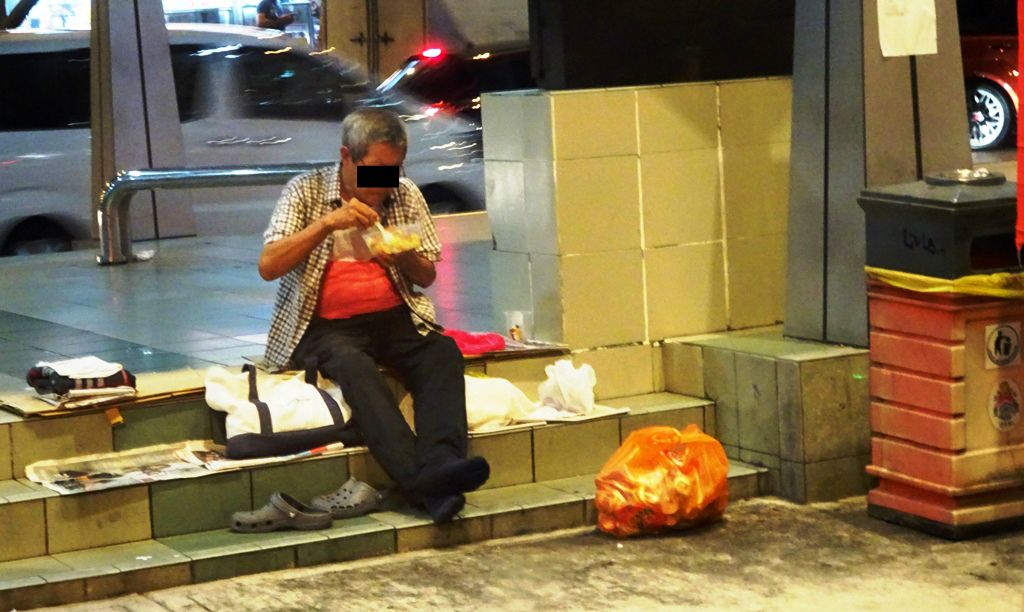
One of the most fundamental rights of the elderly is the right to have shelter, a roof over their head, a place to call home. Take a walk in the inner-city streets. You will be confronted with the sight of homeless elderly sleeping at bus stops or on cardboard pieces spread out along the five-foot ways of shuttered shops or under flyovers.
They rummage through garbage bins to see what they can pick up to sell for a pittance. The ones that are hard to ignore are those sitting on the pavements near popular shopping malls, with the hope that passersby would be moved to give alms.
At their age these seniors should be enjoying their golden years pursuing their passions and playing with their grandchildren.
Untold stories
I once spent three months in downtown areas getting to know the homeless elderly for a documentary project. I wanted to understand the circumstances that led to their situation.
How do they survive the daily challenges of living on the streets without a roof over their heads and without a dime in their pockets?
Here is what I learnt.
It’s not that they want to live on the streets, but many have no choice due to various circumstances beyond their control. For some, their plight is of their own making.
Some have families but shame resulting from gambling debts, drug addiction or failure to find employment stops them from returning to their homes. Others choose the streets over welfare shelters with all the rules and restrictions as they want to retain their freedom and independence.
Those who have been on the streets long enough know where to go for free breakfast, lunch and dinner. There are soup kitchens that distribute food packages and bottles of drinking water.
NGOs and good Samaritans are there to provide sustenance. Food is not so much a problem as money. There are also young medical teams that do weekly rounds to treat the sick and those with infected open wounds.
The hungry are grateful for these free meals and handouts which often include face masks, medicated oil and Panadol. They eat sitting on the pavement, next to piles of stinky uncleared garbage with flies hovering around. At night the mosquitoes take over.
While some have marked out their territorial space along the pavements with their belongings, others are more itinerant, dragging their worn-out trolley bag of clothes and essentials from place to place. There is safety in numbers so it is common to find them congregating in groups at night to avoid getting mugged or robbed of their meagre belongings.
Taking daily baths is a luxury. They wash their clothes with pails of water sourced from restaurants nearby, and leave their laundry to dry on bushes or makeshift clothes lines. The street corners and back lanes are their urinals. Hence the overwhelming stench of pee that assails the nostrils.
Regardless of the circumstances that have led to their current state of destitution, the homeless elderly need a helping hand from the government, NGOs or some good Samaritans. Unfortunately, many of them fall outside the welfare radar. They are not aware they are eligible for welfare aid. Nor do they know where to go to seek help. Talk to any one of them, and they will tell you they are just waiting to die.
It is hard to understand how anyone could be all alone in the world, with no family members or friends to turn to in times of need. But it happens. No one wants to be in a situation like this. No one deserves to be in a situation like this.
It can happen to anyone. Even the wealthy can end up poor and homeless if a sudden calamity befalls them. Wars, accidents and natural disasters can render us in need of helping hands.
Some have a shared rented room to go back to at the end of the day. But there are many who cannot afford a roof over their head. These are the ones who set up “home” along pavements, under bridges and in the void decks of apartment blocks. They literally live from hand to mouth, from day to day.
What needs to be done
Once again, the government is talking about the proposed Senior Citizens Bill. Way back in 2013, I remember being interviewed on radio for my views on the proposed Bill. There was talk then of introducing a Maintenance of Parents Act similar to that already implemented in countries such as India and Singapore. There were differing views from various quarters on whether there should be legislations to protect and care for our warga emas. The debates would taper off, only to resurface when an elder abuse case makes the headlines again.
All talk, but no action. Lately it has again become the topic of public interest and controversy.
I can understand the government’s reluctance to implement it. There are certain quarters that view it necessary to introduce such legislations.
There are also groups that oppose it as unjustified “punishment”. They argue adult children may not be in a position financially to care for their ageing parents as well as their children.
With longer life expectancy, middle-aged couples could be looking at supporting two sets of elderly parents and grandparents! A heavy financial burden indeed.
If the proposed Bill is similar to Singapore’s Maintenance of Parents Act, then it is not meant to be seen as punishment but as a deterrent. There is room for cases to be heard by a Tribunal. The aim is to recommend reconciliation. The amount awarded to the parent is also dependent on the financial situation of the adult children.
Not every case brought to the Tribunal is a win for the parent.
While waiting for the Bill to be passed, here’s what we can all do:
• Set up more halfway houses or Anjung Singgah to provide temporary housing for abandoned elderly and the jobless. Extend the current two-week free board to a month. This gives them more time to look for a job.
• Remove ageism in employment. Allow those who are still fit and capable to continue working.
• Establish a skills-based training centre for older people to enable them to be self-supporting.
• Introduce programmes and activities that strengthen family bonding and intergenerational understanding.
• Promote an active lifestyle so that every citizen will age well. Our health and well-being are our responsibility. Start early. Start young.
• Be good examples for our children by caring for our elderly at home.
The Ministry of Women, Family and Community Development, to their credit, have initiated various programmes to promote healthy lifestyle and lifelong learning.
There are Pusat Activiti Warga Emas (PAWE) for older persons to meet up and enjoy social activities. The University of the Third Age (U3A) conducts short courses both online and onsite to Malaysians 50 and above. But most of these programmes are held in the Klang Valley and in the bigger towns. Those in rural areas have yet to benefit fully from these initiatives.
While it is next to impossible to completely eradicate poverty and homelessness, it pricks our conscience to stand by and do nothing. But how many can we help? How much can we do? It requires a whole-nation approach, not just the government alone.
Ultimately, it’s the family, the home that is the best starting point for teaching and learning. Positive family dynamics is vital for bonding. Next come the schools, the friends and peers, and finally the community. The government and NGOs cannot solve major social problems without everyone pitching in too.
Where there is a will strong enough, there is always a way. Homelessness may not be completely eradicated, but it can certainly be reduced.
Lily Fu is a gerontologist who advocates for seniors. She is the founder of SeniorsAloud, an online platform for seniors to connect and enjoy social activities for ageing well. The views expressed here are entirely the writer’s own.