
FOR years, lecturer Dr Mehran Behjati and his wife would spend their weekends outdoors, taking to the bike trails and cycling into the remote areas and villages of Selangor, and even as far as Bukit Tinggi in Pahang, some 70km away from the Klang Valley.
Armed with binoculars, they would keep a lookout for birds, particularly hornbills.
“For us, the hornbill is one of the most majestic birds we have ever seen. Every time I see this majestic bird in its environment, I’m fascinated. I’m excited to see them,” Behjati says during a recent interview at his office in Sunway University’s Faculty of Engineering and Technology.
Behjati, an enthusiastic birdwatcher, also knows that these magnificent creatures, like much of the wildlife in Malaysia, are increasingly losing their habitat due to deforestation and other factors.
“So I think, yeah, why not? We use technology to protect these animals. Most of the time, researchers are developing systems to help humans but not many researchers think about other species,” he says.
With that in mind, Behjati has come up with a way to help not just his favourite hornbills but also other wildlife species.
Using his knowledge of tiny machine learning (TinyML) and edge computing – which brings computing power closer to where the data is generated – he has put together a cost-effective, sustainable device to monitor these birds’ presence in the dense Malaysian jungle. This is done by first recording their calls and then identifying the species by comparing those sounds against a database.
Anyone who has hiked through our jungles will understand the challenges faced by wildlife researchers trying to identify calls amid the din of the forest, or even spotting a bird, what more with wildlife like hornbills which are shy and occupy the more dense areas of the jungle.
The land of hornbills
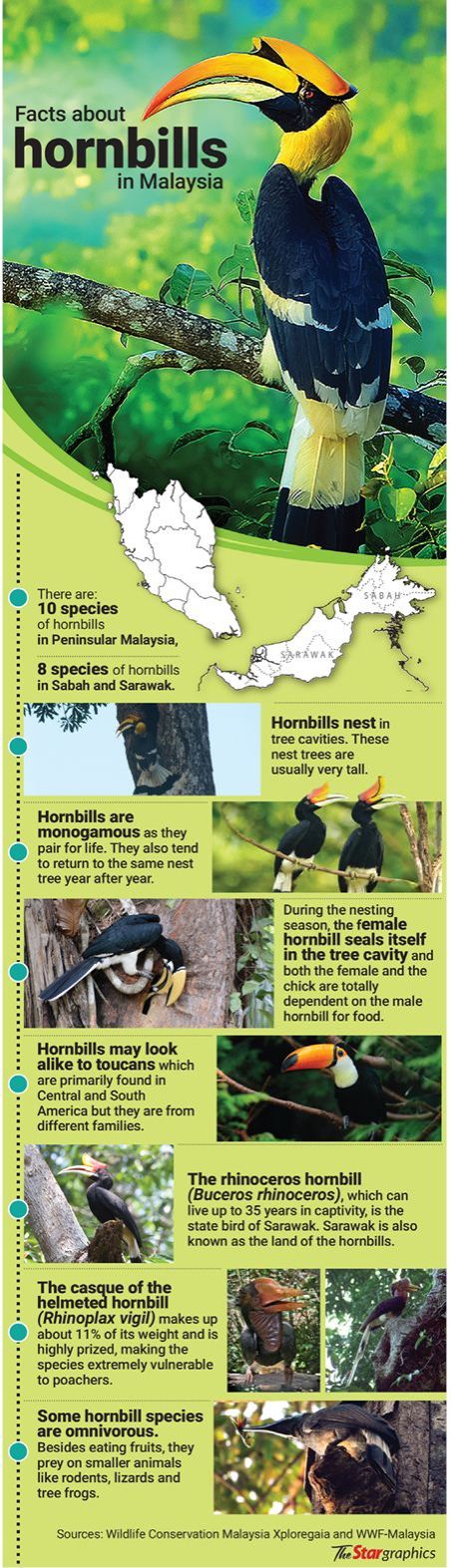
Although globally there are 57 species of hornbills, Peninsular Malaysia is considered to be a stronghold for Asian hornbill species, trailing only behind Thailand and Indonesia, both of which have 13 species.
At some sites, such as the Greater Ulu Muda Forest Complex in Kedah and the Belum-Temengor Forest Complex in Perak, all 10 hornbill species can be found in one spot.
The Malaysian species includes the great hornbill, the rhinoceros hornbill, and the rare, frumpy-looking helmeted hornbill, valued by poachers for its heavy casque known as “red ivory”.
Dubbed “farmers of the forest”, hornbills play an important role in dispersing seeds, which is crucial for plant diversity.
A study of Asian and New Guinean hornbills by the National University of Singapore in 2024 strongly suggests that large seeds are highly dependent on hornbills for their dispersal.
However, deforestation from development has massively impacted the local hornbill population. Besides being ousted from their habitat, many hornbill species need tree cavities in which to nest and raise their young – and trees are disappearing.
Behjati, who has worked on various environmental monitoring and protection projects in Malaysia over the past decade – including one at Tasik Chini, Pahang – knows how challenging things can get for researchers.
“In Malaysia’s dense rainforests, traditional environmental and wildlife monitoring methods – like manual surveys, remote camera traps, or conventional wireless sensor networks – often fall short.
“These approaches can be expensive, labour-intensive, invasive, and impractical in remote and hard to reach areas,” he points out.
But thanks to recent innovations in embedded systems, artificial intelligence (AI), and advanced wireless technologies like 5G and 6G, we now have the essential tools to build low-power, autonomous, and sustainable devices that can “listen” or “see” without disturbing or intruding on the environment.
“These intelligent systems can detect animal behaviours, track ecological changes, and deliver real-time insights to researchers – all with minimal human intervention.
“This will empower ecologists, conservationists, and policymakers to make faster, more informed decisions to safeguard endangered ecosystems.”
Smart networks
Originally from Iran, Behjati has been based in Malaysia for 15 years, lecturing at Sunway with expertise in, among others, wireless communications, nonterrestrial networks, Internet of Things (IoT), edge intelligence, and TinyML.
Behjati focuses his research on designing intelligent systems for real-world applications, particularly in the areas of environmental monitoring, smart cities, and digital inclusion.
He explains that while most Malaysians would know AI by the popular large language models like ChatGPT, Deepseek, and Gemini that can generate text or images or answer questions, these cannot be applied to real world conservation efforts.
“Why not? Because they are power hungry. They are a centralised system, they rely on Internet connectivity,” he says.
While such AI models can be used to implement, say, an air quality monitoring system in Kuala Lumpur where there’s telecommunication infrastructure to transmit data captured by sensors to a centralised machine learning system, this is not possible in remote areas where there’s no data network or even electricity.
The other limitation, says Behjati, is that centralised AI is power hungry, consuming a huge amount of energy to maintain algorithms.
“When it comes to implementing these devices in remote areas, then we need to provide a power source as well. This is very challenging.
“So these limitations are the main reasons that we can’t use AI to support conservation efforts,” he says.
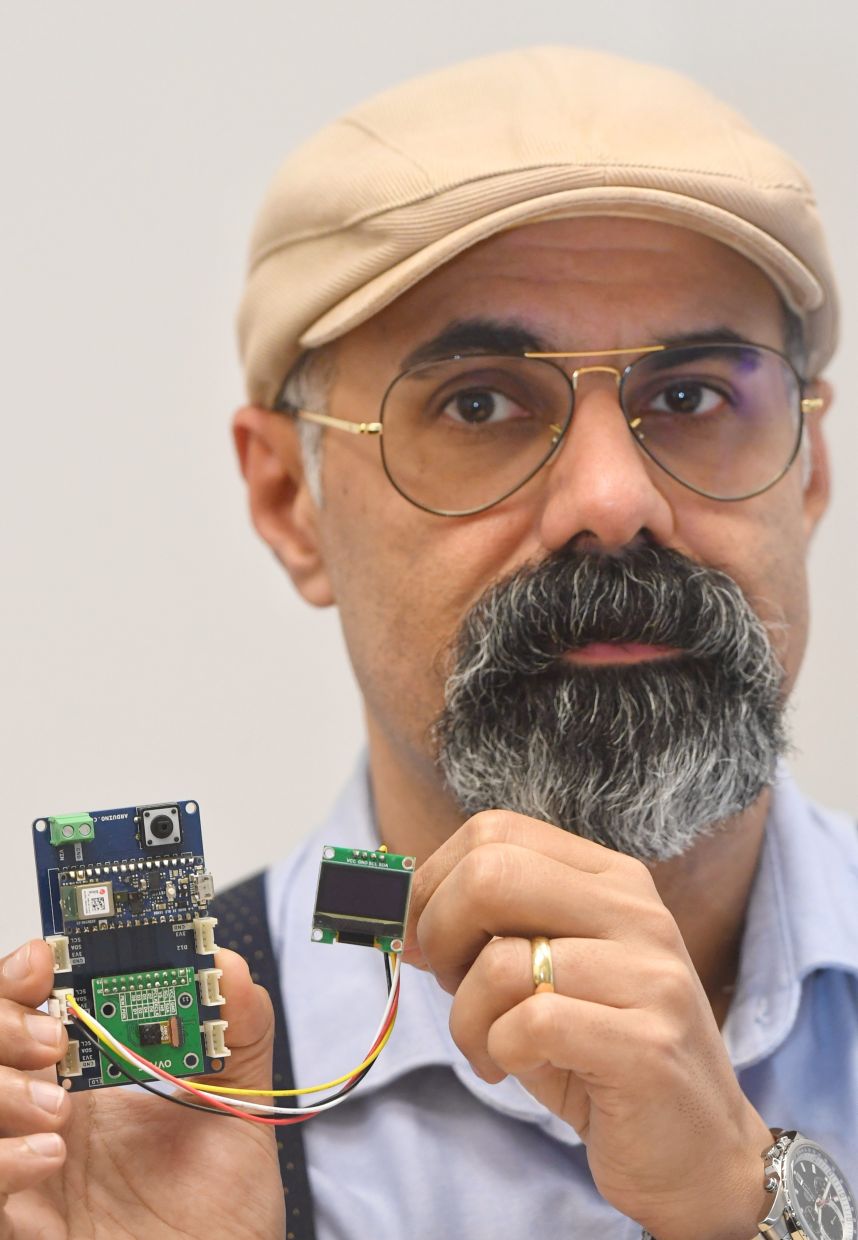
Microcontrollers are small computers on a single integrated circuit chip that are designed for specific tasks. Examples of microcontrollers are the Arduino Nano 33 BLE, which can cost anywhere between RM115 and RM140, a tiny fraction of the cost of a Nvidia AI chip.
For Behjati, the hornbill conservation project began with the collection of real-world audio samples of hornbill calls from open source bird sound archives like Xeno-Canto. These recordings were then digitally cleaned up and processed to extract distinct acoustic features using a method called mel-frequency energy, which effectively captures an acoustic “fingerprint” of each bird’s call.
“Next, we trained a lightweight yet powerful AI model – a 1D Convolutional Neural Network – to recognise and classify the calls of five hornbill species: the Oriental pied hornbill, black hornbill, white-crowned hornbill, rhinoceros hornbill, and bushy-crested hornbill.
“After compressing and optimising the model, we deployed it onto the Arduino Nano, a low-power microcontroller equipped with an onboard microphone,” Behjati explains.
By bringing intelligence to the “edge”, where data is collected, the system can function independently, detecting, classifying, and recording wildlife activity in real time, without the need for Internet access or external servers.
Once installed in the field, the device continuously listens to its surroundings and identifies hornbill calls in real time, without relying on Internet connectivity or cloud processing.
Behjati has detailed the research in a paper titled “Edge Intelligence for Wildlife Conservation: Real-Time Hornbill Call Classification Using TinyML”, co-authored with fellow Sunway University researcher Kong Ka Hing, and published in April; it is accessible via the open access repository arXiv, as well as Behjati’s blog.
Proof of concept
Ultimately, Behjati believes that the system he developed is not limited to saving any particular wildlife and can be applied to broader realms of ecological conservation.
The first phase of the project, the proof of concept which corresponds to universal Technology Readiness Level 4, has already been successfully completed. In this phase, the system was successfully tested under simulated forest conditions, confirming its technical feasibility and reliability.
“We are now preparing for broader field deployments in collaboration with local conservation groups and ecologists,” he says, adding that they are especially keen to partner with biodiversity researchers and NGOs that are actively involved in hornbill conservation to scale up the initiative.
“Our long-term goal is to establish a network of these intelligent listening nodes across protected forest areas, enabling continuous, real-time monitoring of hornbill activity.
“By developing a solution that is low-cost, energy-efficient, and open to collaboration, we aim to complement and amplify the important work already being done by Malaysia’s environmental community, particularly in biodiversity hotspots such as Taman Negara, Bukit Tinggi [in Pahang], and Sabah and Sarawak, where hornbill habitats face increasing threats,” says Behjati.
It’s about time that smart technology in the field of conservation in Malaysia takes flight.
Already a subscriber? Log in
Get 20% OFF The Star Digital Access
Cancel anytime. Ad-free. Unlimited access with perks.