



AS children spend more time in digital spaces, experts say digital literacy must go beyond understanding technology to include critical thinking, emotional regulation and an awareness of the consequences of one’s actions.
Critical thinking, said Asia Pacific University of Technology & Innovation School of Computing head Assoc Prof Dr Tan Chin Ike, helps young people understand what they see, how they think and how to solve problems.
“We also need to teach emotional literacy and empathy to students so they understand how they feel and how their feelings affect others. We need to teach them the consequences of their actions.
“This is far more important in creating a caring society,” he told StarEdu.
Tan’s comments come amid growing concerns over the influence of online gaming platforms on children.

Earlier, on Oct 4, the Sunday Star reported that the CMCF, an independent self-regulatory body that develops and administers industry content standards, was leading an initiative to draft a Gaming Sub-Code.
The Gaming Sub-Code is a set of industry rules aimed at promoting a safer and more accountable gaming environment, with requirements tailored according to the roles and levels of risk involved.
Tan said such safeguards can address certain risks.
“We should also consider that some individuals may already have aggressive tendencies or other risk factors, regardless of whether they play video games.
“One cannot simply assume that playing games created those tendencies,” he said.
However, he noted that the influence of digital environments must not be dismissed.
“No matter what games are developed, as long as there are competitive elements, combined with anonymity and no threat of any real consequences, players may say or act in a manner that they would never do in the presence of adults or their peers.
“Toxic behaviour such as trash-talking and bullying is not unique to video games, but could flourish in digital spaces without effective oversight.
“The more anonymous the platform, the more trash-talking you will see,” he said.
Monash University Malaysia Assoc Prof Dr Anne Yee agreed that it is important to avoid two extremes: assuming that violent games inevitably produce violent children, or dismissing the possibility that game content could influence children’s thoughts and behaviour.
Yee, who is also an adjunct professor at Universiti Malaya’s Centre of Addiction Sciences and honorary secretary of the Addiction Medicine Association of Malaysia, said video gaming should not automatically be regarded as harmful.
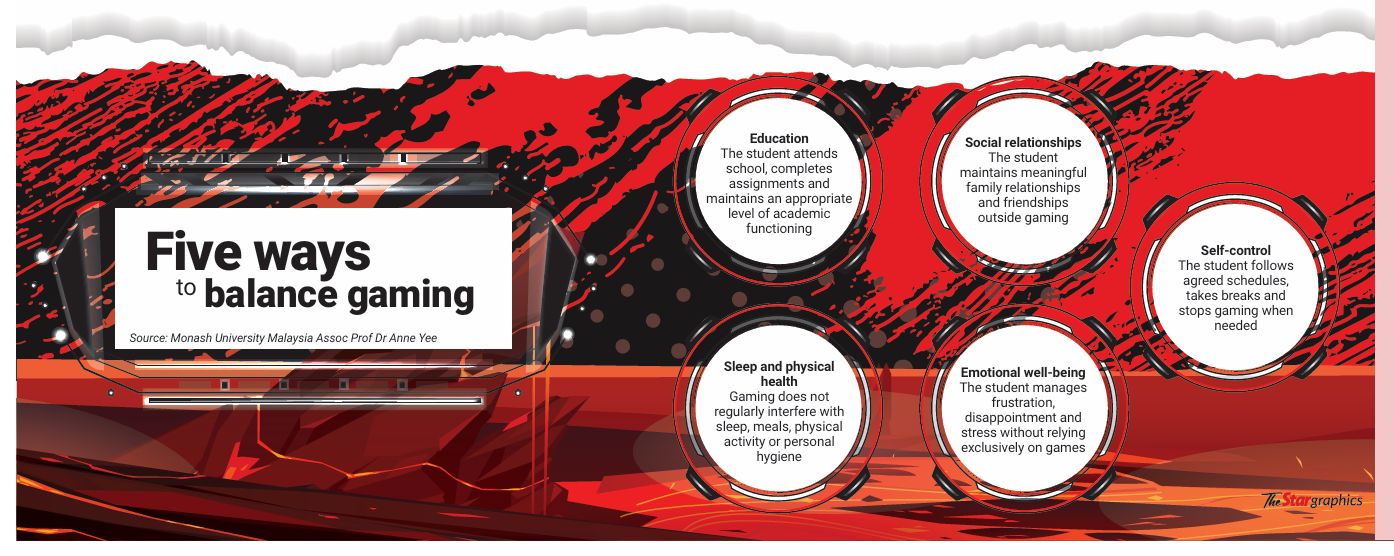
“The concern lies in whether gaming becomes difficult to control, interferes with important activities and continues despite negative consequences.
“The objective is not to raise children who never play video games, but to raise children who can enjoy gaming, compete responsibly, think critically and recognise when they need support,” she said.
She noted that while some studies have found associations between exposure to violent video games and measures of aggression, findings remain mixed, with researchers disagreeing on the strength, consistency and clinical significance of these associations.
Teaching self-regulation

“They may not be able to stop this very basic human nature, but learning about it helps them to figure out controls to curb this,” he said.
He added that regulation alone could not address every risk in the digital environment, making digital literacy education an important priority from an early age.
“What we should be focused on is to educate our children to recognise those risks, teach them how their actions affect others and learn how to make responsible decisions,” he said.
He added that digital literacy should be taught both at home and in schools, as children are exposed to a wider digital environment that includes video games, social media and other online platforms.
“Ultimately, the best protection we can give our children is not simply restricting what they can access, but equipping them with the knowledge, maturity and values to navigate the digital world responsibly,” he said.
Echoing Tan’s views, Yee said teaching children to become responsible digital citizens is more sustainable than relying solely on restrictions.
“Strict restrictions may reduce gaming time temporarily, but they do not necessarily teach children how to regulate their gaming independently, recognise harmful content or make responsible decisions.
“Teaching responsible digital citizenship is particularly important for younger children, whose emotional regulation, moral reasoning and decision-making abilities are still developing.

To help children navigate such content, Yee said parents could use gaming experiences as opportunities to discuss empathy and the consequences of one’s actions.
“For instance, when a child witnesses another player being insulted or bullied during an online match, parents could ask: ‘What do you think that player feels when everyone attacks them verbally? Would you be comfortable if your classmates treated you that way?’,” she suggested.
Such conversations, she said, could help children understand that while game characters may be fictional, the people participating in online multiplayer games are real.
“Parents should reinforce the message that respect, empathy and accountability apply equally to online and offline interactions,” she said.
Youth on digital responsibility
No reward is worth compromising one’s values or putting someone at risk. When trends go viral, students may participate because their friends are doing it or they want attention online, without considering the consequences.
Students need to be taught critical thinking and digital responsibility so they can distinguish virtual rewards from real-life consequences and have the confidence to resist peer pressure.
Tharshanraj Pillay
The stigma surrounding video games among young people can shut down proper discourse on boundaries. Games are simply taboo in many Asian societies, resulting in a lack of awareness and discussion. Open discussions about gaming can help young people understand the boundaries between virtual entertainment and real-life actions, while enabling them to make informed decisions without succumbing to peer pressure.
Chia Li Shyen

