HIGHER education institutions (HEIs) should work together to broaden students’ perspectives and help address society’s needs.
Collaboration between universities, polytechnics and community colleges could help students understand how different areas of expertise complement one another in developing practical solutions for society, says Higher Education Minister Datuk Seri Dr Zambry Abd Kadir.
“Universities, polytechnics and community colleges have complementary strengths.
“Bring together expertise in research, prototype development, training and joint implementation with communities, with clear objectives and outcomes,” he told attendees at the launch of the 2026 National Academia Day and Month Celebration at Universiti Malaya (UM) on Oct 5.
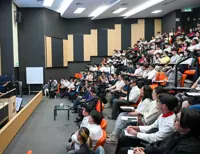
Themed “Synergy of Knowledge, Technology and Innovation in Academia”, the celebration, which drew more than 1,000 academics and students from HEIs nationwide, recognised academics’ contributions to higher education and reaffirmed the role of HEIs in advancing knowledge, research and innovation for the nation.
Zambry said the value of education extends beyond acquiring knowledge, with HEIs having a role in ensuring that learning translates into tangible benefits for the community.
“Addressing challenges such as food security, public health, climate change, productivity and an ageing population requires expertise from different fields working together.
“Knowledge helps us understand problems, technology expands our ability to address them, and innovation produces better solutions,” he said.
He illustrated this through the example of HEIs working together to support local food businesses, showing how students could learn to combine their knowledge and skills to address the needs of industries and communities.
“When expertise is brought together, the benefits of knowledge reach the people,” he said.
Zambry added that university students should look beyond their own disciplines and seek opportunities to apply their knowledge to real-world problems.
He urged institutions to give students opportunities to experiment, test their ideas, learn from failure and improve their work, allowing them to apply what they learnt in classrooms to practical situations.
He cited the achievements of Malaysian polytechnic and community college students, who won 14 medals at the FIRA RoboWorld Cup and Summit 2026 in Canada, as evidence of their ability to innovate and compete internationally.
“This robotics achievement proves the ability of our students to create and compete on the international stage,” he said.
Beyond technical knowledge, Zambry said students also need to develop critical thinking and the ability to make sound judgements, particularly as artificial intelligence makes answers more readily available.
“Students need to understand how a conclusion is formed and be able to test its accuracy.
“Education should strengthen students’ ability to explain their arguments, defend their decisions and solve real-world problems, rather than focus solely on obtaining answers,” he said.
He also stressed the importance of integrity, as technological progress needs to be accompanied by an understanding of its effects on people and society.
“We want graduates who are sharp in their thinking, firm in their principles and sensitive to the lives of others,” he said.
Meanwhile, UM vice-chancellor Prof Datuk Seri Dr Noor Azuan Abu Osman said nurturing students’ potential requires more than imparting knowledge, with educators also responsible for developing their character and encouraging them to contribute to society.
“The nation’s gems do not emerge on their own; they are discovered through attentive care, polished by knowledge, and illuminated by values,” he said in his address in conjunction with the celebration.