
MALAYSIA’S universities are making broader inroads into global rankings, with more institutions gaining international visibility and a stronger presence in the tables.
However, sustaining that progress will require more than expanding the number of universities listed.
Experts say the country must also strengthen research performance and translate growing international recognition into greater competitiveness among the world’s leading institutions.
According to University of Southampton Malaysia chief strategy officer Prof Dr Ng Jo-Han, Malaysia has come a long way since its universities were first benchmarked internationally in 2004, despite the challenges posed by increasingly expansive ranking systems.
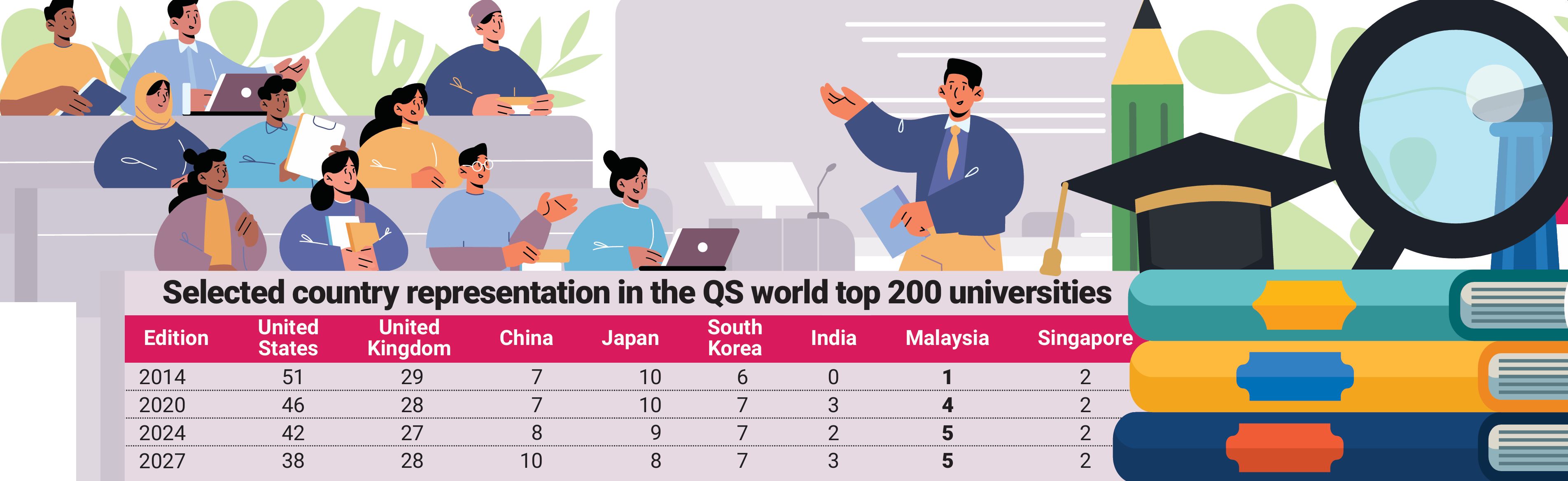
Malaysia has recorded growth in both its overall representation and the number of institutions in the top 200, he noted, adding that the country remains second to Singapore in Asean and ahead of other regional peers.
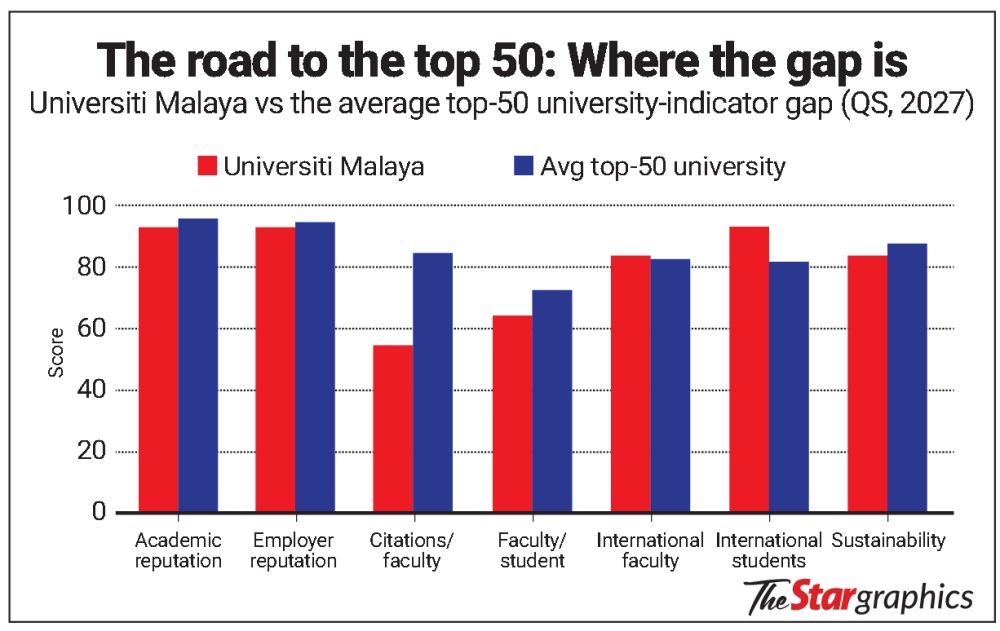
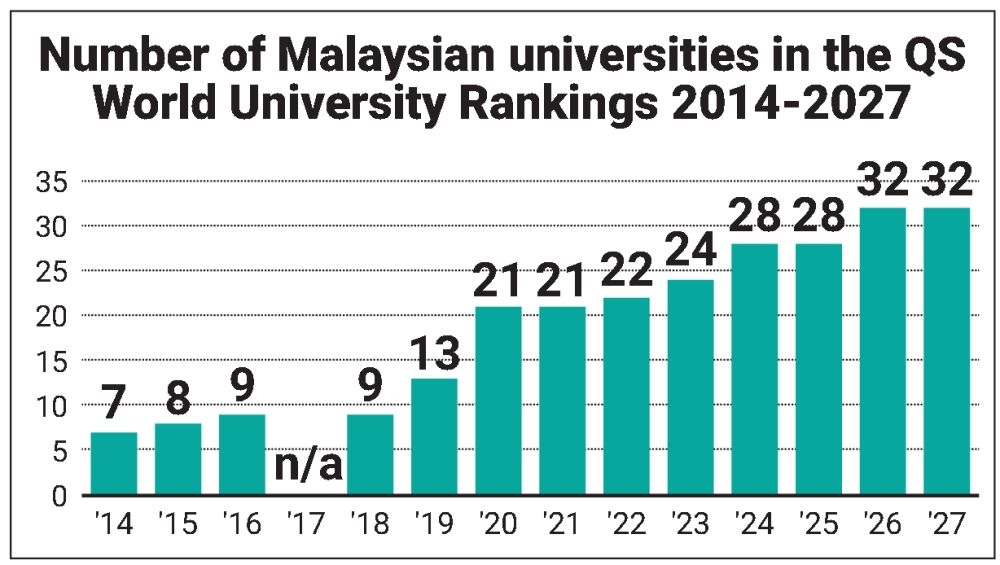
In the 2027 QS World University Rankings, 32 Malaysian institutions were ranked among more than 1,500 institutions across 106 countries and territories. Universiti Malaya (UM), Malaysia’s oldest university, also broke into the top tier, rising to 56th place globally – the highest position ever achieved by a local institution.
The latest Times Higher Education (THE) World University Rankings also showed continued progress, with 29 Malaysian universities listed among 2,297 institutions across 118 countries and territories.
The differences between the QS World University Rankings and the THE rankings, he explained, largely stem from their methodologies.
THE places greater weight on research environment and research quality, which together account for 59% of its score, while QS allocates 45% to reputation surveys and places greater emphasis on internationalisation.
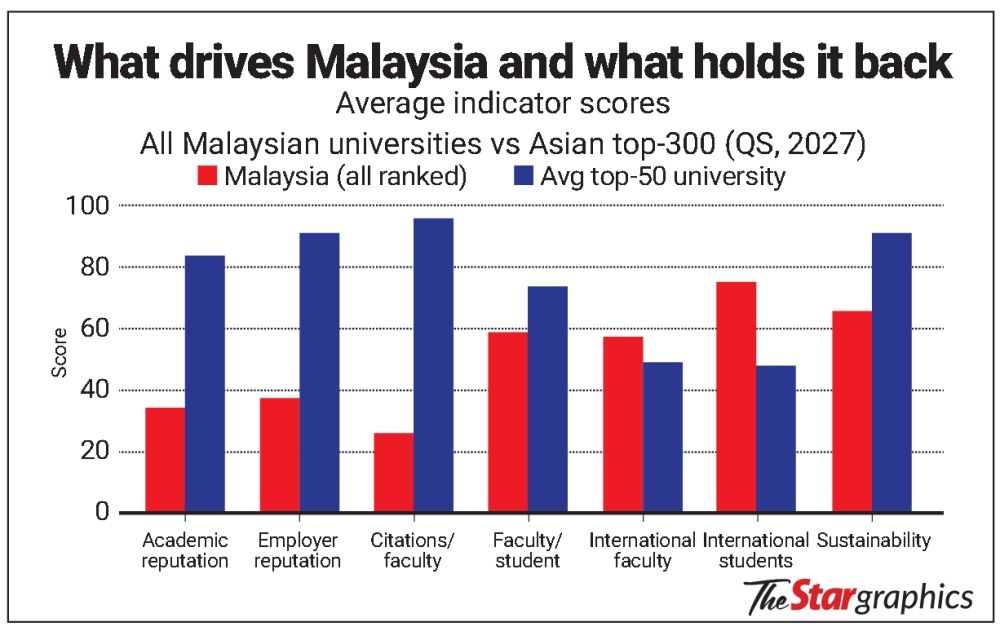
Malaysia’s comparative strengths are particularly evident in reputation, internationalisation and employability, Prof Ng said.
Staying competitive
As global rankings expand to include more participating institutions, Prof Ng said this also changes how a university’s position should be interpreted.
He noted that the global rankings landscape has evolved from one dominated by a relatively narrow group of established Western higher education systems to one featuring more Asian institutions, particularly from China, Hong Kong SAR, Singapore, South Korea, Malaysia, Saudi Arabia and India.
Pointing to the 2027 QS World University Rankings, which featured more than 1,500 institutions, he said a university maintaining a position near the top 100 as the ranking expands is defending its standing against a much larger international field.
“For Malaysia, the top of the system is still led by the established research universities, especially UM, but the middle of the table now includes a larger mix of public universities, corporate-linked universities and private universities.
“This creates a more competitive domestic hierarchy and a more complex international positioning environment,” he added.
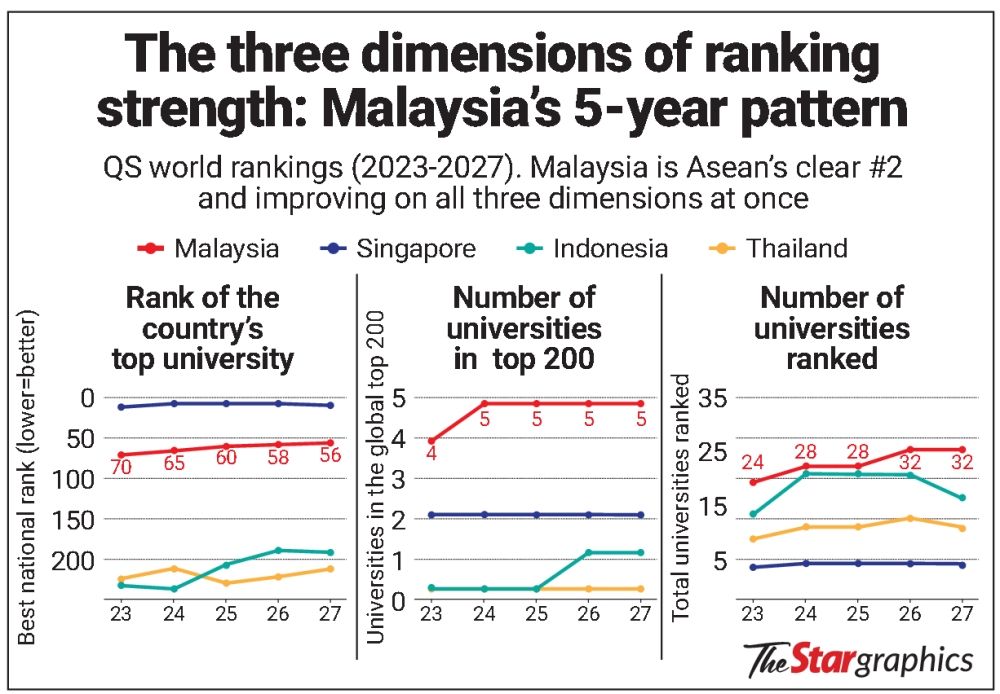
Looking deeper into Malaysia’s performance in the QS rankings (see infographic), Prof Ng identified three phases of growth.
The first, from around 2011 to 2016, was characterised by a relatively small group of ranked institutions, anchored by established public research universities.
The second phase, from around 2019 to 2023, saw the rankings broaden as more Malaysian institutions entered the list.
The third phase, from 2024 to 2027, represented a period of consolidation. Malaysia now has a wider base of ranked institutions, but the key question is how many can progress from international visibility to elite competitiveness.
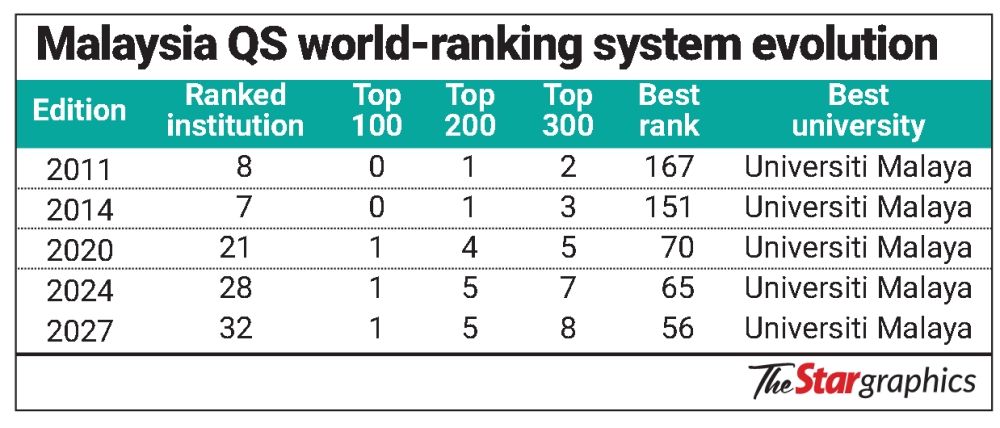
Prof Ng noted that five Malaysian universities featured in the top 200 of the 2027 QS rankings: UM, Universiti Sains Malaysia, Universiti Kebangsaan Malaysia, Universiti Putra Malaysia and Universiti Teknologi Malaysia.
“This shows that Malaysia’s ranking development is not only about the number of institutions listed. There is also meaningful movement at the upper end of the system,” he said.
The Asean context
Zooming in on Asean, Prof Ng said Malaysia should not be compared solely with Singapore, which represents a small system with an exceptionally high concentration of elite institutions.
Malaysia, he said, has a larger system with broader institutional participation and a more diversified mix of public and private institutions.
“Therefore, we cannot just ask ‘who has the highest-ranked university in Asean’ but should look into these dimensions – how high the best institutions rank, how many institutions sit within the globally visible elite or mid-elite layer and how many institutions appear in the ranking at all,” he said.
Of these dimensions, Prof Ng said Malaysia’s strength is increasingly evident in the second and third, while Singapore’s remains concentrated in the first.
“Indonesia, Thailand and Vietnam are also expanding visibility, but Malaysia currently has a particularly strong combination of breadth and top-200 representation within the region,” he said.
He pointed out that the number of Malaysian institutions in the QS rankings rose from 24 in 2023 to 32 in 2027, driven substantially by private universities entering the table.
“In short, over the past five years, Malaysia has improved on all three dimensions simultaneously. That is genuinely rare and healthy for any country.
“In a way, Malaysia’s higher education sector is improving very solidly.
“One caveat is the improvement is concentrated in the reputation or internationalisation dimensions QS rewards. On THE’s research-weighted scale, the elite-peak and top-200-density dimensions have barely moved,” said Prof Ng.
Malaysian Association of Private Colleges and Universities president Datuk Parmjit Singh said Malaysia’s performance in the rankings has been encouraging across both public and private institutions, and is not confined to one or two universities.
“We are also seeing a broader group of institutions gaining international visibility, which suggests that our higher education system is becoming more differentiated and mature,” said Parmjit, who is also Asia Pacific University of Technology & Innovation chief executive officer.
However, he cautioned against interpreting university rankings as a direct measure of the overall quality of higher education.
With QS and THE using different methodologies, a university’s rise or fall in the rankings does not necessarily mean that the overall quality of its teaching or student experience has changed to the same degree, he said.