AS industries evolve and demand for job-ready skills grows, experts say Budget 2027 should strengthen technical and vocational education and training (TVET) to prepare young Malaysians for a changing job market.
They call for earlier exposure to TVET, modernising training facilities, strengthening industry links and ensuring graduates gain skills that translate into meaningful employment.
Pertubuhan Penggerak Huffaz Berkemahiran Selangor chairman Datuk Ahmad Tajudin Jab said TVET should be made a mainstream pathway at the upper-secondary level, particularly for students who may not proceed to university, rather than being viewed mainly as a post-Sijil Pelajaran Malaysia option.
“Each secondary school grade (such as Form Four or Five) has about 450,000 students enrolled under the Education Ministry across the country
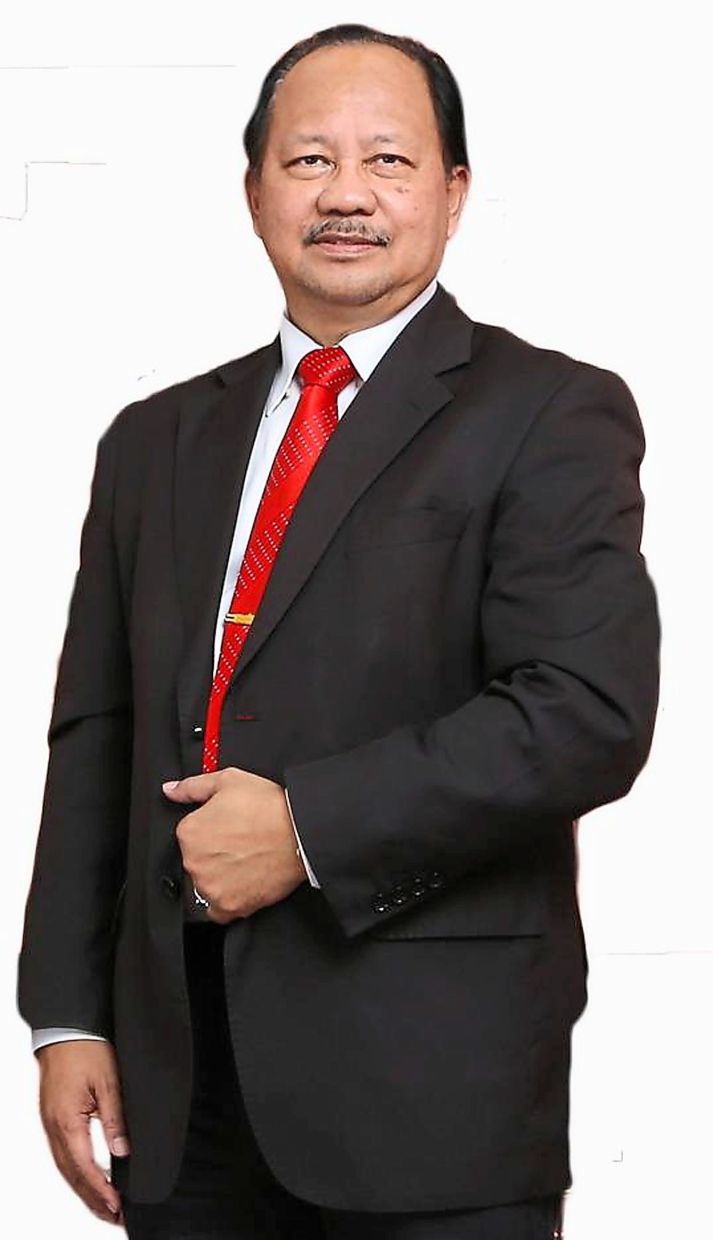
“Out of 450,000 students, higher education institutions only have enough spots to admit a maximum of 100,000 students, leaving more than 350,000 students who need to seek other pathways,” he told StarEdu.
Introducing TVET earlier, he said, would allow students to acquire technical skills while still in secondary school and potentially enter the workforce by the age of 20.
“There are only 7% of upper-secondary students who are currently enrolled in vocational colleges,” he noted.
Ahmad Tajudin said this approach is already seen in countries such as Finland, Germany, Austria and China, where vocational education is incorporated and streamlined into upper-secondary pathways.
While improving access to TVET is important, Perda Advanced Technical Institute general manager Datuk Mohd Asri Baharum @ Harun said the quality and relevance of training must also keep pace with industry.
He stressed that TVET institutions need sustained funding to modernise workshops and training facilities so that students are trained using equipment and technologies that reflect actual workplace practices.

“Without continuous investment, a gap can emerge between what students experience during training and the technologies they encounter when entering employment,” he said.
For agricultural TVET in particular, Mohd Asri said Budget 2027 should support the development of a smart agrotechnology teaching and innovation ecosystem.
“Agricultural TVET can no longer focus solely on conventional farm operations.
“The next generation of agricultural technicians and technologists will increasingly need competencies in mechanisation, sensors, automation, drones, Internet of Things, precision agriculture, controlled environments, artificial intelligence (AI) and agricultural data management,” he said.
Beyond infrastructure and equipment, he said investment in TVET educators is also needed to ensure institutions could deliver training in emerging technologies.

Mohd Asri also proposed the establishment of a TVET innovation and commercialisation fund to help turn ideas developed by lecturers and students into practical solutions.
“TVET lecturers and students frequently develop practical solutions to industry and community problems, but additional support is required to move promising projects from prototypes to field validation, intellectual-property protection, technology transfer and commercialisation,” he said.
Chiming in, Universiti Tun Hussein Onn Malaysia Faculty of Technical and Vocational Education Prof Dr Razali Hassan called for RM9bil to transform TVET from a training system into a national engine for talent development and productivity (see infographic).
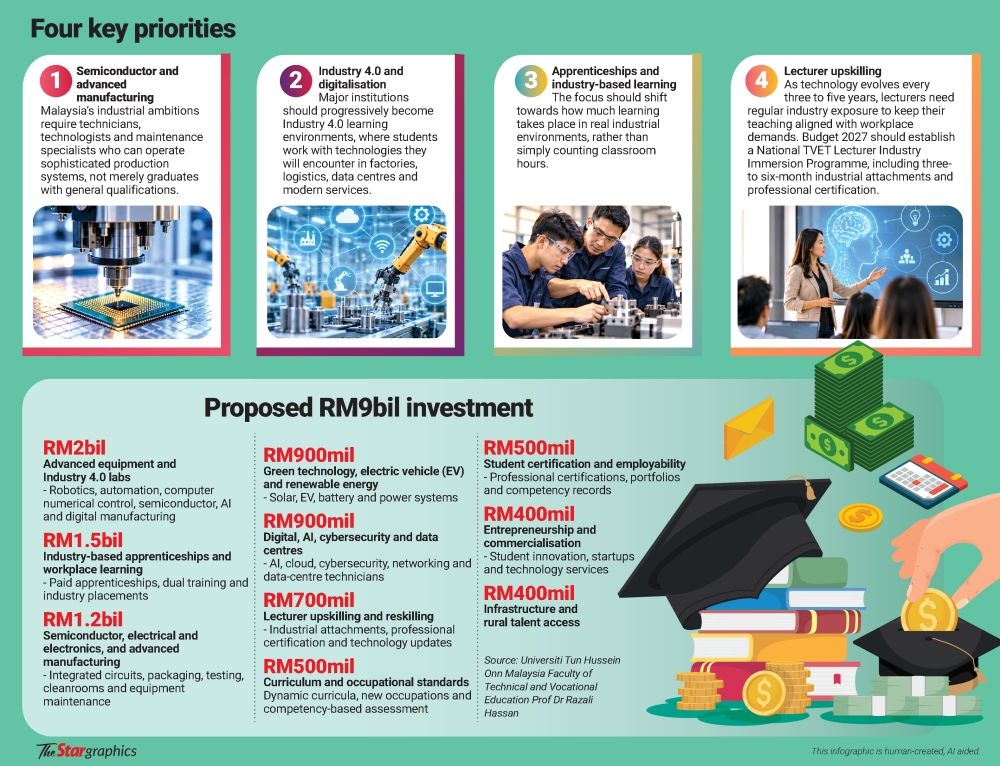
“This should be performance-linked funding, rather than simply increasing institutional operating budgets,” he said.
Echoing the need for a stronger focus on outcomes, Taylor’s University School of Accounting and Finance senior lecturer Dr Paul Anthony Maria Das said the success of TVET should not be measured simply by enrolment numbers, training places or the number of graduates produced.
“Greater attention should be given to graduate salaries, underemployment, skills matching and career progression. Highly skilled Malaysians are more likely to remain in the industry when they see meaningful opportunities for professional development, innovation and career advancement,” he said. — By SAMANTHA SO