
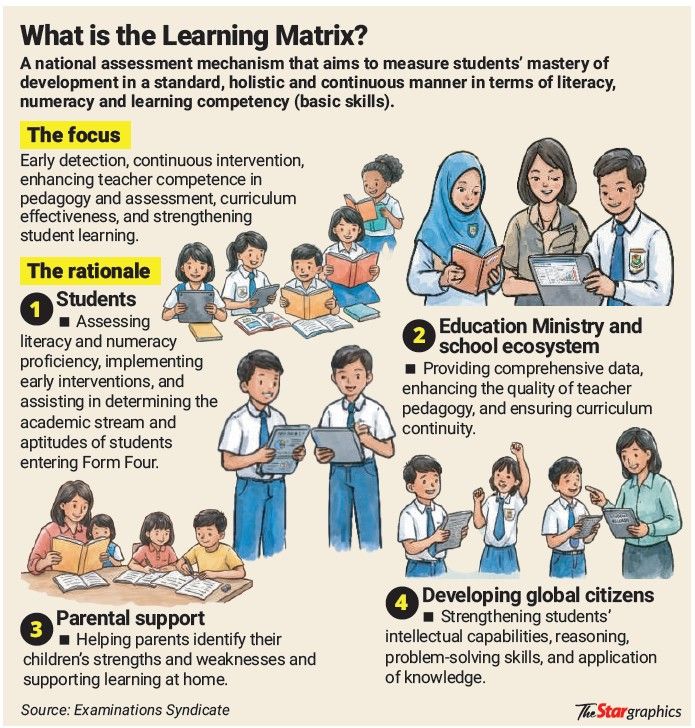
THE aim of the Year Four Learning Matrix (MPT4) is to ensure that primary-level learning issues are addressed by the end of Year Six.
This, says Director of Examinations, Examinations Syndicate (LP), Ab Aziz Mamat, would allow pupils to enter secondary education with stronger foundations.
“This Learning Matrix must be understood in its proper perspective.
“The assessment is not intended to determine pupils’ academic future, but to ensure learning gaps are identified early enough for action to be taken.
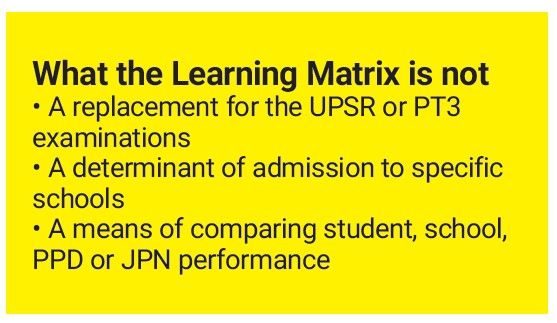
“The MPT4, to be conducted this October, and the Form Three Learning Matrix (MPTg3), to be introduced next year, are neither new assessments nor replacements for the Ujian Pencapaian Sekolah Rendah (UPSR) and Pentaksiran Tingkatan Tiga (PT3),” he stressed.
During the launch of the National Education Plan 2026-2035 on Jan 20, Prime Minister Datuk Seri Anwar Ibrahim said the Learning Matrix would be introduced.
Year Four pupils will sit for the MPT4 in October, covering six subjects: Bahasa Melayu (BM), Bahasa Inggeris, Sains, Matematik, Bahasa Cina (SJKC) and Bahasa Tamil (SJKT). For Form Three students taking the MPTg3 next year, History will also be assessed, while Bahasa Cina and Bahasa Tamil are optional subjects (see infographic).
Education Minister Datuk Seri Fadhlina Sidek also said the assessments would be administered by the LP instead of schools to instil public confidence.
Elaborating on the Education Ministry’s intention behind the MPT4, Ab Aziz said schools would have more time to identify and address learning gaps before pupils move on to secondary education.
“The MPT4 would help teachers pinpoint where pupils are struggling and tailor interventions to address those weaknesses during Years Five and Six,” he told StarEdu.

“Through this approach, teachers, schools and parents gain information that helps pupils strengthen their learning and ensures they are better prepared to advance to the next level of education,” he said.
This, he noted, would allow the formal curriculum to continue while pupils receive additional support based on their identified learning needs.
Complementing UASA
Ab Aziz stressed that pupils would not need special preparation for the MPT4.
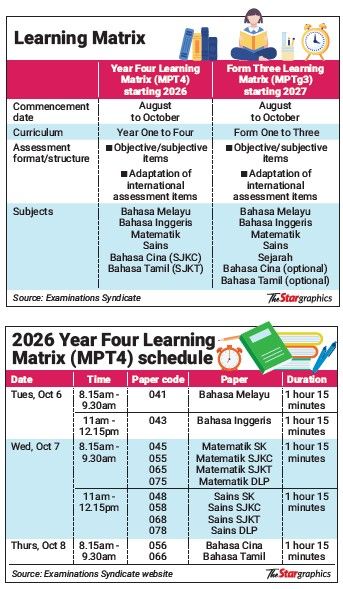
He said the assessment is based on learning pupils have already gone through from Year One to Four, and does not introduce material outside the scope of classroom teaching and learning.
“Pupils sitting for this assessment should understand that they are not facing a novel or unfamiliar form of assessment.
“The process is similar to the annual Academic Session Final Test (UASA) pupils are already familiar with, although the MPT4 uses nationally standardised instruments developed by the LP rather than assessments prepared independently by individual schools,” he said.
Clarifying further, he said the MPT4 is not a replacement for the UASA, as both assessments serve different purposes while complementing each other in evaluating pupils’ mastery levels and learning progress.
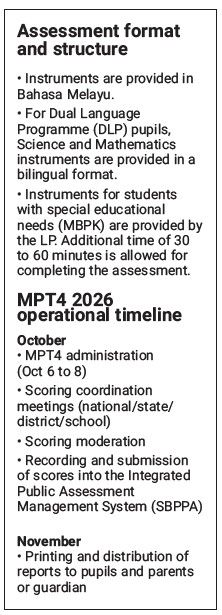
“Meanwhile, the UASA is part of the classroom-based assessment (PBD) conducted at the end of the academic session to evaluate pupils’ achievement levels based on the curriculum they have studied,” he said, adding that Year Four pupils would sit for both assessments.
He, however, pointed out that subjects assessed in the MPT4, namely BM, Bahasa Inggeris, Sains, Matematik, as well as Bahasa Cina or Bahasa Tamil for pupils in national-type schools (SJK), will not be assessed in the UASA.
The MPT4, he emphasised, is not a high-stakes assessment and is not intended to encourage examination-oriented learning or add to teachers’ workload.
“Teachers will receive management guidelines, explanatory materials, operational and quality-assurance briefings, professional training and sample assessment items, while the LP, State Education Departments (JPNs) and District Education Offices (PPDs) will provide ongoing guidance, monitoring and technical support,” he said.
He added that the assessment results would give teachers a more detailed picture of pupils’ performance by domain, rather than simply providing an overall score.
This, he said, would allow teachers to plan more targeted interventions among different groups of pupils.
“For instance, one group of pupils might struggle with one domain while another group might need support in a different domain, depending on the subject assessed.
“Schools could then prioritise specific groups of pupils and focus on developing their potential in the domains identified through the MPT4 results,” he said.
“Formal PdP already has its own curriculum, but remedial, enrichment and other intervention programmes suited to pupils’ weaknesses can be implemented by schools when pupils are in Year Five and Year Six,” he said.
Global readiness
According to Ab Aziz, the MPT4 was designed with future international assessments in mind.
“Pupils at the primary level would encounter the South-East Asia Primary Learning Metrics (SEA-PLM) before moving on to international assessments such as the Trends in International Mathematics and Science Study (TIMSS) and the Programme for International Student Assessment (PISA),” he said.
Conducted every five years, SEA-PLM assesses Year Five pupils in four domains: reading literacy, mathematics, writing and global citizenship.
TIMSS, which is conducted every four years, compares the performance of Form Two students in science and mathematics across participating countries.
PISA, which assesses reading, mathematics and science, is administered by the Organisation for Economic Co-operation and Development (OECD) every three years to 15-year-olds in both OECD and non-OECD countries.
“For SEA-PLM, the methods and questioning approaches had been adapted to international standards, while teachers and officers involved in developing assessment items had received training to develop items similar to those used in PISA,” Ab Aziz said.
This, he added, means that Year Four pupils would gain earlier exposure, particularly in Mathematics and Science, to questioning approaches that they would encounter later in the SEA-PLM, TIMSS and PISA.
“The aim is to familiarise them with these forms of assessment,” he said.