
WITH the world becoming increasingly complex, students need strong values to guide them through university and into the workforce, say experts.
Values-based education (VBE), therefore, must be given greater emphasis at university, they stress, with its success ultimately depending on whether institutions can move it beyond classroom theory.
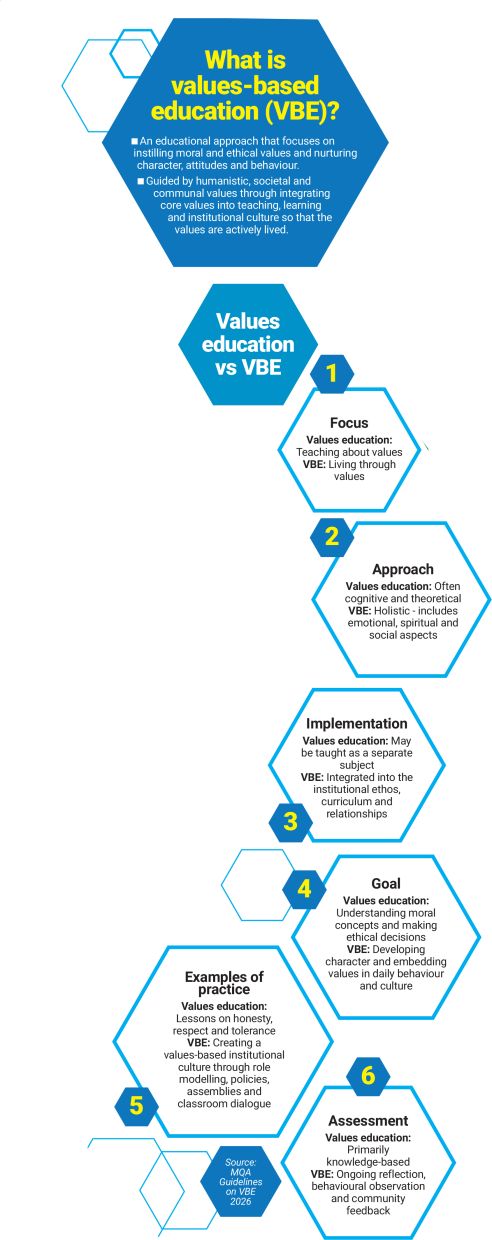
Their views come as the Malaysian Qualifications Agency (MQA) strengthens requirements for higher education institutions to incorporate VBE into their programmes under the second edition of the Malaysian Qualifications Framework, which took effect on Aug 1.
The move aims to help students develop strong values, work towards a more united society, and make positive contributions to the country and its future.
Agreeing with the MQA’s emphasis on values, Sunway University School of Education dean Prof Malissa Maria Mahmud said VBE is particularly important because the world has moved from information scarcity to information abundance.
“Access to information is therefore no longer sufficient. Students must be able to judge whether information is reliable, whether a decision is fair, who may be affected and who remains accountable,” she told StarEdu.
She stressed that academic capability without ethical judgement leaves graduates only partially prepared for professional responsibility.
“In education, for example, a teacher may possess strong subject knowledge but still cause harm if fairness, empathy and respect are absent from their practice,” she said.
These risks, she noted, are becoming more significant as technology allows decisions to be implemented and scaled rapidly.
“This makes it increasingly important for universities to give students opportunities to exercise ethical judgement before they enter workplaces where such decisions can have real consequences,” she said.
Prof Malissa Maria added that workplaces have also become more digitally connected, culturally diverse and multidisciplinary.
“Graduates are increasingly expected to work across professional and cultural boundaries. Integrity, empathy, accountability and respect are therefore essential to building trust, handling disagreement and making responsible decisions,” she said.
Weighing in, Taylor’s University Centre for Counselling Services and Student Welfare head Ng Shan Na said university represents an important transition between adolescence and working life.
“Many students are experiencing greater independence for the first time while still developing their beliefs, relationships, career aspirations and sense of identity,” she said.
This transition, she added, means students are not only acquiring knowledge, but also learning to exercise judgement and take responsibility for their decisions.
Learning by doing
The challenge, however, is that such qualities cannot be developed through lectures alone.
Prof Malissa Maria said values should be embedded across programme learning outcomes, teaching activities, assessments, co-curricular experiences and institutional practices.
“Students should encounter authentic situations involving competing interests, uncertainty and situations where there is no immediately perfect answer,” she said, citing examples like ethical dilemmas, simulations, service-learning, community projects, industry placements and collaborative assignments.
“Students can be asked to justify decisions, consider different perspectives, take responsibility for their contribution and reflect on the consequences of their actions,” she added.
Ng agreed that values become meaningful when students have opportunities to practise them.
At Taylor’s University, for example, she said the Impact Labs provide opportunities for students and staff from different disciplines to apply their knowledge and contribute to communities.
The university’s counselling services centre also trains peer counselling buddies through a structured process of selection, training and supervision.
“By supporting peers who need a listening ear, students learn that empathy and kindness are not merely abstract concepts, but values expressed through attentive and responsible action,” she said.
With appropriate guidance from lecturers, counsellors, advisers and senior students, such experiences can become valuable opportunities for reflection, learning and personal growth, she added.
Observable action
Universities must also consider whether such experiences translate into students’ everyday behaviour, the experts say.
Beyond examination results, Ng said universities should consider how students behave in classrooms, group projects, co-curricular activities and the wider campus community.
“Academic integrity is one important indicator. Students demonstrate honesty and accountability when they submit original work, acknowledge their sources and take responsibility for their learning.
“Everyday behaviours such as meeting deadlines, attending classes consistently and fulfilling commitments to others can also provide indications of self-discipline and respect,” she said.
Values, she added, can also be seen in how students respond when someone is struggling.
“Showing kindness, listening without judgement and helping a peer connect with appropriate support are meaningful expressions of empathy,” she said.
However, assessing values does not mean attempting to determine what students personally believe.
Prof Malissa Maria said assessment should instead focus on observable behaviour and the quality of students’ ethical reasoning.
Transparent rubrics, reflective portfolios, peer evaluation and feedback from community or industry partners, she added, can provide meaningful evidence of how students demonstrate accountability, empathy, fairness and respect.
Leading by example
Students’ behaviour does not develop in isolation. The people and systems around them also shape how values are practised.
Prof Malissa Maria said lecturers play a central role because students learn values not only from what educators teach, but also from how they exercise responsibility and authority.
“Students notice whose voice is heard, how disagreement is managed, whether expectations are applied consistently, whether feedback is fair and timely, and whether a lecturer is willing to acknowledge an error,” she said.
Modelling values, she added, does not require lecturers to present themselves as morally perfect.
Rather, it requires consistency, transparency and a willingness to be accountable.
“Lecturers should also create spaces where students can examine difficult questions, disagree respectfully and consider the human consequences of professional decisions,” she said, adding that their role is to facilitate ethical reasoning rather than impose personal views.
However, she cautioned that lecturers cannot carry VBE alone.
“They require appropriate professional development, clear institutional expectations and access to academic, counselling and student support services.
“University leaders and administrators must also demonstrate the values expected of lecturers and students,” she said.
Where lessons meet real life
A university degree only covers what happens inside the lecture hall. True values are shaped by the hands-on experiences we actively choose to pursue, such as volunteering for university programmes.
During my time at university, I volunteered as a media liaison officer to guide incoming first-year juniors. The role was a massive test of character as I had to juggle multiple tasks simultaneously and manage intense schedules while barely getting enough sleep.
Despite the exhaustion, seeing the event succeed and watching new students feel welcomed made every sleepless hour worth it. This experience taught me far more than any textbook could. It drilled real-world accountability, empathy and resilience into me.
If universities want to develop stronger values in students, they must look beyond traditional lectures. They should actively provide and promote impactful experiential learning opportunities, student-led mentorship programmes and community volunteering roles. These real-world pressures are what truly transform students into empathetic, accountable individuals.
Fiona Flonika Joshman, 23
As a communication major and psychology minor, I believe good values can only truly be cultivated when a person chooses to embrace and internalise them. Being taught about respect or empathy does not necessarily mean someone will immediately practise them.
University has taught me that people can have different values, and that is okay. Everyone comes from different experiences and perspectives, and these differences should be recognised rather than judged.
Universities can play an important role by exposing students to people from different walks of life. These interactions can help students develop empathy and other soft skills.

Hermione Ooi Yung, 22
During my first year, I struggled to find a role that would allow me to realise my potential. I continued to persevere and eventually took on several appointments.
These experiences taught me resilience and encouraged me to advocate for marginalised communities.
Universities should provide more opportunities for students to learn through experience. Orientation programmes, for instance, can encourage juniors and seniors to work together, build relationships and contribute to their college community.
Universities should also strengthen initiatives such as start-up labs to nurture an entrepreneurship mindset, while promoting cross-campus collaborations with private and public sectors. These partnerships could give students greater access to high-quality leadership programmes.

Aaron Lim Hong Rong, 21