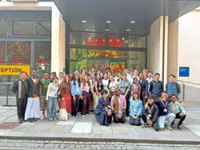
EVERYONE goes to the English Speaking Union-International Public Speaking Competition (ESU-IPSC) with one thing in mind: to win. I was no different.
It was an honour to represent Malaysia at the competition in London, the United Kingdom, recently.

It was during the competition that I realised winning would not matter as much. I have studied in the UK for the last two years, but for many of the participants, this was their first time in London – and you could see it in the way they looked at everything.
We watched Witness for the Prosecution in a grand old hall. We spread out across the parks with our picnics, green stretching in every direction under a generous summer sun. And we rode on the top deck of a big red bus, with the whole city streaming past – every bridge and spire new to people who had only ever seen them in pictures.
Many participants came from countries I have never visited, spoke languages I could not place, and brought food I had never tasted – dishes passed around the table, with names I asked them to repeat twice.
It was a cultural exchange like no other, and the one thing bringing us together was a love of public speaking.
I made many friends – notably a finalist from Uganda, with whom I could talk for hours about poetry and art, the way you only can with someone who loves the same things you do.
Some of these kids are only 16 or 17, and the brilliance and maturity they carry are nothing short of breathtaking – the kind that makes you forget their age entirely.
Many people cried when they didn’t make the finals, deeply disappointed. I did too. We all had the same goal in mind: to win.
But as much as I love public speaking – I fought and fought at the national competition to finally win in my final year – that is not the mentality we should be teaching people who are just starting out.
Competitions are great for motivating people to join; they are an incentive and a platform for the art of oracy. But they are never a comprehensive or conclusive measure of someone’s intellect, skill or ability.
Oracy is deeply subjective; one person’s speech can be interpreted in a thousand ways.
I want to tell all the participants, and everyone who will join ESU in the future: the skills you refine through practice will outlast any competition.
A shiny medal is nice, but it will sit in a drawer. What stays is you – the version of you brave enough to stand up and speak, to do the one thing most people spend their whole lives avoiding.
I did well. I gave a speech on Strategic Lawsuits Against Public Participation, the kind of case designed to intimidate people into silence – and it seemed to land: a group of Hong Kong lawyers came up afterwards to congratulate me, and delegates from Korea, China and elsewhere stayed in touch.
That is why I say public speaking should be about more than a title: don’t pressure people to win, but dare them to dig into their creativity, test the rules and push at the limits of what an audience expects. And most of all, trust yourself – because at the end of it, you are the one speaking.
JENNY OOI JIE YUEE
Note: The writer is the champion of the ESU-Taylor’s Public Speaking Competition held on June 27, having clinched the title after four attempts over four years. The law student at Bristol University in the UK then joined champions from over 40 countries at the ESU-IPSC, held from July 13 to 18. The annual competition marks its 46th edition this year, bringing together young speakers aged 16 to 20 for oracy, cultural exchange and friendly rivalry. Since its inception in 1980, the IPSC has engaged over 115,000 young people worldwide.