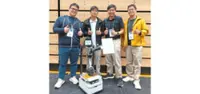
Demonstrating the potential of embodied artificial intelligence (AI) in service robotics, a team of Universiti Tunku Abdul Rahman (UTAR) students made the country proud by winning the “Main Task Challenge” at the RoboCup Japan Open@Home League Bridge Competition.
Organised by the RoboCup Japan Regional Committee, the competition was held from April 24 to 27 at Shiga Daihatsu Arena, Otsu, Japan.
Representing UTAR were Doctor of Philosophy (Engineering) candidate Sim Sheng Wei, Bachelor of Electrical and Electronic Engineering (Hons) student Lim Zi Quan and Bachelor of Mechatronics Engineering (Hons) student Kevin Chew Ken Yi, from the Lee Kong Chian Faculty of Engineering and Science (LKC FES).
The team was supervised by LKC FES academics Dr Danny Ng Wee Kiat and Xinwei Institute deputy director Assoc Prof Dr Goh Choon Hian.
Their winning project, titled “Autonomous Embodied AI Service Robot”, was developed to perform practical assistance tasks in home-like environments.
The robot integrates vision-language understanding, language-based reasoning, speech interaction, perception, navigation and robot control, enabling it to interpret human instructions and act autonomously in real-world scenarios.
The RoboCup@Home League focuses on autonomous service robots designed for domestic and daily-life assistance. Its tasks assess human-robot interaction, perception, navigation, practical behaviour and decision-making in realistic environments.
For the UTAR team, the competition offered a valuable platform to test whether their research could perform beyond the laboratory.
“We joined the challenge because it aligns closely with our interest and research direction in service robotics, embodied AI agents, and real-world AI applications,” the team shared.
They said the competition allowed them to validate their research ideas in a structured but realistic setting, while integrating vision-language models, large language models, robotic perception, navigation and task planning into a complete robot platform.
During the competition, the robot was put through a myriad of tasks including assisting a user with luggage-related movement, which required safe navigation, user awareness and real-time interaction; and welcoming guests, communicating with them, remembering details such as names and preferred drinks, introducing them to the host and guiding them to available seats.
These tasks, which required more than individual technical functions, tested the robot’s ability to combine perception, communication, reasoning and physical movement into a coherent, autonomous response.
Reflecting on the win, the team said the recognition was especially meaningful because it acknowledged the integration behind the robot platform.
“The win is really encouraging. It gave us confidence that the system we developed is moving in the right direction,” they said, adding that one of the most rewarding moments was seeing the robot understand a request, decide on the necessary actions and complete the task in a real competition environment.
Crediting UTAR for providing the academic foundation and institutional support that contributed to their success, the team said their studies helped them build technical knowledge in AI, robotics, programming and system integration, while the varsity’s financial support made their participation possible.