
WHILE some children are happily answering questions and naming shapes in a preschool class, others are noticeably distracted, refusing to sit still or take part even when coaxed by teachers.
Conversations with their parents reveal that these distracted children spend a large amount of time on mobile phones, watching videos or “doomscrolling” reels – often unsupervised.

And it is worrying.
“Other preschool teachers and I are seeing six-year-olds who cannot hold a pencil or concentrate for even a short while in class,” she told StarEdu.
Among the issues linked to excessive digital use, she noted, are short attention spans, antisocial behaviour, and resistance when teachers try to teach them to write properly.
“While it is normal for children not to have a long attention span, they should be able to concentrate for a short while at that age,” said Fonny Dameaty, who specialises in the psychological development of young children and regularly visits preschools for research.
What she is seeing in local preschool classrooms is also happening globally.
Several studies have linked heavy digital use to weaker memory retention and lower comprehension, especially among students who struggle to focus.
According to “How’s Life for Children in the Digital Age?”, a report by the Organisation for Economic Co-operation and Development (OECD) published in May 2025, available evidence suggests that excessive and passive screen exposure can alter children’s neurocognitive development, including leading to speech delays.
This aligns with international indicators, including findings from the OECD’s Programme for International Student Assessment, which measures student performance in reading, mathematics and science.
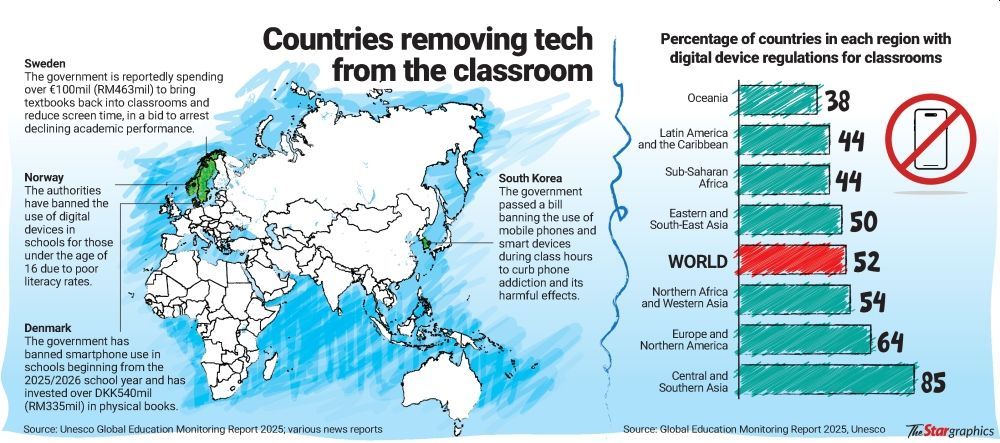
At the same time, some countries are taking steps to counter this issue (see infographic).
Unesco’s Global Education Monitoring Report, published in March this year, points out that 114 education systems, including Malaysia, now have national bans on mobile phones in schools, representing 58% of countries worldwide.
One reason for eliminating phone use in schools is to improve concentration and strengthen social skills among children and young people.
The 2025 edition of the same report noted that over half of the countries worldwide have bans on digital device use in the classroom.
Too much too soon
Fonny Dameaty, who also conducts counselling sessions with families of slow learners, said early access to digital devices is a contributing factor to their difficulties.
“From what I have observed, giving children mobile phones or tablets too early in life is a reason many become slow learners,” she said.
She added that children who spend too much time on devices often experience speech delays.
“When they are just watching things on a tablet, they are passive and not thinking as much.
“Compare this with doing an activity such as planting a tree. This engages not just children’s bodies but their minds as well, because there are many steps involved,” she explained.
Children aged six and below, she added, especially benefit from not using digital devices.
“This is the time for them to explore – when their neurons are connecting all over their brains,” she said.
Writing and drawing, said Fonny Dameaty, are “kind of like exercise for the brain”.
“The feel of a pencil in a child’s hand and the pressure they apply to the paper help them learn to write or draw faster. There is feedback their brain gets from holding and using the pencil that they cannot get when swiping on a screen,” she said.
“Learning to write requires vocabulary, organisation and memory. Writing by hand engages the brain more deeply than typing or using a computer.
“As for mental mathematics, it boosts working memory and number sense,” he said, adding that possessing these basic skills frees up a person’s “working memory” and allows them to focus on “tricky” tasks such as problem-solving.
Saeid, who is also the Master of Child Psychology programme head at the university, added that overusing technology can affect students’ thinking, writing, planning and problem-solving, although it does speed up work and access to information.
“Research has shown that these skills are important and necessary for brain development,” he said.
He added that too much digital device use can have effects beyond academics.
“Studies suggest that frequent digital media users have shorter attention spans and struggle with long-term employment,” he said.
Between pen and screen
As someone who grew up with digital devices, I prefer doing my homework and exams by typing if given an option. However, I occasionally use pen and paper when I’m trying to memorise facts by drawing mind maps for theoretical subjects like Biology and History. It also works well when I write down complex mathematical calculations, since I can’t type them out.
Jeanne Sylvester, 18
Though typing is more efficient and organised, I prefer to handwrite. Whenever I use devices to type my essays, I often find myself stuck and struggling to find the right wording. However, when it comes to solving complex Additional Mathematics problems, I sometimes find myself using the calculator more than I should, even for simple division questions.
Leticia Liew En Qi, 16
When it comes to mathematics, I realise I reach for a calculator very quickly. It has become almost automatic. It is not always about difficulty, but about reassurance. I feel the need to confirm the answer before I fully trust my own reasoning. Over time, this habit makes me second-guess even simple steps.
Doing sums in my head feels different. It forces me to stay with the problem, even when the answer is not immediate. That discomfort builds a kind of internal certainty, not that I will always be correct, but that I can work through something without needing instant validation.
Isabel Lim, 15
For shorter tasks, such as taking notes or rough work, I prefer to scribble on paper. It just feels faster and more natural, as if my thoughts can flow more freely. As for calculations, I have to admit that I tend to rely on calculators. I am aware of the importance of mental mathematics in developing number sense, but it is very tempting to choose efficiency over effort. During exams, I prefer to use a calculator because it is less risky and helps to avoid careless mistakes.
Lim Xin Ying, 17
Typing is fast, easy and efficient, but that ease can make thinking feel disposable. Features like autocorrect make it easy to stop paying attention to spelling. In fact, I still see a number of my peers unable to independently spell simple words in English assignments after being accustomed to online learning during the Covid-19 pandemic.
Janani Jsudass, 16