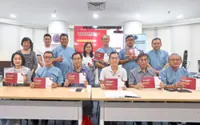
KUALA LUMPUR: Marking schemes, grade boundaries and detailed performance analysis for SPM subjects should be made public to restore confidence in the Chinese Language paper, says Persatuan Kemajuan Bahasa Cina Malaysia chairman Lee Kim Chuan.
He said the lack of transparency in grading has fuelled doubts over fairness, particularly as Chinese has long been regarded as the toughest major language paper to secure a distinction in, and is now the only language subject showing a clear decline in performance.
Lee was speaking at a press conference yesterday, where the association released its “SPM Chinese Language Nine-Year Performance Trends (2017-2025)” report.
The study shows the distinction rate (A+, A and A-) for Chinese rose from 17.9% in 2017 to 23.4% in 2021, before fluctuating between 21.5% and 23.2% in subsequent years. It then fell sharply to 15.1% in 2025, the lowest level in the nine-year period.
According to the report, 11,130 candidates obtained distinctions in 2024, compared with about 6,950 in 2025 – a drop of 4,180 top scorers in a single sitting.
“For a large-scale public examination, such a sharp swing is highly unusual and should be treated as a serious anomaly,” Lee said.
The report also shows Chinese lagging far behind other SPM language papers last year. Bahasa Melayu recorded a 32.9% distinction rate, English 30.9%, Arabic 36.7% and Tamil 34.7%, compared with Chinese at 15.1% – less than half of most peers.
While Bahasa Melayu has generally stayed within the 30%-36% range and Tamil around 30%-35%, English has nearly doubled its distinction rate from 16.5% in 2017 to 30.9% in 2025.
He said the consistently lower results point to a broader imbalance, raising questions over grading standards and systemic practices.
The report also highlights a steady decline in candidates taking Chinese for SPM, from 60,521 in 2017 to 46,046 in 2025.
Lee said concerns over difficulty and grading have discouraged students from taking the subject, as many fear it could drag down overall results and affect entry into pre-university programmes.
With university admissions heavily dependent on cumulative scores and straight-A profiles, a lower grade in Chinese is often seen as a disadvantage, the association said.
Feedback from teachers and students, it added, suggests a disconnect between the exam paper and classroom learning, affecting both confidence and performance.
The association is urging authorities to make the paper more relevant to Malaysian students by incorporating local Chinese literary works and real-life contexts, while ensuring a balance between rigour and accessibility.
The association warned that treating Chinese as a high-barrier subject could have long-term consequences, including weaker enrolment in Chinese studies at higher levels, a shrinking pool of teachers, and a widening talent gap that may erode Malaysia’s multilingual strengths.
Committee member Chia Sang Sang stressed that the association’s goal is not to criticise students or the examinations system, but to address growing concerns and improve outcomes for the subject.
She said the aim is to find practical solutions to strengthen SPM Chinese so students are not discouraged from taking the paper, and to ensure the broader Chinese education ecosystem remains healthy.