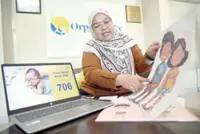
CURRENT sexual and reproductive health education (SRHE) efforts need to be revisited to make them more practical, urges Universiti Kebangsaan Malaysia Specialist Centre consultant obstetrician and gynaecologist Assoc Prof Dr Anizah Ali.
“It needs to be delivered in a tone that makes young people more aware of what happens when they engage in sex, especially unprotected sex, including the implications it may have for their families and their future.
“Putting it in that context, and perhaps coupled with real-life peer stories, may help them understand better,” she said.
At the same time, she added, there needs to be equal emphasis on SRHE for boys.
“They need to be aware of, and held accountable for, the role they play in pregnancy,” she said.
More importantly, Dr Anizah stressed, teenage mothers must have continued access to education after giving birth and confinement.
“This ensures they are able to obtain a good educational qualification, have a purpose, and do not fall through the system,” she added.
Government initiatives
According to the Women, Family and Community Development Ministry, government measures to curb teenage pregnancy include the Reproductive and Social Health Education Policy and Action Plan (Pekerti) framework, which targets high-risk communities, rehabilitation centres and higher learning institutions.
The ministry said the comprehensive policy framework, approved by the Cabinet in 2009 and recently updated for 2022-2025, was designed to provide a “lifelong learning” approach to SRHE.
“The government addresses teenage pregnancy through the implementation of SRHE or the Pekerti policies and educational programmes coordinated by the National Population and Family Development Board (LPPKN), with an emphasis on prevention, accurate information and child protection,” the ministry said in an email response to StarEdu.
It added that under the Pekerti framework, LPPKN delivers age-appropriate, culturally sensitive and values-based education that provides adolescents with accurate information on physical development, reproductive health, personal safety, consent, and responsible decision-making, emphasising that the programme is tailored to the adolescents’ developmental stage.
To date, more than 300,000 participants, including parents, teachers, volunteers and adolescents, have participated in the programme since its inception in 2011.
In addition to Pekerti, the ministry stressed the development of skills to avoid risky behaviours and to maintain abstinence.
“For teenagers at risk, education on contraceptive methods should be provided to prevent unplanned pregnancies, thus reducing the incidence of baby dumping,” it added.
LPPKN also implements family life education and parenting programmes to strengthen parent-child communication, enabling parents to guide adolescents effectively on SRH matters.
“Apart from that, SRH-related videos are available on its social media platforms, and physical copies of informational pamphlets on parent-child communication are disseminated to the public and at hospitals, clinics, schools and community-based rehabilitation centres,” the ministry said.
At the school level, there is the Reproductive and Social Health Education (PEERS) module, which is set to see its teaching time increased when the new school curriculum begins next year, Education Minister Fadhlina Sidek said last June.
She said the ministry’s module will also be expanded to raise awareness of reproductive health among students, teachers and parents.