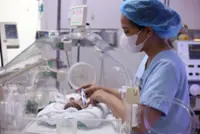
IN an unassuming apartment unit, a 16-year-old girl changes yet another diaper for her newborn.
Her schoolwork remains untouched as she sits rocking her child back to sleep for the umpteenth time since they came home from the hospital two months ago.
This girl, who should be focusing on her studies at this young age, is one of many teenage mothers in the country.
Her case reveals a complex reality where shifting societal values have reduced the traditional “shame” of unwed pregnancy, yet there is still a lack of adequate protective knowledge, says Taylor’s University Master of Clinical Psychology programme director Dr Lim Hooi Shan.

“Sexual and reproductive health education (SRHE) in Malaysia remains a taboo topic due to conservative thinking and the belief that teaching it encourages premarital sex.
“When it is not delivered through official platforms, it appears under the ‘hidden curriculum’, where discussions occur in informal settings such as bathrooms, online chat groups and school corridors,” she told StarEdu.
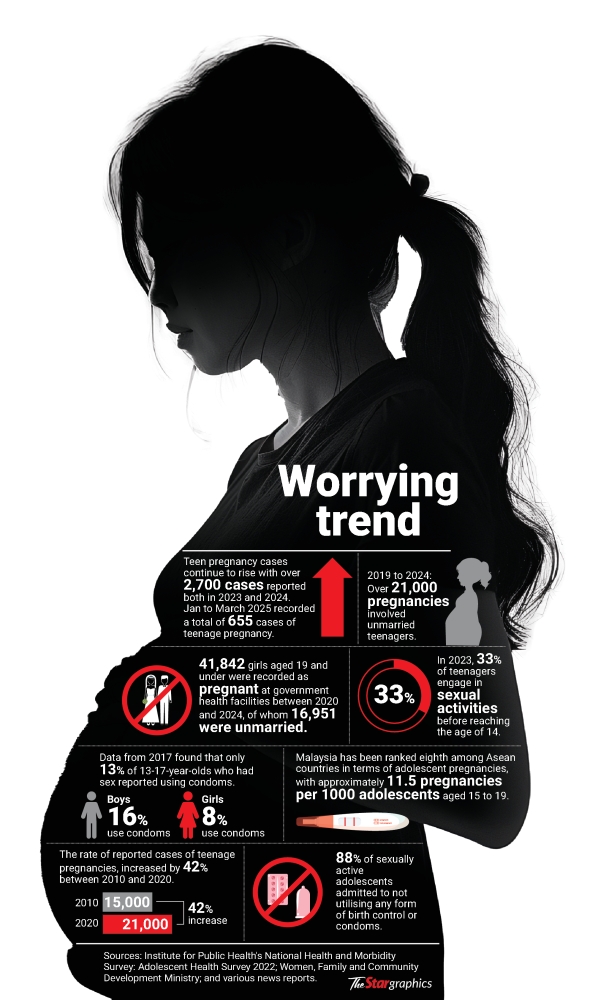
Women, Family and Community Development Minister Datuk Seri Nancy Shukri said in a parliamentary written reply on Feb 11 that over 21,000 pregnancies involving unmarried teenagers were recorded at government health facilities between 2019 and 2024.
Last November, she said that 41,842 girls aged 19 and under were recorded as pregnant at government health facilities between 2020 and 2024, of whom 16,951 were unmarried.
Lim, who is also a senior lecturer at the Taylor’s University School of Liberal Arts and Sciences, Faculty of Social Sciences and Leisure Management, added that the currently favoured “abstinence only” SRHE has been shown to be ineffective.
“It creates a knowledge vacuum that ignores social realities, framing sex solely as a moral failure rather than a health decision,” she said, adding that this pushes teenagers to turn to unreliable or inappropriate sources for information.
She also said the consequences faced by a pregnant teenager are “developmentally and emotionally significant”.
They face “parentification”, where a child is forced into a parental role before fully developing emotionally and psychologically, often leading to loss of identity, confusion, regret and depression.
Academically, she added, many discontinue schooling due to intense social exclusion.
“While policies may technically allow pregnant students to remain, social pressure often leads them to drop out or seek specialised environments such as Sekolah Harapan or non-governmental organisations,” she said.
She also noted medical risks, as their bodies may not be fully developed to handle pregnancy safely.
“They may also face long-term economic struggles, as their adolescent stage is replaced by a role they were never prepared to fill. Career opportunities may be limited as their focus shifts from personal development to early parenthood,” she said.
Health risks
Among the medical complications a pregnant teenager may face are sexually transmitted diseases, anaemia, the risk of delivering smaller babies and preterm labour, said Universiti Kebangsaan Malaysia Specialist Centre consultant obstetrician and gynaecologist Assoc Prof Dr Anizah Ali.
“Being teenagers, they are at risk of certain medical complications compared with older pregnant women.

“Their pregnancy could have been the result of high-risk behaviour or illicit drug use, and it is important for us to establish if there are any infections or other issues,” she said.
Dr Anizah shared that she sees about one or two such cases per year in the private wing of a university hospital, where patients seeking confidentiality and who have the financial means tend to go.
“This is not many compared with what I see in the public setting,” she said, adding that most pregnant teenagers go to public health facilities, where treatment and follow-ups are cheaper, if not free.
Dr Anizah, who subspecialises in paediatric and adolescent gynaecology, said it is part of medical practitioners’ role to “bridge the gap” between the family and the teenager when the latter becomes pregnant and seeks help.
“Most parents will be angry and shocked at first. When that subsides, they may become fearful and ashamed of what society will think, and worried about their daughter’s future.
“Some families take time to accept the situation, with many either blaming or scolding the girl for what happened,” she added.
Dr Anizah said this can be problematic for the girl, as she may lose access to medical help if her family shuns her.
“It’s important for doctors to be there and shift the focus from grudge and anger to managing the pregnancy so that the pregnant mother and foetus receive the best possible care to avoid complications,” she said.
Teen views on sex ed
The sexual and reproductive health education offered in my school is sufficient in form, yet restrained in practice. As a single-gender institution, there appears to be an underlying assumption that the absence of the opposite gender lessens the immediacy of such concerns. Although elements of prevention and self-care are included in subjects such as Health Education, the coverage is cursory. The focus rests primarily on biological knowledge, while broader considerations such as personal decision-making, social realities, and long-term consequences receive comparatively little attention. Perhaps there is an implicit belief that the existing material is adequate, yet many students are left with unanswered questions.
Isabel Lim, 15
We received sexual education from Form One in Health Education. Over the years, textbooks, seminars and lectures organised by the Education Ministry raised awareness about hygiene, gender differences, respect, the effects of premature pregnancy, and abstinence. I remember many students laughing when sensitive parts were shown, while others grew bored of the same things taught every year. Still, it was insightful to learn about the country’s efforts to address issues related to the syllabus. The constant reminders were helpful, especially in developing critical thinking and a sense of responsibility in challenging situations.
Khoo Kay Yan, 18
Although included in subjects like Health Education and Science, sexual and reproductive health lessons in schools are very often shaped by discomfort, selective teaching and gendered assumptions instead of educational intent. In theory, boys and girls should receive the same content, but in practice, this rarely happens. At my school, Health Education classes are divided by gender, with girls consistently taught the textbook material while boys often miss these lessons entirely.
Janani Jsudass, 16