For many tertiary students, college or varsity is their home away from home – it is where these local and international talents learn and grow together, and where parents expect their children to be safe and well cared for.
But keeping campuses secure is not just about monitoring movement on the grounds, it is also about understanding the surroundings and why some in the community might pose a risk in the first place, Universiti Sains Malaysia criminology Assoc Prof Dr Geshina Ayu Mat Saat said, while stressing the need for both proactive and reactive crime prevention measures to be in place.

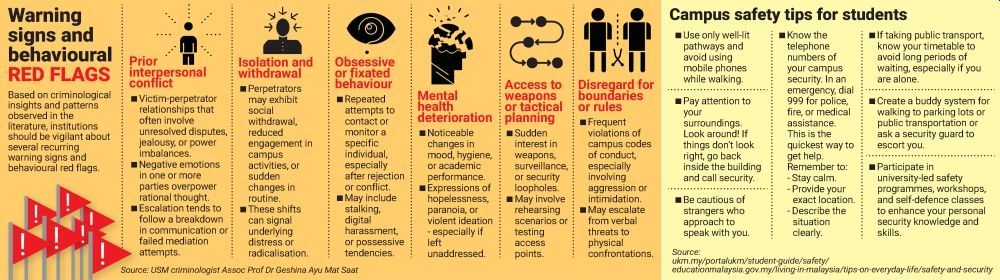
“Over time, unresolved conflict, psychological distress, or latent antisocial tendencies can intensify and manifest suddenly as violence,” she said, adding that these are not just security threats but indicators of deeper systemic and behavioural issues.
Last month, a foreign student was allegedly stabbed by an ex-boyfriend in Subang Jaya. The attack happened barely a month after a girl was found murdered in her room at a varsity hostel in Cyberjaya. Both victims were aged 20.
Geshina Ayu said these cases reflect a dangerous mix of factors – social isolation, interpersonal conflict, and psychological distress – that can escalate in environments lacking proactive safeguards.
“The perpetrators were known to the victims, and the violence occurred in spaces presumed to be secure.
“That is a red flag for institutional complacency that needs attention.
“Otherwise, we risk normalising preventable harm as people fail to recognise danger signs,” she cautioned.
Geshina Ayu called for a long-term, systemic approach that includes behavioural monitoring, mental health support, early intervention, and coordinated response teams, to be implemented from the student admission screening stage right through their entire study duration at the institution.
A student, she said, should not be judged solely based on their academic performance.
“Grades alone do not provide a complete picture of an individual.
“Focusing only on how many As a student has in their college or varsity application disregards other aspects of a person’s personality, such as traits, cognition, desires, and emotional stability; as well as the influence of the individual’s past experiences on their current life,” Geshina Ayu explained.
She also urged learning institutions to identify and support students at risk – whether due to mental distress or pro-criminal tendencies – before admission.
“If an application is rejected for these reasons, universities should advise the student and their family to seek help.
“This prevents future violent incidents and increases the chances of work and relationship success later,” she offered.
Beyond early intervention, Geshina Ayu suggested fostering a campus culture of social values, mutual respect, and care through mandatory courses and lectures, as these can build habits that persist beyond graduation.
Multiple approaches

National Association of Private Educational Institutions (Napei) deputy president Dr Teh Choon Jin said many universities are already doing their part to make their campuses safer.
According to him, measures already in place include increased security patrols, expanded CCTV coverage, improved lighting, 24-hour crisis hotlines, enhanced visitor screening, and comprehensive security audits.
Still, Teh suggested that universities go further by installing more comprehensive surveillance systems, deploying round-the-clock security personnel, and providing accessible emergency call buttons across campus.
Equally important, he added, is medical preparedness.
Having on-campus medical stations staffed with trained personnel, as well as offering first aid training to staff and student leaders, can greatly improve response times during health emergencies, he said.
“Collaboration with local medical services and potentially employing emergency medical technicians on campus can further enhance emergency care capabilities,” he said, highlighting the value of a real-time campus alert system to communicate instantly with students, faculty and staff during emergencies, enabling coordinated and timely responses.
Comprehensive strategies
Both Teh and Malaysian Association of Private Colleges and Universities (Mapcu) president Datuk Parmjit Singh, however, pointed to how there is no one-size-fits-all solution that applies to all university campuses.
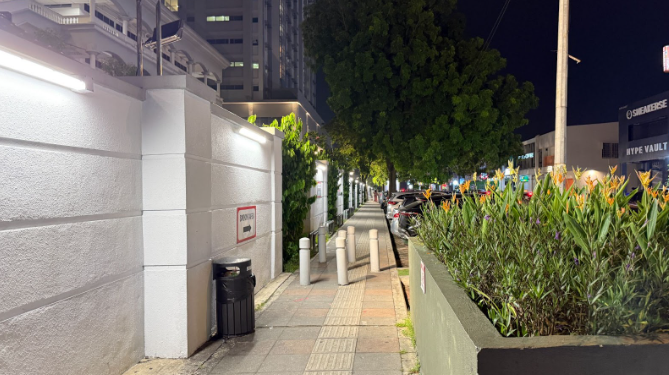
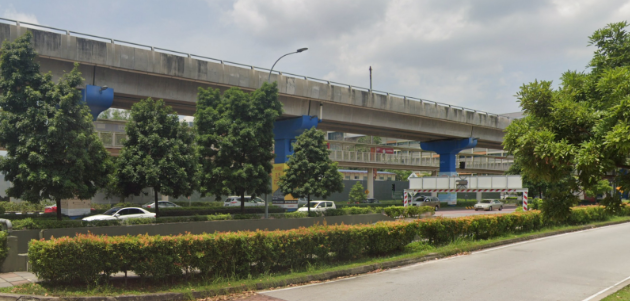
“Each university varies widely in terms of size and the types of premises they occupy, ranging from high-rise buildings in city centres to sprawling, purpose-built campuses,” Teh said.
Thus, benchmarking exercises are commonly carried out between universities to share best practices for safety procedures, according to Parmjit and Teh.
These visits, explained Teh, allow member institutions to learn from one another in key areas including student well-being, campus security and emergency preparedness.
By exchanging ideas and strategies, institutions are better equipped to strengthen their safety protocols and adapt to emerging risks, he added.
Teh reminded universities that creating a secure learning environment is not about quick fixes – it requires both immediate interventions and long-term planning.
“A comprehensive safety strategy must balance physical upgrades with investments in technology, human resources and operational processes.
“Ultimately, safety should be embedded into the institution’s daily operations, not treated as an afterthought,” he said.
Stronger together

“A significant number of students live in accommodations managed by private landlords, which often do not fall under the institution’s direct oversight.
“These premises may not always adhere to the same safety standards, leading to inconsistent student safety experiences,” Parmjit said.
To bridge this gap, Teh highlighted that the ministry’s support is essential in offering guidance, tools and best practices to improve security in off-campus housing.
“This would help institutions develop a more comprehensive security system and ensure safer environments for all students,” he offered.
He also suggested specialised training and seminars be organised through the Higher Education Leadership Academy (AKEPT).
These, he added, would be especially beneficial for universities that may lack in-house expertise to identify and mitigate security risks.
Partnerships between institutions and nearby police stations, said Parmjit, can make a real difference.
“Joint patrolling, rapid response, and real-time information sharing ensure regular monitoring, early threat detection, and swift action in emergencies,” he said, adding that police-led “safety first” awareness sessions can be highly beneficial for both students and staff.
Community policing models involving campus security and local councils can be another effective approach, Parmjit added.
“In some cities, liaison officers or police representatives are stationed near university campuses for rapid coordination.
“Crime prevention through environmental design is another area where local authorities can assist with lighting, visibility, and urban planning in areas surrounding campuses,” he noted.
Safety through solidarity
While institutions must provide a secure environment, students share equal responsibility in protecting themselves and looking out for their peers.
They need to learn to depend on themselves instead of expecting their parents, teachers, or others around them to do the protection, Geshina Ayu said.
“If everyone is of this same expectation, no one is protected,” she added, pointing to how small, proactive actions – reporting suspicious behaviour, staying aware, and speaking up when something feels wrong – can prevent harm.
“Know your campus emergency protocols, look out for your peers, and if you are struggling, seek help early.
“Safety begins with connection, with recognising that everyone has a part to play in creating secure, respectful and resilient campus environments,” she said.
Echoing her views, Parmjit stressed the importance of community policing – being vigilant, complying with safety regulations, identifying and escalating threats, and working together to keep campuses safe.
Teh also urged students to work with their student leaders to raise concerns about off-campus safety, fostering more collaborative solutions.
Prioritising concerns

Sunway University Student Council president Justin Yong Wenn Weii

UCSI deputy vice-chancellor Prof Datuk Dr Rohana Yusof