
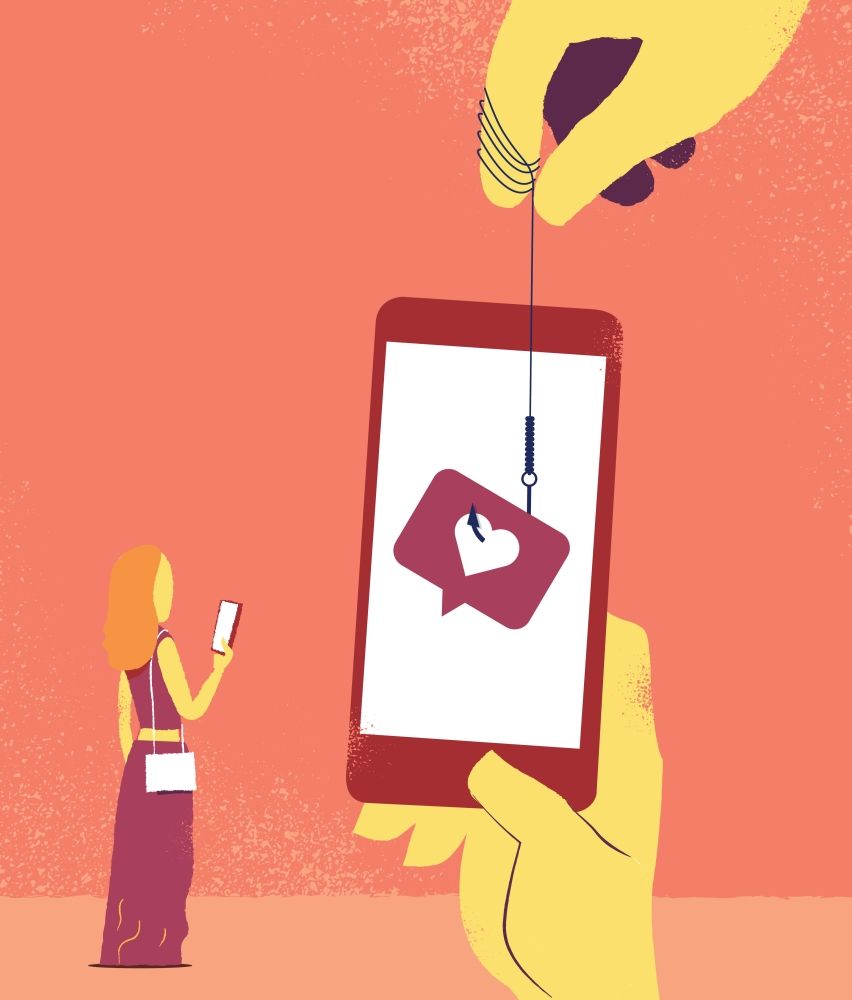
Need for digital literacy, open conversations and heightened awareness to help young users navigate dangers of online dating, says expert
THE rise of online dating, coupled with increasing reports of online sexual exploitation, makes digital literacy and awareness more critical than ever.
According to Taylor’s University senior lecturer and programme director for the master’s in clinical psychology Dr Lim Hooi Shan, interacting online is second nature for teens and young adults, especially with apps that make it quick and convenient to reach out to people they are interested in.
ALSO READ: ‘I do’ or ‘I don’t’ – youths weigh in
“As technology evolves, so do the ways people connect.
“Teens and young adults who grew up in the digital age have adapted to virtual communication, especially after the global shift during the Covid-19 pandemic.

“Some use these platforms to seek validation, gaining a boost in self-esteem when they receive multiple matches and conversations,” she told StarEdu.
She cautioned that students must learn to recognise red flags and potential dangers when engaging with others on dating apps.
Asking for explicit pictures or videos, she said, should always be seen as a warning sign, regardless of how stable the relationship seems.
“You can never be certain whether the recipient will sell them to adult sites or share them on other platforms without consent.
“Likewise, invitations to meet in a private or isolated location – such as someone’s home, an empty parking lot or a dark cinema – should raise concerns.
“Always request to meet in public spaces such as shopping malls or restaurants you are familiar with to ensure your safety,” she advised, emphasising that while social media itself does not directly cause risky behaviour, it increases exposure to such situations, making education and awareness essential.
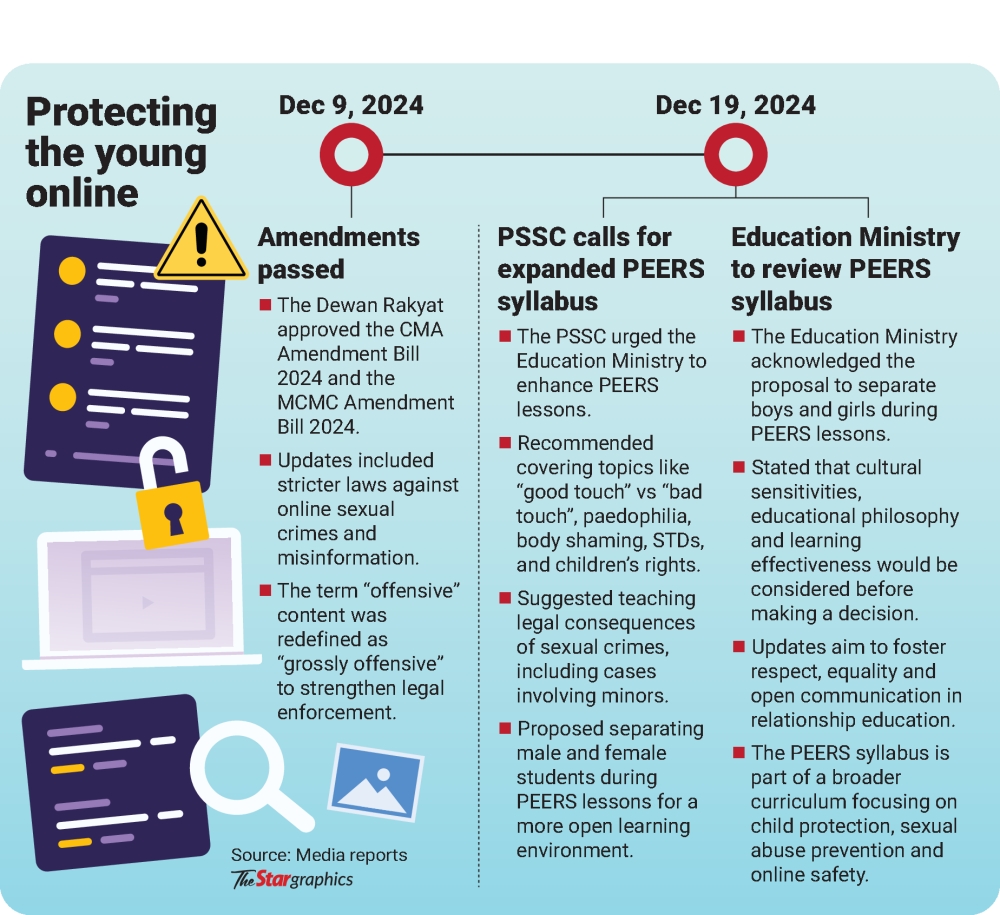
On Dec 19, 2024, the Education Ministry announced that it would consider a proposal to separate boys and girls during lessons under the updated Reproductive and Social Health Education (PEERS) syllabus (see infographic).
This move, aimed at improving students’ comfort levels during discussions on sensitive topics, was proposed by the Parliamentary Special Select Committee (PSSC) on Women, Children and Community Development.
The PSSC also called for an expanded PEERS scope to include crucial lessons on “good touch” and “bad touch”, paedophilia, body shaming, and sexually transmitted diseases (STDs), alongside legal literacy on sexual crimes.
On steps being taken in the curriculum update, the Education Ministry said age-appropriate and culturally sensitive topics on PEERS, human relationships, personal boundaries, and safety in personal and online spaces would be included.
Lim warned against having the mindset that not talking about safe relationships and the repercussions of sexual health will reduce its occurrence.
“We need to know that given the current era, if parents, educators or guardians do not provide accurate information and responsible guidance to them, they are going to get into it one way or another through unauthorised platforms and strangers,” she said.
The urgency to regulate online interactions intensified when the Dewan Rakyat passed the Communications and Multimedia (Amendment) (CMA) Bill 2024 and the Malaysian Communications and Multimedia Commission (MCMC) (Amendment) Bill 2024 on Dec 9 last year.
These amendments, covering 118 existing sections and introducing 15 new ones, aim to strengthen protections against online sexual crimes, cyber threats and misinformation. The amendments redefine “offensive” online content to “grossly offensive” to better target harmful digital behaviour.
Simultaneously, a 2024 study showed a significant link between dating app usage and risky sexual behaviours. A study published in the journal Frontiers in Reproductive Health found that dating apps contribute to higher engagement in unprotected sex, particularly among young users.
According to the study, dating apps facilitate casual encounters, which may increase risky behaviours, while those already engaging in such behaviours may gravitate towards dating apps for similarly inclined partners.
Lim said risky behaviour can be influenced by multiple factors, including peer pressure, lack of safe sex education, and limited parental or societal guidance.
However, she noted that social media has played a major role in the rise of STDs, as its easy access, unchecked information, weak content regulation, and lack of parental or societal oversight expose young people to misleading or harmful content.
“Having an open conversation about safe relationships helps young people understand each behaviour’s consequences, risks and benefits.
“This awareness will help them make better-informed choices about their bodies, relationship boundaries, sexual health, lifestyle, consent to sexual behaviours, and self-well-being. It helps to protect them from regrettable situations and promotes healthier relationship dynamics,” she said.