FROM an app that spots scams before victims tap to a system that stops mosquito larvae before they hatch and a device that flags drowsy drivers, young Malaysians are turning classroom curiosity into practical technology.
That spirit was on show at this year’s Shell NXplorers Malaysia state challenges, held in the peninsula, Sabah and Sarawak, where secondary school students pitched innovative solutions to tackle real-world problems.
Shell NXplorers is a global education programme that challenges students to address complex food, water and energy challenges through critical and systems thinking by incorporating science, technology, engineering and mathematics (STEM) principles.
The programme seeks to build the capacity of next-generation thinkers, leaders and innovators, equipping them with the STEM skills and knowledge to address growing energy demand challenges.
Crushing dengue
The Peninsular Malaysia challenge, held on Oct 15, brought together 213 student participants from seven schools.
Champions, team Hogwarts from SMK Vivekananda, Kuala Lumpur, comprising Vashnie Ramesh Kumar, Sakthivelan Kumaraguru and Meenal Muthiah, built Smart BTI Bio-Sentinel, an automated dengue prevention system.
The system detects stagnant water, monitors water temperature and releases a biological mosquito larvicide solution to help control larvae when conditions suit breeding.
“Our project not only helps communities tackle mosquito problems, but it can also operate automatically with minimal human intervention,” the team said.
“We target mosquitoes at their larval stage, before they grow into adult mosquitoes and become a bigger problem.”
They also shared that they have gained a lot since joining the programme, including valuable teamwork and communication skills, as well as practical electronics skills.
Apart from the winners, runners-up, team Hidronix from SMK Tengku Idris Shah designed Auto Aqua Plant, a sustainable smart aquaponic system that waters plants using water from a fish tank.
Meanwhile, the Most Innovative Award went to team Sea Shell from SMJK Chong Hwa for their Smart Fridge System, which tracks stored food in a refrigerator and updates users through a mobile app to prevent spoilage and reduce food waste.
A digital safety net
Held at One Shell Square Miri on Oct 5, the Sarawak challenge brought together 183 students from eight secondary schools.
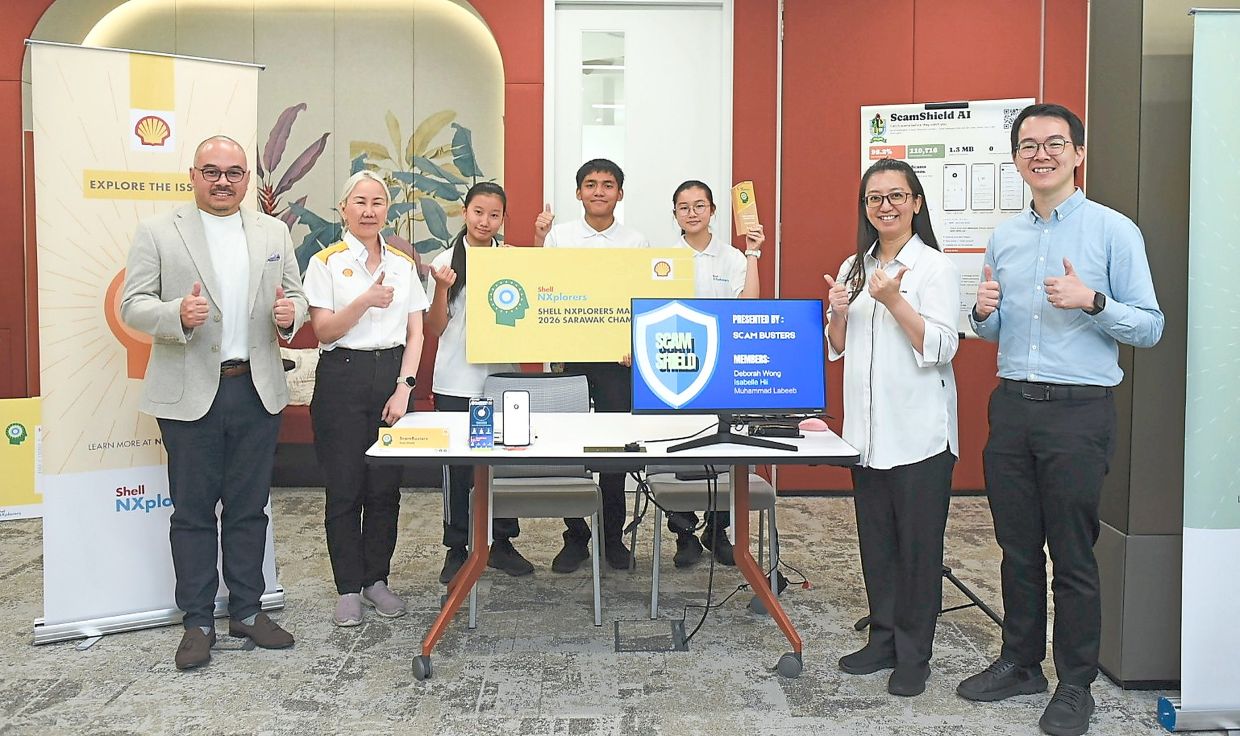
Top honours went to team ScamBusters from SMK Lutong, comprising Muhammad Labeeb Aryan, Deborah Wong En Xuan and Isabelle Hii Yi Shin, for their invention, ScamShield AI.
Their project is an Android app designed as an “investigator in your pocket”, scrutinising messages, WhatsApp chats, links, QR codes and downloadable APK files.
It then delivers a clear risk score with plain-language explanations in Bahasa Malaysia and English. Most of the analysis happens on the phone itself, so the app works offline and keeps messages private.
“We realised that many existing tools focus on blocking or identifying suspicious phone numbers, but scammers can simply change numbers,” they said.
“The real danger is often inside the message itself – the urgency, impersonation, suspicious links and requests for money or personal information.”
Runners-up, team Theory from SMK Bandar Bintulu, turned their attention to eldercare with ElderCare AI, an automated medication recognition, sorting, reminder and health monitoring companion that can read medicine labels, sort pills and alert caregivers.
Additionally, the Most Innovative Award went to team Nerd Inc from SMK Baru Bintulu for Calm Meadow, a confidential digital well-being platform designed to support student mental health.
Push for safer roads
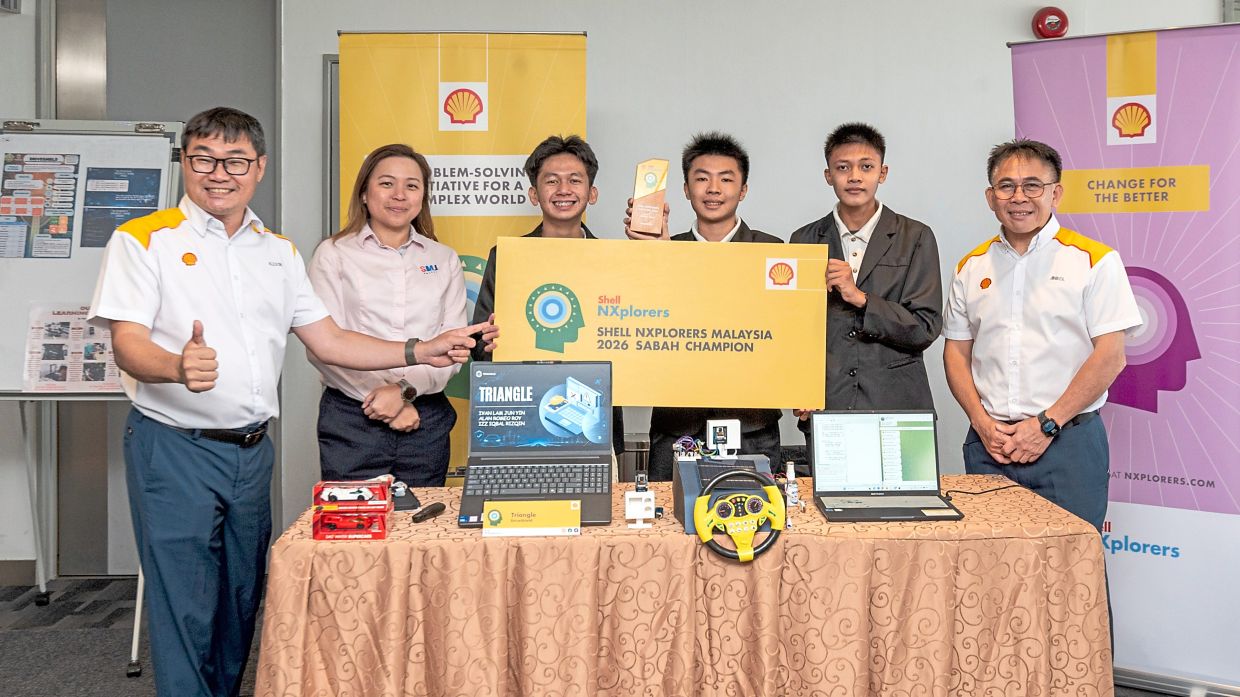
The Sabah challenge, held at Plaza Shell in Kota Kinabalu on Oct 19, involved 210 participants from eight schools across the state.
Team Triangle from SM Sung Siew, comprising Ivan Lam Jun Yin, Alan Romeo Roy Joseph Boguli and Izz Iqbal Rizqin Mohd Shamsul, were crowned as state champions for their project, DriveShield.
DriveShield is an affordable, AI-powered road safety system that detects risky driving behaviours, including drowsiness, mobile phone use, smoking and alcohol consumption.
It is also solar-powered and can provide real-time alerts and record incidents to encourage safer driving.
“We wanted a solution that stops an accident before it happens, not after. Therefore, we came up with a device that checks the driver before the engine starts and keeps watching them while they drive,” they said.
“When the system detects danger, it triggers a buzzer and sends a Telegram alert to the driver’s family or company.”
Runners-up, team Trecento Percento from SM All Saints, developed Tag Tracker 300, an Arduino-based attendance system that uses RFID technology at school gates for faster and more reliable attendance tracking.
The Most Innovative Award went to team Elsevier from SMK Lok Yuk for Automark, another smart attendance system that uses fingerprint scanning to record student attendance in real time.
Shell NXplorers Malaysia 2026
The state-level competitions are part of Shell Malaysia’s wider push to enthuse, nurture and empower young problem-solvers.
Supported by the Education Ministry, the programme has engaged over 600 students across 29 schools nationwide, while reaching an additional 1,000 students through student-led peer-to-peer learning.
By exposing students to structured toolkits, such as the Perspective Circle, Connecting Circle and Feasibility Funnel, the programme’s curriculum helps students navigate interconnected social issues, evaluate real-world constraints and design scalable, human-centred technologies.
The three winning teams, Hogwarts, ScamBusters and Triangle, alongside the runner-up teams, Hidronix, Theory and Trecento Percento, will now pit their inventions against each other as they go on to compete in the Shell NXplorers Malaysia national finals on Oct 30.
For more information on Shell NXplorers Malaysia, visit https://www.shell.com.my/about-us/sustainability/communities/shell-stem-programme.