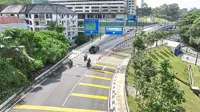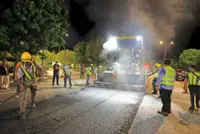
Frequent users of Jalan Syed Putra, Kuala Lumpur, would have noticed soil-testing equipment being set up along the road, much of it is close to mature urban trees that have stood along the corridor for decades.
The soil investigations are a visible reminder that Kuala Lumpur continues to build infrastructure.
But they also raise a less frequently asked question: what will happen to the environmental assets already standing in its path?
The works are associated with the New Pantai Expressway Extension, or NPE2, an elevated highway project along the corridor.
But “elevated” does not mean impact-free.
Its piers, foundations, utilities and construction areas will occupy space at ground level, while the viaduct itself may compete for the same vertical space occupied by mature tree canopies.
Jalan Syed Putra is not a blank canvas.
A 2021 Universiti Putra Malaysia study documented 785 trees along the road, including 276 rain trees and significant numbers of other mature species. These are not merely roadside landscaping.
Mature trees provide shade, moderate urban heat, intercept rainfall, store carbon, support biodiversity and improve the public realm.
They are part of Kuala Lumpur’s green infrastructure.
Unlike concrete infrastructure, however, their value cannot be created overnight.
A mature tree represents decades of growth and accumulated ecological benefits.
The question should therefore not simply be how many trees need to be removed, but how many can be retained and what can be done for those that genuinely cannot?
Other major cities offer useful examples of good urban practice.
Singapore considers mature trees during development planning and adjusts infrastructure and associated works where feasible to retain significant trees.
Hong Kong’s transport projects have assessed alternative alignments according to their impact on mature trees and considered transplantation where retention is not possible.
London recognises that replacement should consider the benefits and canopy value lost, rather than simply counting trees.
The principle is straightforward: Avoid. Retain. Protect. Transplant. Replace. Maintain.
Can a pier or associated infrastructure be adjusted to avoid a significant tree?
If not, can its root zone and canopy be protected during construction?
Where removal is unavoidable, has transplantation by qualified arborists been properly assessed?
Only then should replacement planting become the principal mitigation.
Replacement should also not be reduced to arithmetic.
A mature tree removed today and a sapling planted tomorrow are not ecological equivalents.
The sapling may eventually provide similar benefits, but not immediately.
This matters along a corridor associated with the River of Life project, following years of public investment to improve waterways and the surrounding public realm.
The introduction of a substantial elevated concrete structure into such a landscape deserves consideration beyond the highway’s engineering footprint.
The concessionaire has an opportunity to demonstrate a higher standard of urban responsibility by investing in transplanting suitable trees to other public sites, establishing large-canopy replacements, enhancing planting around the elevated structure and committing to long-term maintenance.
The public should be able to see how these decisions are being made.
A simple tree-impact inventory could disclose which mature trees will be retained, transplanted or removed, why removal is necessary and what replacement and maintenance measures will follow.
Mature trees should not be treated as landscaping that happens to be in the way.
They are living infrastructure that took decades to build.
The real test of modern infrastructure is not simply how much concrete we can build, but whether we can build intelligently enough to preserve what makes the city liveable.
Shing Si Yan
Kuala Lumpur