
RUBBISH collection and delivery schedules across Kuala Lumpur will be coordinated to prevent further waste pileups at the Kuala Lumpur Transfer Station (KLTS) in Kepong.
In a written response to StarMetro’s Sept 8 report, “Revised waste schedule needed to clear backlog”, Solid Waste and Public Cleansing Management Corporation (SWCorp) said the government has acknowledged problems faced at the facility.
“The Housing and Local Government Ministry acknowledges the waste backlog and odour problems at KLTS,” it said.
SWCorp said its assessment found that the situation was due to operational constraints including faulty equipment and machinery at KLTS.
There was also a need for better coordination of waste deliveries to the station and Bukit Tagar Sanitary Landfill, it said.
SWCorp said waste concessionaire Alam Flora Sdn Bhd planned its collection schedules based on on-the-ground conditions including traffic, premises operating hours and collection point locations.
“Nevertheless, the ministry directed all parties to jointly realign their collection and delivery schedules to ensure rubbish can be received, processed and transported in a more orderly manner to prevent the backlog from recurring.”
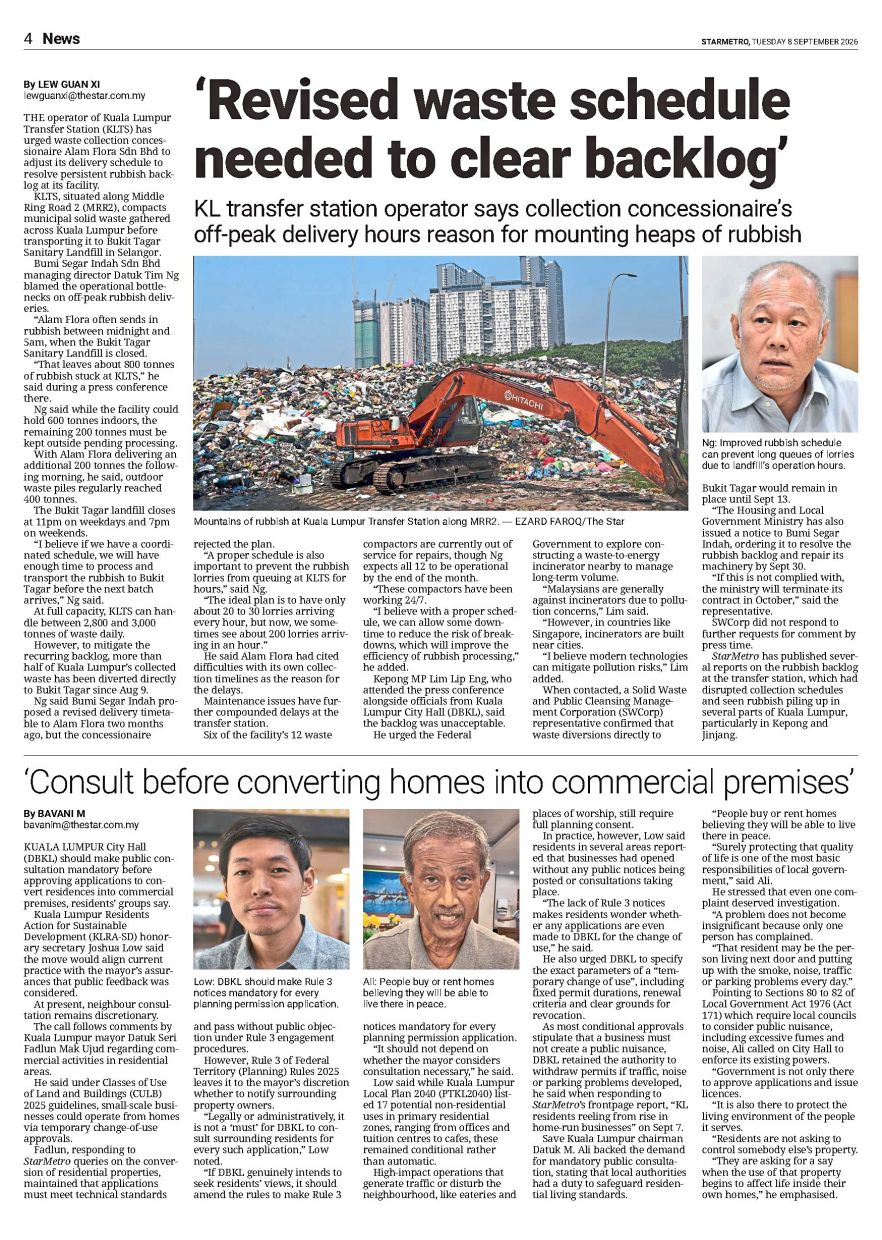
As an immediate measure, some of Kuala Lumpur’s rubbish has been diverted to Bukit Tagar to reduce the volume at KLTS.
KLTS operator Bumi Segar Indah Sdn Bhd has been told to speed up repairs to faulty equipment and machinery, transport piled up rubbish to Bukit Tagar, and improve cleanliness and odour control at the station and its surroundings.
The ministry has ordered Bumi Segar Indah to clear the backlog and repair its machinery by Sept 30, failing which its contract could be terminated in October.
SWCorp said the ministry would closely monitor KLTS operations, repair works, management of accumulated waste and the operator’s performance.
StarMetro had earlier reported that Bumi Segar Indah attributed the recurring backlog to large volumes of rubbish being delivered between midnight and 5am, when Bukit Tagar was closed.
Located along Middle Ring Road 2, KLTS compacted municipal solid waste collected across Kuala Lumpur before transporting it to the Selangor landfill.
In the report Bumi Segar Indah managing director Datuk Tim Ng was quoted saying that the mismatch in delivery times had resulted in about 800 tonnes of rubbish being stranded at KLTS.
He had said the station could hold 600 tonnes indoors, while the remaining 200 tonnes are kept outside pending processing.
A further 200 tonnes arriving the following morning could push the outdoor pile to 400 tonnes, he added.
Ng had said KLTS should ideally receive between 20 and 30 rubbish lorries an hour, but as many as 200 would arrive at times within the same period.
Bumi Segar Indah had proposed a revised delivery timetable to Alam Flora two months ago, but the proposal was rejected due to the concessionaire’s collection timelines.
The situation was further compounded by six of KLTS’ 12 waste compactors being out of service.
Ng had said a coordinated schedule would allow the machines to undergo regular maintenance.