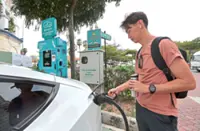
New developments nationwide are now required to provide a minimum number of electric vehicle charging bays (EVCBs).
Under the Planning Guidelines for Electric Vehicle Charging Bays, multi-storey residential and non-residential developments must allocate EVCBs equivalent to at least 2% of parking bays, including at least one in visitor parking.
Prepared by the Housing and Local Government Ministry through the Town and Country Planning Department (PLANMalaysia), the guidelines were approved at the 42nd National Physical Planning Council meeting on Sept 18, 2023.
A PLANMalaysia spokesperson said developers were also encouraged to instal at least one EVCB for electric motorcycles, while non-residential developments should provide an accessible charger for shared use by drivers with disabilities.
Highrise residential developments are likewise encouraged to include an accessible EVCB in visitor parking.
To help close the gap towards the 10,000 public charging bay target, PLANMalaysia introduced an EVCB manual through the OSC 3.0 Plus System to streamline approvals.
Applications for chargers in existing developments are processed within seven days for alternating current (AC) chargers and 14 days for direct current (DC) fast chargers.
The guidelines also encourage EVCBs at existing developments, including commercial centres, institutions, rest and relaxation (R&R) areas, petrol stations, and government and private premises.
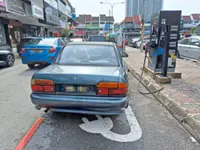
Public parking bays, including on-street parking, may also be converted into EVCBs, subject to local authority approval.
The spokesperson acknowledged that expanding the charging network remained challenging.
“From a physical planning perspective, the main challenges include electricity supply capacity, utility infrastructure upgrades, space constraints in urban areas and coordination with the relevant technical agencies.
“Strict compliance with fire safety and technical requirements for DC fast chargers can also lengthen installation timelines.
“From a business perspective, charge point operators (CPOs) must also consider bay locations and commercial viability.”
Based on Malaysia Electric Vehicle Charging Network (MEVnet) data as of March 31, 2025, Kuala Lumpur had 1,192 EVCBs, exceeding its indicative target of 900 bays by 32.4%.
The spokesperson said the capital’s higher concentration of EVCBs reflected its larger population, higher EV ownership and stronger economic activity.
“Although the guidelines provide a standardised framework for all states, implementation ultimately depends on the readiness of local authorities, investors and local conditions.
“User demand, electricity supply readiness, investment by CPOs, site suitability and coordination with relevant agencies all influence the pace of implementation.”