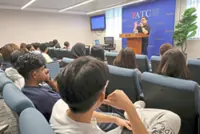
YOUNG people should not assume they are free from legal consequences when renting out bank accounts or sharing personal information online.
Speaking to students at a legal awareness talk titled “Juvenile Offences: Rehabilitation or Punishment?” at the Advance Tertiary College (ATC) Penang, lawyer Ng Kian Nam said many youths unknowingly became involved in criminal activities such as acting as money mules, often for small sums of money, without realising the long-term consequences.
Ng shared the case of a hawker from Seremban who allegedly rented out his bank account and is now facing charges in 10 states nationwide.
The hawker, believed to have acted as a money mule, was allegedly paid only several hundred ringgit a month to rent out his account.
“However, he is now facing charges under Section 424 of the Penal Code involving dishonest or fraudulent removal or concealment of property.
“The hawker merely lent out one bank account, but now has his life disrupted to attend court proceedings in 10 states and comply with police investigations,” he said.
The talk aimed to raise awareness on child related offences, the Child Act, and responsible behaviour among young adults.
Ng reminded students not to think that empty or inactive bank accounts carried no risks.
“Do not become a money mule over a small rental fee,” he said.
He also warned students against handing over photocopies of their identity cards, saying syndicates could misuse them to create fake social media accounts or for other illegal activities.
Ng said investigations under laws such as the Anti-Money Laundering Act and Financial Services Act could also result in bank accounts being frozen, leaving account holders unable to access their savings during investigations.
Moving beyond financial scams, Ng also urged the 70 students in attendance to keep an eye on broader shifting trends in Malaysian juvenile law.
He said discussions were ongoing on proposals to lower the age of criminal responsibility from 10 to seven years old, together with a rebuttable statutory presumption that children below 10 lacked criminal capacity.
According to Ng, supporters of the proposal argue that children today mature earlier due to increased internet exposure and access to information.
He said under such proposals, children as young as seven could potentially be held criminally liable if offences involved violence and malicious intent.
“In such cases, the prosecution must prove the child’s maturity, the seriousness of the offence and the inadequacy of rehabilitation alternatives,” he said.
Ng also spoke about proposed changes involving children convicted of capital offences.
Currently, children convicted of such offences are detained at the pleasure of the Yang di-Pertuan Agong without a fixed release date.
However, he said there were discussions on replacing the system with fixed-term detention orders following Malaysia’s abolition of the mandatory death penalty in 2023.
“Fixed-term detention orders would be clearer, fairer and more consistent with the current sentencing landscape,” he said.