
Deputy Works Minister Datuk Seri Dr Ahmad Maslan set a mandatory 24-hour timeframe for fixing potholes on federal roads in August last year.
For non-federal roads, the Works Ministry is supposed to have “service-level agreements where potholes will be covered or treated (temporarily) within 24 hours” from the time complaints are received via its official MyJalan app.
In February, the ministry reported that 90% of complaints on roads received through the MyJalan app between August 2023 and January this year had been fixed.
But does this figure reflect the reality on the ground?
To test the effectiveness of complaints channels, StarMetro reported potholes in Kuala Lumpur and Petaling Jaya using MyJalan along with a few other avenues provided, to determine their efficacy and evaluate compliance with the 24-hour requirement.
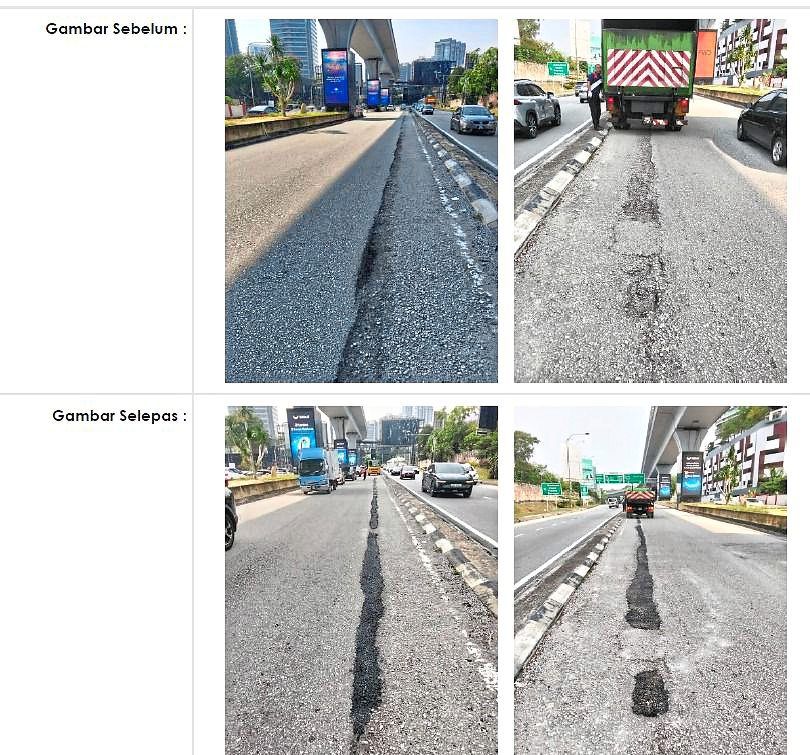
Two potholes connected by a large crack on Jalan Damansara, near Taman Tun Dr Ismail, Kuala Lumpur, were reported using the MyJalan app on March 2.
By March 12, despite the road not being repaired, the report was marked as “completed” with a note indicating the complaint had been forwarded to the local council.
However, an additional note indicated that it was “beyond the jurisdiction of Kuala Lumpur City Hall (DBKL)”.
This negates the ministry’s claim that the app functions with a “no wrong door policy” since it is supposed to forward complaints to the correct agency.
When no repair is performed or it is done unsatisfactorily, the user has no option to re-open the complaint.
The only option given is to provide a one-to-five-star rating of the handling and to submit a fresh complaint.
One benefit to using MyJalan is that agency jurisdiction is identified once the user indicates the road location on the app’s interactive map.
After significant difficulty in logging into Adu@KL, a complaint for the same set of potholes was lodged on March 19.
Using DBKL’s portal was more effective as the potholes were fixed on March 27.
A PDF report was issued listing how many days DBKL’s team took to act on the complaint, along with before and after images.
Potholes along Jalan Damansara, reported on March 10, via DBKL’s WhatsApp number, led to a call from the contractor on the night of March 12.
Not only were the potholes patched up, the contractor even went the extra mile of fixing unreported potholes on a parallel road, in addition to sending time-stamped, work-in-progress images to the complainant.
Checks on the Jalan Damansara location a few weeks later showed that the pothole fixes were still in place.
Similarly, potholes on Jalan Haji Salleh in Sentul reported via WhatsApp on March 11, were fixed within a few days.
DBKL’s WhatsApp channel emerged as the clear winner in this experiment.
One advantage of reporting via WhatsApp is the possibility of following up in the event the pothole is not fixed or is improperly repaired.
Over in Petaling Jaya, a large pothole on a road off Jalan Prof Diraja Ungku Aziz leading to the Federal Highway, was reported using both the MyJalan and Respons Rakyat apps on March 1.
On March 3, the ticket was closed on the MyJalan app as “completed” with a note from Public Works Department (JKR) stating that it was under the jurisdiction of Petaling Jaya City Council (MBPJ) and had been forwarded to the council.
As of April 2, the Respons Rakyat app still has the complaint as “under review”.
Despite the size of the pothole, it has not been fixed after a month.
Other potholes reported in Petaling Jaya and Subang Jaya using Respons Rakyat have not been fixed either.
A March 18 complaint of multiple potholes near the Da Men Mall, Subang Jaya, was marked “completed” on March 26 with a note indicating that the area was slated for repair in mid-April.
A large pothole at the junction of Jalan 17/21 reported on March 12 was fixed 20 days later, after being repeatedly escalated to the MBPJ councillor.
Other potholes in the same area that were reported on March 12 but not escalated to the councillor, had not been repaired at press time.
It can be deduced that Selangor local councils are not meeting the 24-hour requirement for getting potholes attended to.
Given the grave threat potholes pose to motorists, the efficacy of complaint management systems and time taken to fix them need to be audited.