JOHOR government has announced a RM250,000 allocation to support the Johor Baru Chingay Festival, a cultural celebration that has been passed down for more than a century.
State health and environment committee chairman Ling Tian Soon said the contribution reflected the commitment to preserve the long-standing tradition while ensuring it continued to flourish in the years ahead.
ALSO READ: Unity shines at Chingay parade
“We hope the festival will continue to thrive into the next century while bringing prosperity and harmony to Johor,” he said before flagging off the parade at the Xing Gong temple in Johor Baru.
Ling, who represented Johor Regent Tunku Ismail Sultan Ibrahim to officiate the parade, said the festival was an important feature in Johor’s tourism calendar and a source of pride for locals.
“Every year, Chingay is organised without rehearsals. This is something we are proud of.
“It only succeeds through the collaboration of various government agencies, the police and non-governmental organisations,” he said.
Ling said its purpose was to unite the Chinese community and the five main clans when the festival first began over 150 years ago.
“Today, it is no longer just about uniting the Chinese community, but also bringing together people of different races, reflecting the spirit of Bangsa Johor and our shared unity.
“Although there was a new condition set by the police requiring participants to lower noise levels near mosques due to Ramadan, everyone was happy to comply. We are glad the parade went on smoothly without any hiccups,” he added.
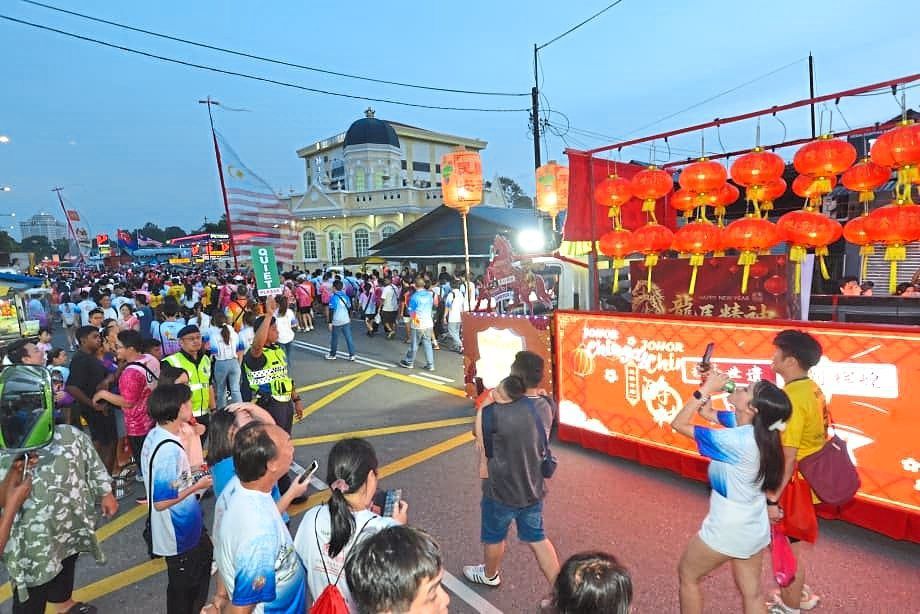
Johor Baru Tiong-Hua Association president Chee Wing Kien said the five-day celebration concluded successfully.
He said following police advice, the starting time of the night parade this year was moved from its traditional 7pm to 7.20pm.
“The Chingay Festival will also coincide with Ramadan for the next two years.
“As the time for breaking fast can shift, we will adjust the parade schedule accordingly to achieve harmony,” he added.
Chee said the organisers remained committed to pushing the festival onto the global stage through its “Road to Unesco” initiative.
He hoped the joint application with Penang and Singapore could secure recognition as a Unesco intangible cultural heritage as early as next year.
Johor investment, trade, consumer affairs and human resources committee chairman Lee Ting Han, who took part in the festival, said it carried a special feeling each year.
The parade, he said, traced its roots to the early Chinese settlers who built the Johor Ancient Temple in the 19th century.
The temple symbolised the unity of the five major dialect groups – Hokkien, Teochew, Cantonese, Hakka and Hainan – whose early migrants supported one another in Malaya, forming the spirit known as wu bang gong he meaning “unity among the five clans”, said Ting Han.
“Generation after generation gathers on the same streets to take part in the same tradition.
“Those children who once came with their parents, now bring their own children.
“Cities need economic development and physical infrastructure.
“But what truly creates a sense of belonging is the shared experiences of its people.
“When a city has culture and stories passed down through generations, it becomes more than a place to work, it becomes a home,” said Ting Han. — By YEE XIANG YUN