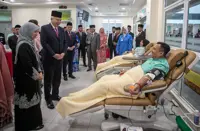
THREE times a week, an elderly man spends four hours hooked up to a haemodialysis machine at the Amitabha Foundation Dialysis Centre in Johor Baru.
Retiree Ong Kean Gim, 66, said this has become his routine as part of his fight to stay alive after being diagnosed with kidney failure in June last year.
“I have been receiving treatment at this centre for the past four months, since learning of my condition,” he said during a handover ceremony of two haemodialysis machines from Eco World Foundation to Amitabha Foundation Dialysis Centre.
A widower with no children, Ong said he relied on government aid to survive.
“I receive RM600 monthly from the Welfare Department and another RM350 to pay for the rental of a small room where I live alone,” he said, adding that the centre was helping him apply for additional assistance from Health Ministry.
Another patient, C. Silvi, 66, has been battling kidney disease for nearly a decade alongside heart problems.
The former oil palm estate worker said she stopped working at 45 due to deteriorating health.
“I rely on my daughter to support our family, as my 78-year-old husband is no longer working,” she said, adding that she previously underwent treatment at a centre in Taman Universiti last year before transferring to Amitabha two months ago.
Like Ong, she is awaiting Health Ministry assistance.
According to Amitabha Foundation charity director Jeffrey Lim, the centre operates 18 machines and serves 51 patients.
“This centre subsidises between RM13,000 and RM16,000 every month for dialysis treatments, depending on each patient’s financial background.
“The operational cost of this centre is close to RM1mil a year.
“People only see the machines, but there are many hidden costs such as maintaining the reverse osmosis system, equipment servicing and manpower.”
Lim said the centre welcomed contributions from young entrepreneurs, corporations and non-governmental organisations through corporate social responsibility initiatives.
He added that the foundation was planning to expand the centre to the third and fourth floors in anticipation of a growing number of patients within the next two to three years.
Lim said the foundation, established in 1998, was founded on the spirit of compassion and provided assistance regardless of race, religion and background.
Besides operating centres in Melaka and Johor, the foundation is also involved in poverty aid, elderly care and children’s homes.
Over the past two decades, the foundation has treated between 2,000 and 3,000 patients across both states.
Eco World Foundation chairman Tan Sri Lee Lam Thye said the donated machines were intended to replace ageing units that had exceeded their six-to-seven-year lifespan.
“These machines are crucial because patients depend on them three times a week, four hours each session.
“Therefore, the equipment must be reliable and efficient,” he said.
Lee said this was the third haemodialysis machine donation by Eco World Foundation to the centre.
“Over the past decade, we have donated about 10 dialysis machines to various centres, including recent contributions to St John Ambulance Pantai Selangor and the Ampang Kau Ong Yah Foundation Dialysis Centre,” he added.
Lee said about RM200,000 was allocated annually for assistance related to healthcare.