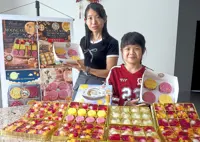
Ipoh family’s clay-oven legacy captivates generations of customers
A beloved fixture in Jalan Tambun Baru in Ipoh, IXiang Biscuits and Confectionery has been drawing locals for decades with its Ma Ti Su biscuits – better known to many as Heong Peng.
With more than 40 years behind it, the family‑run business continues to thrive by doing things the traditional way: baking in clay ovens fuelled by coconut shells and charcoal, filling the air with a sweet, smoky aroma that has become its signature.
Today, the shop is run by 47‑year‑old Teoh Seng Nyap, alongside his brother‑in‑law Liew Ming Foon, 54, and Liew’s wife Teoh Fei Looi, also 54.
Together, they preserve a trade that has been passed down through generations.
Liew believes the charm of their biscuits lies in the unmistakable fragrance that rises from the clay ovens, a scent that simply cannot be replicated by modern machinery.
“It’s the aroma that brings people back. Especially during Chinese New Year, customers want something authentic, something that is made the way their parents and grandparents remember it,” said Liew.
He explained that the biscuits’ distinctive character comes from being baked in clay ovens using coconut shells as fuel which imparts a richer, deeper aroma than machine‑ produced alternatives.
“We bake around 120 biscuits an hour and on a busy day, we can reach 1,200 just to keep up with demand,” he said, as reported by Bernama.
Fei Looi, who oversees much of the preparations, said the recipe remained intentionally simple – onions, maltose, sugar and flour – with no need for elaborate equipment.
The challenge lies in the precise measurements required to prepare the two doughs: pei (flour and water) and sor (oil and flour).
Both must be mixed and kneaded to the right consistency before the filling is added.
The biscuits were originally named Ma Ti Su for their horse‑hoof shape, but in places such as Ipoh and Kuala Lumpur, they are affectionately known as Heong Peng which is “fragrant biscuits” in Cantonese – a nod to their aroma.
Across the country, the names vary: Taiping, Penang and Johor still favour the traditional Ma Ti Su.
At IXiang, eight biscuits sell for RM11, while individually wrapped versions, popular as gifts, are priced at RM12.
“During Chinese New Year, demand usually doubles,” Fei Looi said.
“We can sell 200 to 300 packs a day as locals return home and tourists stop by.”
The shop opens daily from 7.30am to 4.30pm, except Wednesdays.
While it also offers a variety of other treats, including crackers, chicken floss rolls, tau sar piah with peanut filling, pineapple tarts and kaya puffs, it is the Heong Peng that most visitors seek out.
Liew, who began learning the trade at 14, worries about the future of the tradition.
“Not many young people want to do this work,” he said.
“The heat, the long hours, the physical effort... it puts them off.
“Making Heong Peng the traditional way is demanding, and that’s why fewer people are willing to learn.”
Yet despite the challenges, the family remains committed to keeping the trade alive.
For them, each biscuit is more than a snack, it is a piece of heritage.