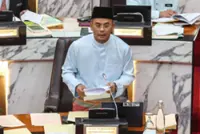
A PETALING Jaya assemblyman questioned the "small" allocation for environmental initiatives under Selangor Budget 2026, which he felt was insufficient to tackle the state's various challenges.
"One of the most obvious weaknesses in the state budget is that only RM1.3mil was allocated for programmes related to sustainability, biodiversity, circular economy and carbon reduction," said Taman Medan assemblyman Dr Afif Bahardin.
"That means that of the RM3.23bil budget, only 0.04% was allocated for environmental initiatives.
"If we are serious about overcoming climate threats, we need to increase the allocation to 1% of the total available allocation."
The Bersatu politician said this when debating the state budget during the Selangor State Assembly sitting at Bangunan Dewan Negeri Selangor, Shah Alam.
During the tabling of the Selangor 2026 Budget on Nov 14, Selangor Mentri Besar Datuk Seri Amirudin Shari said that RM300,000 would be allocated to draft the Selangor Biodiversity Action Plan as a strategic document to sustainably manage, protect and conserve biodiversity as well as RM300,000 for a Selangor Carbon Programme to identify and develop technology-based carbon projects to increase the potential for receiving funds or generating carbon credits that could be traded on the carbon credit market.
"Efforts to reduce the impact of climate change do not only depend on policy and technology, but also require comprehensive cooperation from the people," said Amirudin.
"Therefore, RM500,000 has been allocated for the Local Community and Youth Empowerment Programme for the implementation of direct impact programmes.
"These include river and local ecosystem conservation, greening of community environments by educational institutions and residents' associations as well as waste management activities at the community level including recycling and composting practices."
He added that RM250,000 would also be used to develop the second volume under the Selangor Agenda for Green Economy.
It would focus on the circular economy, such as waste reduction strategies, recycling initiatives and increasing energy efficiency in the public and industrial building sectors.