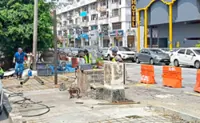
KUALA Lumpur’s former sewage treatment plants (STP) are being given a new lease of life.
According to Kuala Lumpur City Hall (DBKL), 60 decommissioned STPs across the city are being repurposed under the newly gazetted Kuala Lumpur Local Plan 2040 (KLLP2040).
Instead of remaining idle and overgrown with vegetation, these former utility sites will be transformed into housing, commercial hubs, public facilities, and green spaces to meet the city’s growing needs.
“There is something for everyone. Some will make way for pocket parks and urban farms, while others are slated for food courts, carparks, and residential blocks, subject to feasibility, infrastructure readiness, and environmental checks,” DBKL said in a statement to StarMetro.
City Hall said the land use zoning for each site was determined based on original planning intentions, previously gazetted plans, layout approvals, government decisions, and adjustments to current needs and surrounding environment.
At least 10 sites have been designated for public open spaces, including community parks, pocket parks, and urban farms as part of efforts to expand green zones in high-density areas.
Of the 60 sites, 40 sit on government land under the Federal Lands Commissioner (PTP), one is under DBKL’s jurisdiction, while 19 are privately-owned.
“Thirty-two locations have been identified for potential development, including food courts, carparks, and residential projects. These remain subject to detailed studies involving environmental, infrastructure, and financial assessments,” it said (see graphic).
DBKL said the proposed food court locations include Taman Indrahana, Jalan Kelang Lama, Taman Overseas United, Gombak Setia, and Taman Melati.
Meanwhile, a carpark has been planned for Jalan 2/137C, off Jalan Kelang Lama.
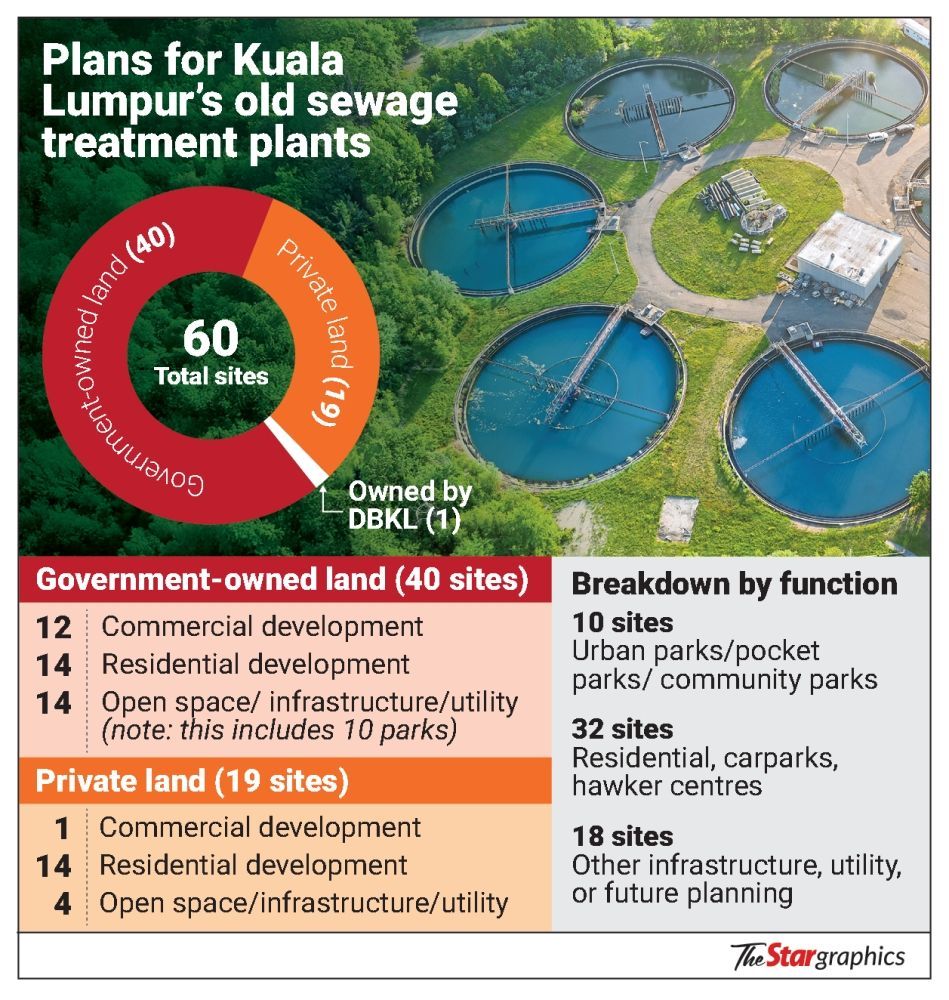
Twenty-six sites have been earmarked for residential development including Taman Gembira, Taman Seputeh, Taman Mutiara, Segambut, Taman Bukit Indah, Taman Midah, Jalan Desa Aman, Taman Cheras, Taman Yarl, Taman Kuchai, Bandar Tasik Selatan, Taman Goodwood Setapak Jaya, Sri Petaling, Taman Sri Lempah and Wangsa Maju.
DBKL reiterated that all redevelopment proposals adhere to the gazetted KLLP2040, and had gone through comprehensive public consultation process involving MPs, residents’ associations, technical agencies, and the wider community.
“The process is transparent, inclusive and prioritises public interest, environmental sustainability and improved urban liveability,” the statement said.
Meanwhile, National Water Services Commission (SPAN) said over the past decade, 362 Indah Water Konsortium (IWK) STPs were decommissioned across Kuala Lumpur, Putrajaya and Selangor as part of efforts to modernise the sewerage network.
“Another 208 STPs are expected to be phased out by 2030, 116 in Selangor and 92 in Kuala Lumpur.
“The closures are part of a long-term rationalisation plan where sewage from smaller plants is diverted to larger regional facilities,” SPAN added.
Many older plants, some built as far back as the 1950s, are outdated and no longer meet environmental standards, said SPAN.
Under IWK’s rationalisation programme, sewage is redirected from these smaller sites to more advanced facilities such as the Pantai 2 STP, which uses green technology and has far greater treatment capacity.
The decommissioning of STPs falls under various frameworks, including the national development plan (Rancangan Malaysia), Greater Kuala Lumpur sub-plan (RMK-GKL), and developer-led initiatives that tie new housing or commercial projects into regional systems.
“Plants are shut down only when the flow can be redirected, or when they are no longer needed.
“SPAN’s role is to oversee the rationalisation, but the land belongs to the original owner – whether it is the government, a developer, or another agency. What happens next is out of our hands,’’ SPAN said.
“Land that was part of the PTP, for instance, falls under the Sewerage Services Department.In the case of private land, it is handed back to the developer or state authority,” it added.
SPAN also said it worked with IWK through submissions made in its role as the Certifying Agency (CA).
Many of the decommissioned STPs are located in older housing estates, often hidden behind rows of terrace houses.
With their original function now obsolete, they have become pockets of unused land scattered across the city.
Some community leaders are calling for these plots to be turned into pocket parks or green buffers, particularly in areas with little access to open space. – By BAVANI M