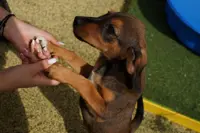
Dogs sold in pet shops may need to be licensed in the future, to prevent owners from abandoning the animals and enable contact tracing in the event of a disease outbreak.
Klang Municipal Council (MPK) Health Department director Azmi Muji said the idea was being discussed as a new condition in the sale of pets.
The council’s annual dog licence costs RM10 and it comes with a coloured dog tag as well as a registration certificate with details of the canine.
“When a dog or puppy is sold, the business will be required to transfer the ownership of the animal to the new owner.
“Our objective is to be able to trace the canine and discourage abandonment of the animal,” said Azmi.
Currently, dogs for sale at pet shops were unlicensed, he said, and this new rule was intended to reduce the stray population through accountability.
“Owning a pet is wonderful for some as they are given as gifts but as the cute puppies grow, the realities of caring for the animal become challenging as the costs to feed and provide medical care increase.
“Before long, the puppy is grown up and abandoned on the streets. It is wrong,” he said.
He noted that Klang district had an estimated 12,500 stray dogs and the council frequently received complaints from the public on this issue.
Azmi said those who want a dog should consider adopting one from the pound.
“We also want to create a sense of accountability on the part of the pet shop and not just dog owners, as this move can protect the animals from getting dumped on the streets,” he said.
Many abandoned dogs move in packs but there are some that roam the streets alone, scavenging for food while rummaging through rubbish strewn behind eateries.
The dogs’ uncontrolled breeding has also become a serious problem for the local council.
MPK Environment Health officer Zakaria Ismail said the department was mulling over the use of the pet owner’s birthday as the expiry date for a dog licence.
He explained that most of the time, pet owners claimed that they had forgotten to renew the licence when door-to-door inspections were carried out.
“We want to ensure owners remember to renew their dog’s licence, so this is one suggestion,” he said.
MPK president Noraini Roslan said the proposals being made were policy matters and must be tabled for a thorough discussion, where their pros and cons had to be weighed carefully.
MPK Corporate Communications Department director Norfiza Mahfiz said on average annually, the council recorded 1,300 complaints about dogs causing a nuisance.
“It is a complex issue.
“Irresponsible pet owners abandon their sick or injured dogs because they do not want to spend money on veterinary treatment.
“Some dump their dogs because the animal is not cute anymore once they grow older; it is cruel,” she said.
In 2021, Norfiza said ratepayers had called to complain about 1,368 stray dogs in the district, while from January to June this year, MPK received 875 complaints on incessant barking, rubbish bags torn apart by strays and motorcyclists being chased by dogs.
Azmi said most stray dogs caught by the council were injured, sick and had skin disease and would end up being euthanised by state-appointed veterinarians.
Last year, the council’s dog pound in Bandar Sultan Suleiman, Port Klang, euthanised 1,311 strays while from January to June this year, 772 canines were put to sleep.
He said most of the dogs kept at the pound became stressed and some had weak immunity.
“Some become territorial and fight other dogs,” he added.
Azmi noted that in 2021, a total of 2,866 dogs in the council pound died from stress, injuries from fights and hunger because they refused to eat dry dog pellets after being accustomed to getting scraps of cooked food.
“From January to June this year, 1,047 dogs died as they were unable to cope with being in a confined area,” he said.
On average, the council’s Health Department spends RM35,680 annually on dry food pellets for the dogs at the pound.
“Those who feed stray dogs should consider adopting the animal and obtaining a licence for it.
“For this year, up until May, 49 dogs were adopted from the pound,” said the department head.
As part of its efforts to get more pet owners to register their dogs, Azmi said the department organised an outreach programme in neighbourhoods, which had gained much traction.
He said many owners brought their canines to the counters, set up under makeshift tents, to get the animals registered and vaccinated.
“Our weekly programme began in Taman Berkeley on June 4, where we registered 51 dogs.
“In Taman Petaling Indah, we issued 46 dog licences and in Taman Klang Jaya, 105 dog licences were issued. In Taman Sentosa, 147 dogs were registered.
“Our team also vaccinated 107 canines at the four locations,” he added.
Azmi also said that his department had licensed 807 dogs last year in a similar outreach programme.
Animal therapy association Petpositive president Anthony Thanasayan said MPK’s plan to get dogs licensed at pet shops was a good idea as it could prevent unsold and sick animals from getting dumped.
“Owners who buy these pets will also appreciate the move and be relieved to know that the process of registering them with the council had already taken place.
“Using the pet owner’s birthdays for pet licence renewals is also a welcome step, as it can help them to be responsible pet owners.
“I applaud MPK for encouraging pet responsibility among dog lovers,” he said.
Pet shop owner Jason Chew, whose business is located in Bandar Bukit Tinggi, agreed that the plan for pet shops to get dog licences was good for responsible pet ownership.
Likewise, Rosin Sim, who owns a pet shop in Pekan Baru, believed the proposed ruling was a step in the right direction and could save dogs from ending up on the streets.
Already a subscriber? Log in
Get 20% OFF The Star Digital Access
Cancel anytime. Ad-free. Unlimited access with perks.