ANXIETY over the rising water levels of Sungai Labu in the district of Sepang, Selangor, kept Azlan Abd Rahman awake last month on the night of Dec 26.
The Kampung Giching village head and several village community management council (MPKK) members had kept watch by the river from 10pm until past midnight.
Azlan said the committee felt compelled to do so while a new bund was being constructed at Jalan Ali Budin, a service road beside a monsoon drain which acts as a tributary to Sungai Labu.
Until it is completed, there is nothing to contain the river water in case the drain overflows.
“It was not raining that night but if there is a downpour upstream, we could be affected as storm water from housing areas in Bandar Baru Salak Tinggi flows into the village’s monsoon drains running along Jalan Ali Budin and Jalan Haji Kaspan.
“These old drains can hardly cope with the increased capacity,” explained Azlan.
True enough, members saw water levels rising at around 11.30pm on Dec 26.
Though the sluice gates at the Sungai Labu water treatment plant should open when water levels reach a height of 2m, Azlan could not help but run over to sound the alarm to the gate operator.
Azlan insisted that he was right to feel anxious as the 100-year-old village has had a history of floods dating as far back as 1978.
But since 2009, floodwater levels have been rising from ankle to waist.
Last year alone, Kampung Giching, which has 120 households, was flooded no less than six times.
The floods occurred in January, April, September, October and recently, December.
The floods in December, where water levels had come up to the chest in homes near Sungai Labu, had been the worst.
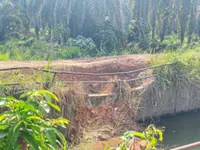
One solution villagers believe will ease their woes is the building of a sturdier bund to stop the monsoon drain at Jalan Ali Budin from overflowing into the village.
“The bund has collapsed three times in the course of the floods. Once in September, second time in October and again during the recent December floods.
“The MPKK had expressed concerns over the sturdiness of the previous bunds, which were constructed out of compact soil and gabion walls.
“In the past, these bunds were not able to contain the overflow from the monsoon drain at Jalan Ali Budin,” said MPKK secretary Azlee Ismail.
Multiple failures
Azlee said villagers were disappointed that the previous bunds had failed to provide adequate protection against the force of the rising river waters of Sungai Labu flowing into the monsoon drain.
“If a proper bund was built in the first place, it might have saved villagers a lot of heartache, not to mention burdening the taxpayers,” added Azlee.
Having worked in the construction line for 19 years, resident Mohd Rizal Madam, 38, opined that shoddy workmanship was to blame.
“About two months before the October floods, maintenance was carried out at the bund. I saw an excavator coming in to clear the area of shrubs, trees and grasses that had grown on the bund.
“Logically, they shouldn’t have done that as roots from the vegetation can play a part in strengthening the bund.
“We felt that trimming the grass or trees would have been a better solution instead but when questioned, the operator said that they were instructed to do so,” said Mohd Rizal.
Given that the bund has collapsed three times, Mohd Rizal also urged those responsible to review the technical aspects of its structural design and construction method.
“Despite the village committee’s constantly urging authorities to built a sturdier bund, we are often given the answer that there is no budget for it,” he said.
Azlee said after the first bund’s collapse, it was only patched up with cement.
Gabion walls and compact soil were added after the second and third bund collapsed. But they too failed to hold up.
As fed up as they are with the situation, residents like Adam Ahmad Supadi, 55, say they have no choice but to live with it.
A look into Adam’s home revealed a minimalist setting.
In his living room is a television, purposely mounted above head level.
In addition to two wooden settees are two double decker beds, their upper compartments laden with valuables like household electrical items.
“In his backyard, tricycles belonging to his grandchildren hang from metal awnings.
Even the washing machine has been placed on a table, which is further elevated on another table.
“It took four people to lift the washing machine up to its current position,” said Adam.
Villager Haslina Ahmad, 49, who operates a food stall along the village main road, said she has to listen to stories of heartbreak every time a flood occurs in the area.
“With their kitchens inundated by floodwaters, people have no choice but to come here to eat.
With the recent December floods, though they are still able to smile, I know that they are in deep despair as some of them have lost all their belongings and are only left with the clothes on their backs,” said Haslina.
Given the village’s long history with floods, she said authorities should be extra diligent when it comes to the maintenance of the area’s monsoon drains.
“Especially during rainy seasons, efforts should be made to monitor the drains to ensure they are not blocked by rubbish.
“Any wild vegetation should be cleared to ensure storm water can flow through smoothly,” she stressed.
One of Haslina’s customers is housewife Rohanizah Mokhtar, 37, who has found work as a part-time helper at the food stall.
Though she and her husband, a lorry driver, have experienced flooding in this village many times before, the recent floods have totally wiped out the couple’s possessions.
It was then that water levels rose above her head in her home.
Tearing visibly at the thought of her losses, Rohanizah said though she was able to accept her fate, she hoped that a solution could be found soon.
“It may not seem financially feasible to put so much into the building of a sturdier bund as this is just a traditional village.
“But bear in mind that many of the residents here make up a majority of the ground and air crew at the Kuala Lumpur International Airport as well as the workforce in nearby factories.
“So if this population is displaced, it will also affect the economy in a way.
“Also, such a project must be undertaken for humanity’s sake,” said Rohanizah.
A check at the site where the construction of a new bund is ongoing revealed that concrete sheet piles would be used in the building of a new bund.
According to Ahmad Mohamad, 43, who is a site supervisor with Pembinaan Mohd Rizal Enterprise, a subcontractor said to be engaged by a main contractor for the bund project here, the concrete sheet piles will be driven into the banks of the drain and be held in place with tie backs to reinforce the concrete square piles.
Ahmad said a distance of 4m between the sheet pile and concrete has been set in between to be filled with compact soil to further strengthen the bund.
He also revealed that the company he works for was responsible for the construction of the Sungai Keramat bund in Klang in 2018.
When contacted, the Drainage and Irrigation Department (DID) said that it would gather more detailed feedback from the respective division or district engineer and release a statement on the issue once it has obtained approval.
A statement from the Selangor DID indicated that unusually heavy rainfall of 189mm occurred in the Sungai Labu catchment area from Dec 17 to 18.
Sungai Labu is the main river that flows from Negri Sembilan to the confluence of Sungai Langat in Sepang, Selangor.
Among the rivers that flow into Sungai Labu are Sungai Cinchang, Sungai Jijan and Sungai Salak.
The drainage systems from surrounding residential areas also drain into Sungai Labu as well.
The unusual amount of rainfall had caused Sungai Labu to hit its highest ever water level.
When the river overflowed and existing drainage systems failed to drain water out to the swollen river, flooding occurred in Kampung Giching as well as the areas of Pekan Salak, Kampung Salak Tinggi, Kampung Labu Lanjut, and also housing estates such as Taman Desa Salak Pekerti in the Labu Lanjut district.
The situation worsened when the Sungai Labu overflow caused existing flood embankments to burst.
As a result, floodwater levels were between 1m to 1.8m in residential and agricultural areas.
As an immediate measure, the Selangor government approved an allocation under the Drainage Contribution Trust Fund for DID to carry out work in the area.
Work started on Dec 23 and is expected to be completed on Jan 22.
The work scope involves stabilisation of the drain’s banks at Jalan Ali Budin using concrete sheet piles, bund construction and other related works.
The estimated cost of this repair work is RM700,000, the DID told StarMetro.
For the long-term flood mitigation, the state government through DID has approved an estimated RM5mil to improve the drainage system in Kampung Giching.
Construction work will begin sometime this year.