
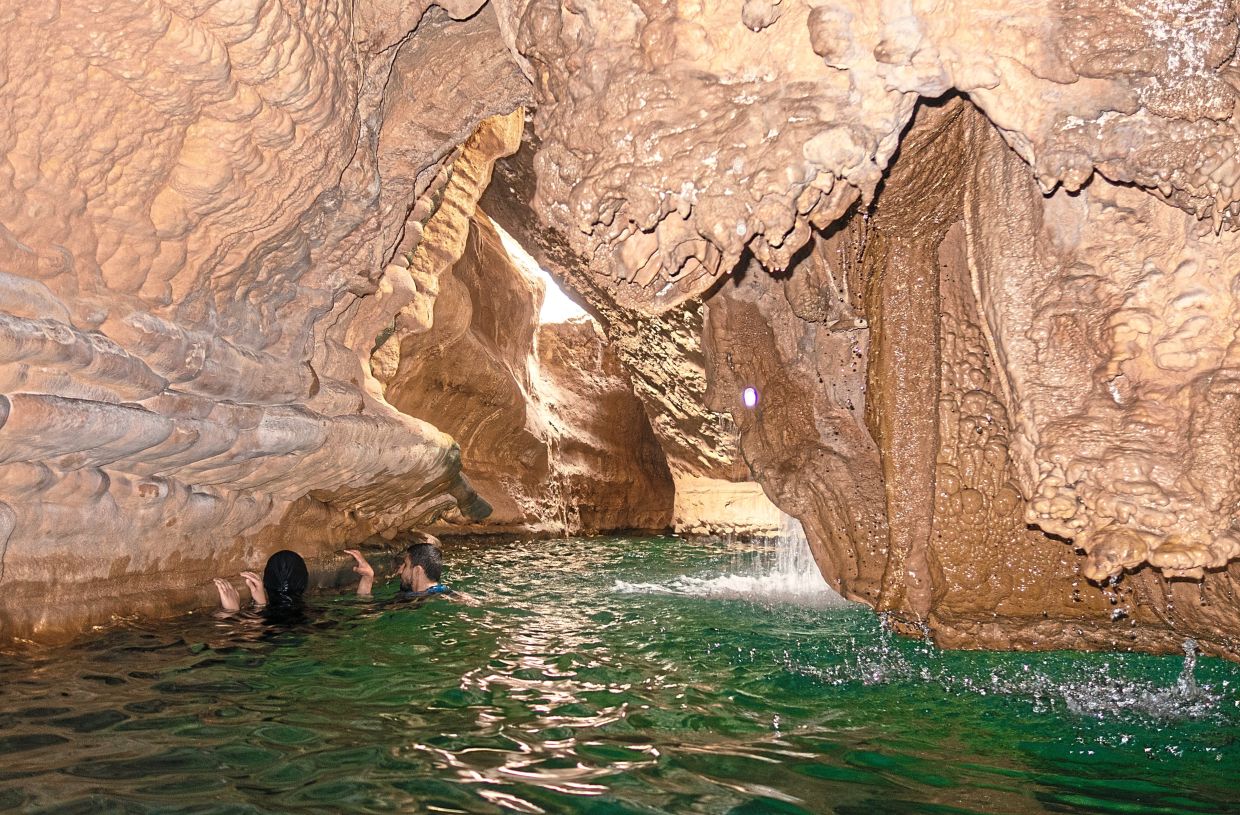
I can barely see the hole in the rock at the end of the last natural pool. “Just swim in,” says guide Mohammed Khalfan Al Riyami. My body just about fits through the narrow opening.
But the passageway opens up a few metres further into a grotto with a small waterfall streaming down into the pool.
There’s nowhere to stand and I hold on to the rocks with my fingers. I look around, at the sunlight shining through cracks in the rocks.
Below, the water glows a deep turquoise colour. It is a magical place, a gem hidden in the earth. This is not at all what I imagined when I came to the desert nation of Oman.
The cave and cascade are part of Wadi Shab, an easily accessible dry valley. The entrance is a 90-minute drive south-east of the capital Muscat, behind the coast.
A short boat trip is followed by a walk through the canyon, lined with overhangs and vertical rock faces. You can’t get lost.
We reach the first pool, the largest and most beautiful in the wadi, or valley, after an hour. The rocks in the water are incredibly slippery.
Families are swimming and splashing about. Here, most people bathe fully clothed, covering themselves in line with Islamic customs. Men and women alike wear shirts and coverings that extend down to their knees.
Water from the desert
Wadis are defined as filling only temporarily after rainfall. “But here, many of them carry water all year round,” says guide Al Riyami, challenging common perceptions.
Amid these barren mountains and desert hills, they suddenly appear out of nowhere. The pools are lifelines, and together with the canal systems built alongside them, they create thriving micro-landscapes.
The Sultanate of Oman has recorded some 60 wadis. In the northern and eastern parts of the country, people set out from Muscat and drive themselves in a wadi-hopping tour.
You can explore the most attractive valleys along a route of around 1,000km. Drive yourself or take an organised tour plus a guide. Both options require an off-road vehicle.
A narrow, steep road winds through Wadi Tiwi, near to Shab. There is a stark contrast between the greenery of the valley floor and the dramatic desert scenery above. In plots of land, there are mangoes, bananas and palm trees growing.
Yet these traditions are fading as younger people move to live in the cities.
In an oasis in Wadi Hawer, Abdullah Khamis Al Rashdi is tending his small plot of land. Clad in ankle-length traditional “dishdasha” or long-sleeved robe, his assistant offers us coffee and dates, in a typical sign of the region’s warm hospitality.
When he is working, Al Rashdi is based at an oil field in the desert but he alternates between two weeks of work and two weeks off.
His family home, where his people have lived for 150 years, is situated on high ground. Many opt for more elevated spots due to the danger posed by rainfall which can trigger devastating flash floods.
We venture deeper into Wadi Hawer, aided by local guide Hweather Hamud. Without his knowledge, it would be impossible to find the connecting path in the wide valley.
The route takes you over scree and pitted rocks. At a critical point, you have to climb upwards using rungs on a metal chain.
Hweather goes barefoot. “That gives me more grip. It’s too slippery for me in shoes,” he says. – ANDREAS DROUVE/dpa