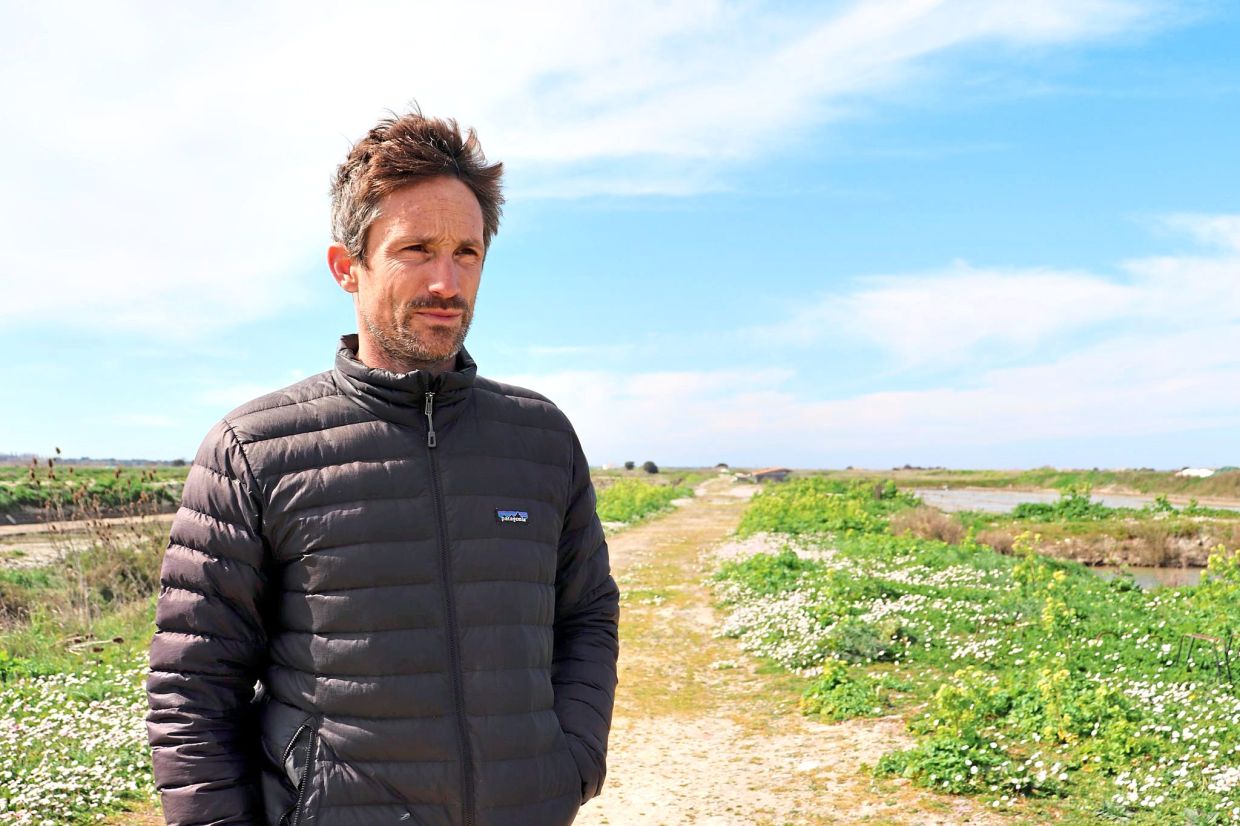
There's a tang of salt in the air when Romain Pedurant cycles across the Ile de Re to his gardens.
A former sports student, he lives in La Couarde-sur-Mer in France, nestled amongst dune paths and winding alleyways.
He started out on the island as a tennis coach, and the summer months are still his busiest time of year. But these days, it’s the sun, wind and tides that set the pace.
Pedurant is a salt producer and he relies on nature’s whims. That starts with the tide.
It washes seawater into the evaporation basins. Then there’s the sun, whose rays ensure the right crystallisation on the water’s surface, but only if the wind isn’t blowing too hard.
That’s when Pedurant himself steps in. He grabs a long wooden rake to harvest the delicate salt crystals – pure manual labour.
“C’est la fleur de l’eau,” he says – it means his harvest is the “flower of water”, and is a play on fleur de sel, considered the most expensive salt.
The island, nicknamed La Blanche, meaning white, is famed for its salt.
But to reduce it solely to the salt would be to do it an injustice.
Through salt marshes
Salt harvesting is hard work, but the cycle path there isn’t: from Saint-Martin-de-Re, the island’s main town, a coastal path leads towards Loix – with oyster fishermen and sea views on one side, and vineyards and lush greenery on the other.
It’s an enjoyable ride on smooth tarmac. The island’s cycle path network spans 140km, and during peak season it can get busy between the salt marshes in the north and the wide sandy beaches in the south.
Yet people have long been cycling along the island’s narrow paths to the salt pans, way before the invention of e-bikes, and we do see plenty here. Pedurant’s salt pans can only be reached on foot or by bike and from April to September, he spends his time describing how the business works to visitors.
At the market in La Couarde-sur-Mer, he officially markets his product as fleur de sel. Gourmets are prepared to pay a premium for this wafer-thin crust of salt.
You can find fleur de sel available in the Algarve in Portugal, Sicily in Italy and Mallorca in Spain, too.
But Ile de Re can hold its own, at least, according to chef Adrien Formica. “The island’s fleur de sel is excellent. It is one of the purest I have ever had the pleasure of tasting.”
Formica, a trained chef and former head patissier or pastry chef at a Michelin-starred restaurant in Paris, originally came to the island to help out a colleague in Saint-Martin-de-Re for a fortnight.
But that was five years ago. What kept him? He fell in love with the light, the landscape and the local cuisine. He now runs the brasserie at a hotel in the neighbouring village of La Flotte, and has bigger plans. He aims to expand it to include Michelin-starred cuisine.
For now, he sees the menu as a playground. He treats his guests to dishes such as salmon and seaweed tartare in a pineapple and passion fruit puree, or smoked scallops with celery puree in a sweet-and-sour sauce made from caramel and brown seaweed kombu, closely watching their reactions.
Alongside fine salt, seaweed and oysters are a typical culinary theme on the island, as are other marine plants. “Kombu is harvested by diving here along the coast, then the seaweed is dried in the sun,” says Formica. That means it retains all its vitamins.
“We should eat it much more often; it’s nutrient-rich and affordable.”
The same applies to samphire, sea fennel and other saltmarsh herbs, he says. “They have a surprising flavour and are often underestimated.”
As a final touch to refine his desserts – such as a chocolate cake – he sometimes uses poivre des marais, the wild island pepper.
His tip for mussel fans: head for the traditional oyster huts where you can slurp the shellfish straight from the source. Local producers offer oyster tours, too.
The salt marshes
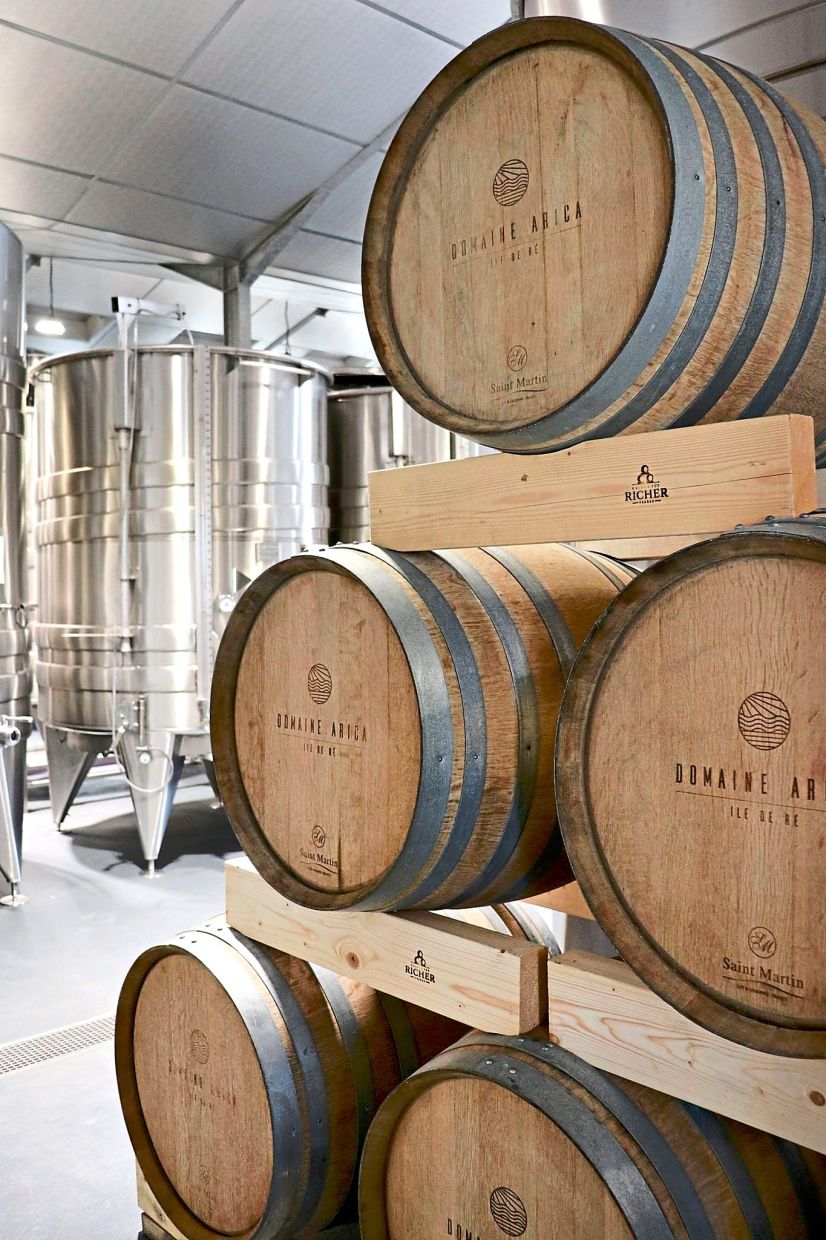
The organic winery Domaine Arica in Loix also introduces guests to its trade and history during guided tours.
The village is surrounded by the sea and the salt marshes – effectively an island within an island, held together by deposited sand and mud. Staff member Thierry Sarrat says, “In the 12th century, this was still a group of islands, known to sailors as the Arica Archipelago.”
The whole of Ile de Re was once formed from several islands through sedimentary deposits.
In the Middle Ages, Cistercian monks introduced viticulture to the north coast. There, in the immediate vicinity of the sea, certain grape varieties are still grown today. The harvest is processed at the Arica estate and fermented in oak barrels or stainless-steel tanks.
The Cistercian monks also established the first salt pans for salt production. Salt was long essential for preserving food and once made the islanders wealthy.
Today, tourism is the main source of income, and the island’s nickname La Blanche refers not only to the vast white salt marshes near Loix, but also to the many whitewashed houses – whether holiday accommodation or second homes.
Since the 3km bridge Pont de l’ile de Re connected the island to the mainland at La Rochelle, tourism has increased significantly.
It opened in 1988, sending property prices upwards. “Before the bridge was built, it was an island of farmers: potatoes, oysters, wine,” says Formica. And before the monks arrived, it was a marshy, inhospitable patch of land off the French Atlantic coast.
In his spare time, preferably at sunset, Formica takes the coastal path towards the ruins of the Abbaye des Chateliers, the island’s oldest religious building and also a legacy of the monks.
There, he lets the sea air and the scent of beach herbs wash over him, Here too, as in many other places on the island, you can watch the waves surging in, bringing with them the salt that is so essential to the white Atlantic island of gourmets. – DEIKE UHTENWOLDT/dpa