Fishing is a cherished pastime in Malaysia, a nation with a coastline of approximately 4,675km.
These extensive coastal waters teem with marine biodiversity, offering anglers many fishing opportunities.

For newcomers to the sport, it is crucial to familiarise oneself with the necessary gear and the specific rigs employed in various fishing scenarios.
One of the most effective methods for targeting bottom-dwelling species is bottom fishing, which uses rigs to position bait near the seabed.
The commonly used rigs are the Apollo Rig, the Carolina Rig, and the Paternoster Rig.
Each setup offers unique advantages and is tailored to specific conditions and target species.
The Apollo Rig, for instance, is particularly popular among anglers for its effectiveness in reef environments.
This rig employs a three-way swivel connecting two short leaders with hooks and a longer leader with a sinker anchoring the setup to the seabed.
Alternatively, one can use the surgeon’s knot, instead of the swivel, to tie the two hook snoods to the main line.
The rig is especially suitable for slow to moderate currents, with sinker weights typically ranging from 30g to 150g.
In stronger currents or deeper waters, heavier sinkers can be used but it require a heavier main line to handle the increased load.
The Apollo Rig is widely used along the west coast, particularly around artificial reefs, shipwrecks and rocky seabeds, where anglers commonly target snappers, groupers and grunters.
Another versatile setup is the Carolina Rig, well-suited for areas with mixed sand and rock substrates.
This rig allows for enhanced bait movement while maintaining proximity to the bottom.
It comprises a sliding bullet sinker, a bead, a barrel swivel, a fluorocarbon leader and a hook. A tanduk or spreader, which is tied to the main line on one end and the leader on the other while holding the sinker with a swivel, can also be used for this rig.
The Carolina Rig excels in slow-moving currents, enabling the bait to drift naturally and attract species such as barramundi, stingrays and mangrove jacks.
This rig can be used for both sides of the coast, especially in estuaries, mangrove areas and sandy seabeds.
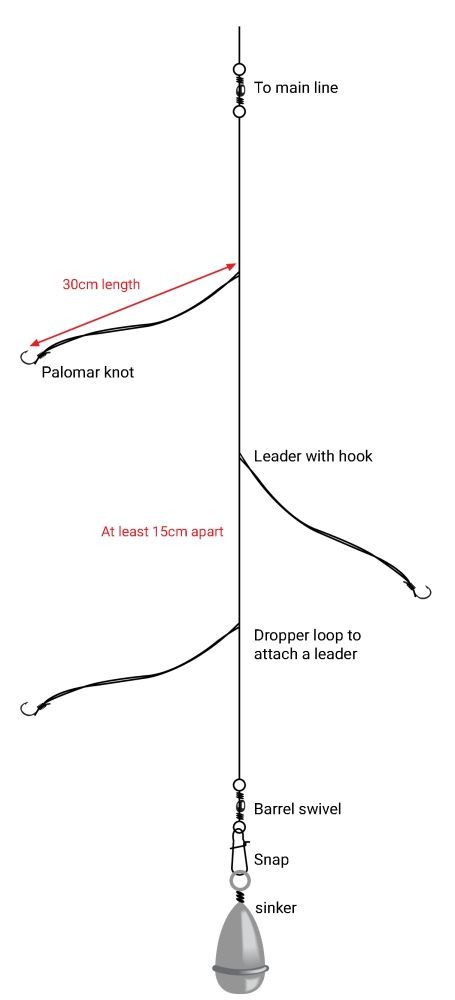
For deep-sea fishing enthusiasts, the Paternoster Rig is a preferred choice, as it suspends bait just above the seabed, appealing to fish that inhabit the water column.
This rig uses a strong mainline with dropper loops for attaching hooks and a heavy sinker at the bottom.
It is particularly effective in moderate to fast currents, ensuring the bait remains elevated and within the strike zone despite dynamic water movements.
The Paternoster Rig is commonly used along the east coast, where deeper offshore waters and stronger currents prevail, making it ideal for targeting large groupers, trevally and deep-water snappers.
Selecting the appropriate rig depends on various factors, including current conditions, target species and specific fishing locales.
Each rig is engineered to optimise bait presentation, enhancing the likelihood of a successful catch.
By understanding the distinct advantages of each setup and adjusting accordingly to environmental conditions, anglers can significantly improve their fishing outcomes and enjoy more rewarding experiences in our rich and diverse waters.