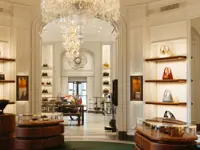
There is a corridor in the sprawling Gucci headquarters on the outskirts of Milan that is unlike any other corridor in the white- and glass-walled space.
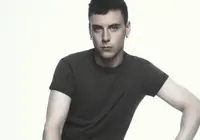
It is a corridor that leads to the office of Gucci’s new creative director, Demna, the mononymic man charged with rescuing the fashion brand from the cliff over which its sales have recently plunged.
And it isn’t really a corridor at all. It’s more like a black hole: black walls, black floor, black ceiling. To enter it is to be swallowed by the dark. But then, at its end, when Demna opens his door: light.
How’s that for a metaphor?
“It’s a reminder this is a reset,” Demna said in January, with some levity.
Even he knows the symbolism is a little obvious. But sometimes obvious is exactly what you need.
Demna had been busy remaking the space since he joined Gucci last March, after 10 years at Balenciaga in which he transformed that brand from a fashion darling beloved by the couture cognoscenti into a bona fide cultural phenomenon.
Gucci itself had been a soaring success story until 2022, when its superstar designer, Alessandro Michele, was replaced by Sabato De Sarno, and an attempt at a “quiet luxury” pivot went badly wrong.
From 2022 to 2025, revenue went from about €10.5bil (approximately RM47.6bil) to €6bil (RM27bil).
Demna was the brand’s Hail Mary.
Yet the appointment was, despite Demna’s previous successes, a surprise to many who thought of him as a streetwear proselytiser and recoiled from the idea of oversize hoodies in the realm of Jackie O.’s Bamboo bag.
The day after the announcement, the share price of Kering, the group that owns Gucci and Balenciaga, fell.
Even Francois-Henri Pinault, the chair of Kering, wasn’t initially convinced. Gucci, after all, has more than 17,000 employees and represents about 40% of the group’s revenue. They couldn’t get it wrong again.
But here’s the thing, said Francesca Bellettini, Gucci’s CEO, whose idea it was to approach Demna in the first place: It wasn’t just Gucci that was ready for a new look. Demna was, too.
As he prepares for his show last month, their attitude, Bellettini said, is: “OK. I’ll show you.”
Read more: Return to sexed-up roots? Kate Moss closes Demna's first Gucci show in a thong
New Demna
When Demna was at Vetements, the upstart brand he co-founded in 2014 and left in 2019, and Balenciaga, he would never appear at the end of his shows for a bow.
He hated revealing himself in public. When he had to be photographed, he wore a black jersey mask that covered his head. He even wore it when he attended the Met Gala in 2021.
He is planning to go to the Met Gala again in May, but this time, he won’t be wearing a mask.
The party used to make him almost paralytically nervous, he said, but now, walking back some previous critical comments, he sees it, he said, “as the only place in fashion that celebrates fun and play”.
“Fun” and “play” are not words often associated with Demna; the more likely ones would be “tortured” and “angry”.
His Vetements and Balenciaga shows often seemed like screams into the void, with sets that included a giant mud pit, a swirling snowstorm and an immersive end-of-days video.
“I was convinced the only way that I could be creative and have ideas was if I was in a dark place – if I was the victim, if I felt betrayed,” Demna said.
“I used to be this fashion designer who works late at night, parties, drinks, doesn’t take care of his health.”
It went with his back story, growing up in Soviet Georgia, forced to flee as a teenager with his family and resettle in Europe.
He thought his fury came from an inchoate desire to change the status quo. But now he has been in therapy for more than 10 years and thinks maybe it was “a lot about me not being enough for myself” (he speaks the language of psychoanalysis as well as Italian, French, English, Russian and Georgian).
Antonin Tron, the new creative director of Balmain, who has known Demna since they attended the Royal Academy of Fine Arts in Antwerp, said he had been struck by how much more comfortable with himself Demna had become.
Gomez, a musician who works under the name BFRND and creates the soundtrack for Demna’s shows, agreed.
“He is the person I know who works the most on himself,” Gomez said. “Once you make peace with pain and trauma, you learn you can be even more creative. But it takes a long time to realise the myth of the sad poet is not necessarily true.”
Read more: Why Gucci’s bold new direction has the fashion world talking and watching
New Gucci
When Demna got to Gucci, the mood was “a little bit hopeless”, he said.
Not only had Gucci become, almost overnight, a very public critical and commercial failure, but it was dragging Kering down with it (the share price had fallen 43.7% between 2022 and 2025).
“We have a responsibility to bring it back up and make it stay there,” Bellettini said.
That’s the deal she said she made with Luca De Meo, the newish Kering CEO, and Demna. If the designer can pull off his part, he will have achieved that rare feat in fashion, transforming not one but two fashion houses.
As a welcome gift, the staff gave him 17 notebooks for inspiration: recreations of Guccio Gucci’s original sketches and jottings about bags and belts.
Then Demna had two big epiphanies.
The first happened when he went to the Uffizi Gallery in Florence, Italy, and saw The Birth Of Venus.
“It really moved me,” he said. “I had tears. Then, when we came out, I saw Palazzo Gucci. And I realised there is Uffizi, there is Michelangelo, there is Botticelli and there is Palazzo Gucci.”
The second came from his 16-year-old cousin, who told him Gucci had become a Gen-Z slang term.
“Like she says, ‘I feel Gucci today’ or ‘It’s too Gucci,’” Demna said. “That exploded my brain. It means that this is more than a brand. It can also represent an emotion or be a state of mind.”
Now, he said, “I’m using it a lot at work: ‘I feel Gucci today.’”
For him, Gucci is, he said, “at the centre of Italian culture but also about having fun, not taking it too seriously".
"Not being naive, but not giving too much space to the drama,” he added.
It has to be both classic and push boundaries. So he is designing what he refers to as Gucci Core, a set of basics that will always be available, and Gucci runway.
If the short film Demna unveiled in September established a set of Gucci characters all dressed in his idea of signature Gucci style (the Primadonna, the Contessa and the Bastardo among them) and the pre-collection unveiled in December plumbed Tom Ford’s Gucci, he has something else planned for the next show.
New show
“What I want to bring to Gucci is cultural relevance, and cultural relevance does not come from mainstream culture – ever,” Demna said.
“It comes from lesser-known or unknown talent. It comes from underground. ”
To that end, he is weighing whether celebrity ambassadors and a celebrity front row are worth the money.
“It’s like an arranged marriage,” he said. “I hate the idea of having to pay someone to wear your clothes if they don’t want to wear them. I hate the word ambassador in general. We tried to have ChatGPT come up with a different word, but it didn’t work.”
Instead, he has targeted about 20 artistes he discovered through his Spotify algorithm, including British rappers Fakemink and EsDeeKid (the rapper everyone thought for a while was Timothee Chalamet in disguise), and invited them to the show.
He is also exploring a new system of sizing, making it less about numbers (0, 2, 4) and more about body types: short and skinny, tall and skinny, short and powerful.
That’s harder than it might sound, since it involves not merely upsizing or downsizing a standard, but making new (and different) patterns for each piece. But, ideally, more body types mean clothes that are more relevant to more consumers.
He knows everyone is waiting for the Gucci hoodie, but, he said, “That is exactly what I wouldn’t do, obviously.”
He’s thinking “body-conscious”. Feeling more physically confident, he has been designing a narrower silhouette. He’s trying to engineer a new kind of minimalism, eliminating seams, making everything lighter.
“This show is how I would love to dress,” Demna said, giggling (he really giggled).
He was toying with including some men wearing jackets over bare chests. That’s one of his goals for himself. He’s not quite there yet, he said. But he thinks some “tightfitting jeans” would be a good start. – ©2026 The New York Times Company
This article originally appeared in The New York Times.