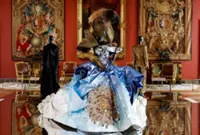
How the dirndl has caught the eye of fashion and is becoming popular


By AGENCY
Fashion designer Vivienne Westwood once said, "If every woman wore a dirndl, there would be no more ugliness in the world." Photo: AFP

The humble Alpine "dirndl" dress, with its distinctive white blouse, full skirt and apron, has won new fans among Austrians and foreign fashionistas alike in recent years.

Its folksy appeal has now made the historic dirndl and other traditional outfits a key part of Austria's clothing industry, about 70 percent of which is exported, according to the Chamber Of Commerce.

Even British style icon Vivienne Westwood, better known for her provocative punk designs, has been charmed by the dirndl, which also features a close-fitting bodice.

Read more: How a fashion designer created Zebucq, a material made from coconut fibre

Now the enduring garment is the star of a new exhibition which traces its journey through the years from the countryside to the runway.

The show is being held in the Austrian spa town of Bad Ischl, the former summer residence of Emperor Franz Josef and his wife Elisabeth, known popularly as Sissi.

It lies in the Salzkammergut, a spectacular region of mountains and lakes which was one of the original homes of the dirndl, along with neighbouring Tyrol and Bavaria in southern Germany.

Thekla Weissengruber, the exhibition's curator, says the dirndl "is to Austria what the kilt is to Scotland or the kimono is to Japan".

Prestigious patrons

It was women living on the land who initially adopted the cheap, practical dress, whose name derives from a dialect term that can also mean "girl". But by the end of the 19th century, it was also being worn by women at the imperial court when they flocked to the countryside in summer.

"Everything was very corseted in Vienna," Weissengruber said. "On holiday they were able to free themselves, with these lighter, brighter styles."

Hosted in the Marmorschloessl, the "cottage" given to Sissi by her husband, the exhibition shows how the dirndl has evolved through some 50 examples. The early, no-frills versions quickly give way to more elaborate outfits fit for those seeking an audience at the imperial villa.

Angelika Schauer runs a family dirndl-makers in Bad Ischl that traces its history back to 1895. She recalls that her grandfather counted visitors at court among his clients.

"When he was taking measurements he was under close watch" from the bodyguards who came with the well-heeled clients, she said.

"He had to refrain from making certain movements".

A dirnd dress is on display at the exhibition 'Dirndl - Tradition Goes Fashion' at the Mamorschloessl palace in Austria. Photo: AFP

'No more ugliness'

During the Nazi period, while women were encouraged to wear similar traditional dress, the word "dirndl" itself was banned, the regime finding it too redolent of the "Jewish-run" clothing industry.

But the dirndl never disappeared, with the patrons of the prestigious Salzburg Festival having sported it from the 1920s onwards.

Abroad it was popularised by White Horse Inn, a musical set in the Salzkammergut that reached Broadway in 1936. It also had a fan in screen icon Marlene Dietrich, according to Weissengruber.

Along with other traditional Austrian clothing, the dirndl has experienced a revival in recent years, especially at beer festivals.

Read more: Jean shorts, or jorts, are no longer just a 'dad style' staple

Women today "wear the dirndl at any occasion", said Schauer, with men donning the famous "lederhosen" leather breeches.

Despite often cheaper dirndl being produced in Asia, Schauer's husband Johannes Topizopoulos says that many dirndl fans prefer to buy local, especially in an age where people want long-lasting, environmentally sustainable clothing.

"The fact that it's hard-wearing fits in with the times very well," he said.

High-end versions are certainly a pricey investment: a made-to-measure dirndl can cost between 650 and 1,000 euros (RM3,250 and RM5,000), not to mention the versions turned out by fashion houses like Westwood's.

But, as the exhibition proudly cites the designer as having said during one visit to Austria, "if every woman wore a dirndl, there would be no more ugliness in the world". – AFP

Get 20% OFF The Star Digital Access

Monthly Plan

RM 13.90/month

RM 11.12/month

Billed as RM 11.12 for the 1st month, RM 13.90 thereafter.

Best Value

Annual Plan

RM 12.33/month

RM 9.87/month

Billed as RM 118.40 for the 1st year, RM 148 thereafter.

Follow us on our official WhatsApp channel for breaking news alerts and key updates!
fashion , trends , dirndl

Next In Style

Framing fashion: Bibo Aswan, the photographer shaping Malaysia's visual style
Has Taylor Swift’s wedding just outshone the Met Gala in fashion stakes?
Fashion awaits Taylor Swift's bridal look, but here's what the guests wore
The American dream, dressed: A look into 250 years of fashion and aspiration
Why letting go of a wedding dress can be among fashion’s hardest choices
Fashion sees clearly as glasses emerge as the chic accessory of the moment
The bikini at 80: Fashion is still pushing the limits of this swimwear classic
Two shirts, one outfit: Is this fashion’s smartest layering trick yet?
A shirtmaker so extraordinary that a luxury fashion house is buying the brand
Holidaying somewhere hot and humid? Stylists share their fashion essentials

Others Also Read