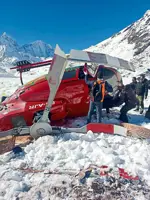
Dawa Finjhok Sherpa and his teammates hashed out a retrieval plan as they stood surrounding a dead body deep in the Himalayas one early morning in May 2017.
It had been around a year since Indian climber Goutam Ghosh, a 50-year-old police officer from Kolkata, died near the summit of Mount Everest.
His face had turned pitch black, his body as hard as the rock next to it.
Dawa and four other sherpas of the Seven Summit Treks agency would spend the next 28 hours working in the “death zone” without food and sleep, and then a few more days downhill, before finally handing over Ghosh’s body to his family in Kathmandu, Nepal.
Ghosh’s body was at an altitude of around 8,400m. Climbers call it the “death zone”, an area where people can easily die due to lack of oxygen, frostbite and cold.
The altitude was one of the many odds Dawa’s team had to overcome.
“He was around six feet tall (1.83m) and over 120kg due to snow. It took us almost an hour just to move the body, ” says Dawa.
Five sherpas hauled the corpse in a stretcher as they trekked downhill along a narrow, treacherous path with the help of snow axes and ropes.
The use of a stretcher did prevent the frozen body from falling apart, as they had hoped, but it also slowed them down.
To make matters worse, the summit was still under way, and they had to intermittently give way to avoid traffic jams.
“Every minute counts at that height because you could easily lose your sense and get killed, even when taking oxygen, ” Dawa says in an interview.
Exhausted by thirst, hunger and cold by the time they arrived at camp four, situated at 7,925m, Dawa also wished to rest and drink water like the rest of his friends. But he pressed his colleagues to keep moving out of fear of dying.
“I remembered my family members many times, especially my son, ” recalls Dawa.
The government of India spent around US$200,000 (RM827,500) to retrieve Ghosh’s and two other dead bodies from Mount Everest that week, according to Mingma Sherpa, also of Seven Summit Treks.
The mission has since stood as a testament to the possibility of recovering all dead bodies from Mount Everest, something that was once considered impossible and often cited as an excuse not to bring the dead bodies down.
But it has also reignited a debate on whether such missions are worth all the risks and money, especially when neither the families nor the governments concerned want to bear the expense.
Exact data is unavailable, but government estimates suggest that over 150 bodies of an estimated 300 climbers are still on Mount Everest, many deep in snow.
It can easily cost up to US$100,000 (RM413,750), a fortune even by Everest’s own expensive standard, to retrieve a body, depending on various factors like altitude and number of sherpas required.
Many climbers and guides think the bodies should be left there out of respect for the dead climbers’ love for mountains and in view of cost.
“Many bodies are there because the family members did not want to take it, ” says Kami Rita Sherpa, a guide who has summited Everest a record 24 times.
“Given that the cleaning campaign gets so little budget, the priority should be in cleaning trash that has been destroying the mountain, ” says Kami.
He is referring to an estimated 20 tonnes of garbage that has piled up on Everest, which has been conquered over 6,500 times since 1953.
Others think the body removal has been indispensable, no matter who bears the expense, as many corpses have started to surface with heavy melting of snow in recent years.
This view is also shared by some Nepali officials, who in recent years have come under fire for putting money over human lives and exposing climbers to unwarranted risk by issuing too many permits.
Dandu Raj Ghimire, director general of the Department of Tourism, says that his department still lacks clear plans for the corpses, but adds that it hopes to gradually retrieve dead bodies as part of a larger clean-up campaign in the future.
“We brought four corpses last year. Others would be brought gradually but it would all depend on money and resources, ” says Ghimire. – dpa
Already a subscriber? Log in
Get 20% OFF The Star Digital Access
Cancel anytime. Ad-free. Unlimited access with perks.