
Stefan Feldbusch serves Darjeeling First Flush in classic Frisian porcelain, in small, delicate cups that are slightly chipped.
"I think the taste is better in thin-walled cups," says Feldbusch, who is chief tea taster at the family-run Laurens Spethmann Holding. "I've always had a soft spot for tea."
Coastal East Frisia, the north-eastern-most corner of Germany, has its own unique tea culture, dating back to the 17th century when tea was introduced by the British and Dutch.
A century on, it had become popular throughout society - after all, many could not afford coffee. Tea soon replaced beer to become a favourite drink and all the associated customs and traditions quickly became firm rituals.
The Messmer brand is produced in Seevetal, Lower Saxony, by the Ostfriesische Tee Gesellschaft (OTG), which supplies 8 billion tea bags to the supermarket shelves of the major discounters throughout Germany every year from the Nordheide region.
OTG is the second largest tea producer in Germany after Teekanne in Düsseldorf. Some 95% of Germans drink teabag tea. The quality is so good that Feldbusch himself says he also enjoys a cup after work.
Feldbusch barely lets the black tea steep for a minute when he is making a cup for himself. That's when the caffeine unfolds best, he says. Unlike the short-lived kick you get from a cup of coffee, tea has a stimulating effect over a longer period of time, but does not agitate drinkers. That makes it a good companion for the day, he says.
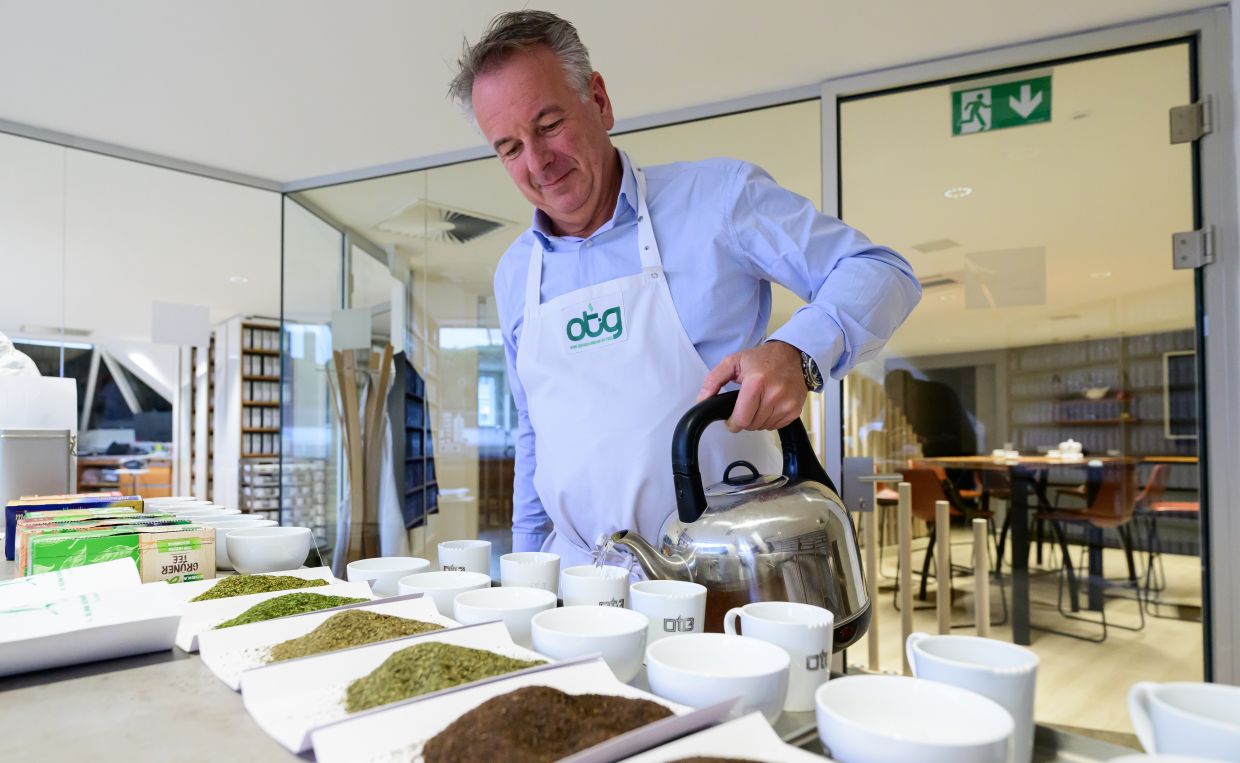
Some 300 varieties of tea tested daily
In order to guarantee consistent quality – despite climate change with shifting harvest times and crop failures – Feldbusch's three-person team tests around 300 varieties every day.
The team weighs each variety precisely from neatly arranged paper plates and poured into white porcelain cups. Today, the focus is on varieties from southern India and green tea from China.
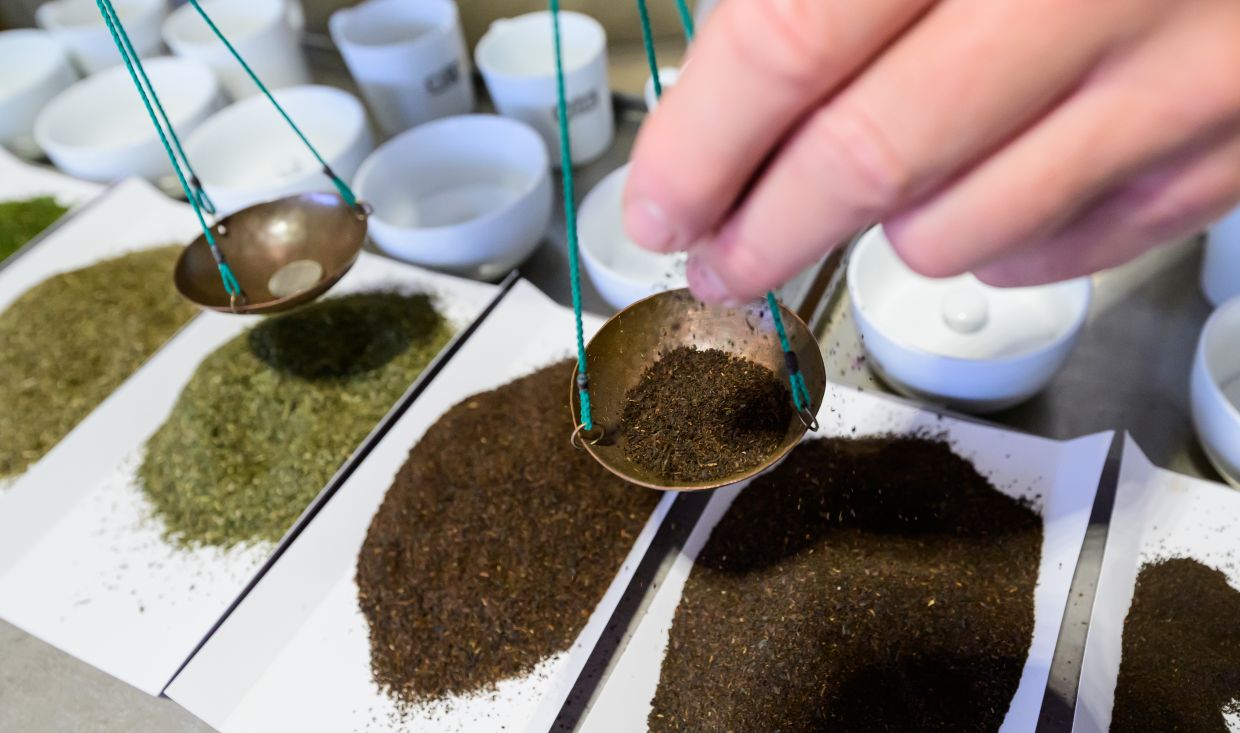
It is a formal, scientific and business-like process. Clad in a white apron, suit and tie, Feldbusch measures out approximately 2.86 grams of dry tea leaves using a small, golden hand scale, just as in the old days.
For verification purposes, an old English sixpence coin, the international standard, is placed in one of the small bowls.
Trend for sweet fruit teas
Herbal and fruit teas account for by far the largest share of sales. They are tasted separately in another room so that the aromas do not mix. "The trend is towards fruit teas, but they have become incredibly sweet," says Feldbusch.
A wholesale and foreign trade merchant, he has been in the tea trade for 37 years, 30 of them at OTG. His first job was in Hamburg's Speicherstadt – at the port, where most of the containers from overseas arrive. When he started, 80% of tea consumed was black tea, but now the proportion of classic varieties has fallen to 25%.
He carefully pours boiling water from chunky four-litre kettles onto the samples, covers them with a lid and, after five minutes of steeping, they are ready to be tasted.
The specialist and his colleagues sip from a spoon – the oxygen helps the flavour spread better in the mouth. Afterwards, they usually spit it out. The different varieties are mixed at the end so that the teas retain a consistent taste throughout the year.
Teas from China, Japan, India and South Africa are tested several times in Germany for pesticides. The holding company spends millions of dollars on quality control.
Tea tasting is all about fine-tuning: do any of the many samples lined up after delivery by sea taste mouldy? After all, in rough seas, some pallets arrive thoroughly soaked.
Tea tester - not something you train for
"There are only about 60 to 100 tea testers nationwide," says Feldbusch. Tester is not a profession you can learn at college or school, unlike many professions and jobs in Germany's highly-structured labour market.
"It takes about five to seven years to get there, then you can pick up on the nuances." Because he and a colleague will be retiring in a few years, two young people at OTG are being introduced to the job after completing a dual study programme.
The experts also travel to the countries of origin, which for
black and green teas are mainly India and China. China remains the largest producer with more than 3.74 million tons – more than half of the world's total.
It is followed by India, Kenya, Turkey and Sri Lanka. Once again, India was the most important supplier to Germany with just over 10,443 tons, accounting for 21.8% of German imports in 2024, according to the German Tea Association in Hamburg.
Annual per capita consumption in Germany in 2024 was 67.2 litres. Consumers drank 27.1 litres of black and green tea and 40.1 litres of herbal and fruit tea. The proportion of organic teas reached a new high of 17.7%.
Herbal and fruit teas continue to top the shopping lists of German households. Peppermint and chamomile are the most popular single varieties among consumers.
But new trends have emerged with matcha and cold brews – fruit teas in bags that are suitable for quick cold infusion.
Are all these a threat to Germany's hallowed ritual of coffee and cake in the afternoon? Perhaps it just depends on what's your cup of tea. — By Britta Körber/dpa